
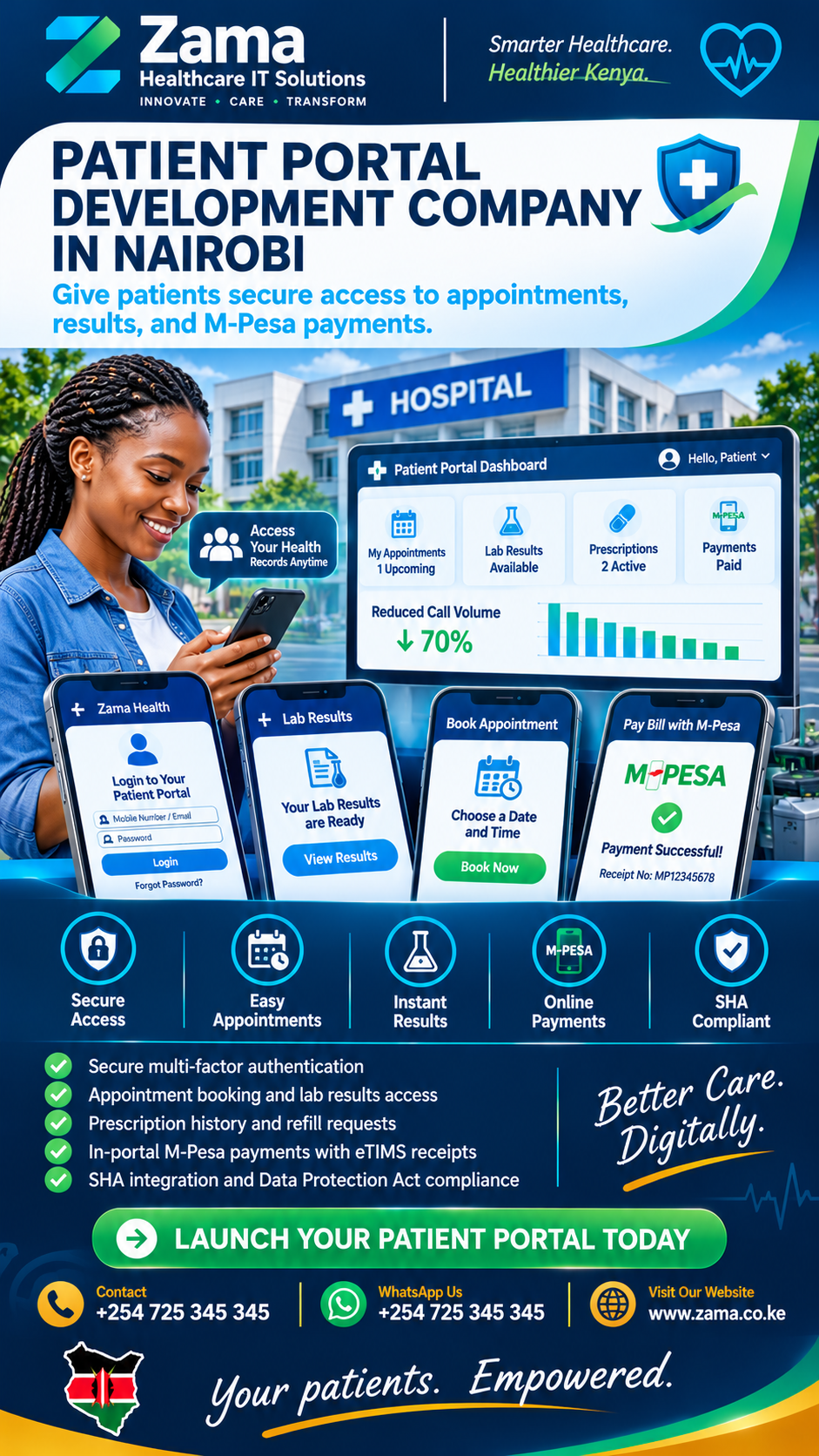
Patient portal development company in Nairobi is a question that every hospital administrator, clinic owner, and healthcare technology leader must answer in 2026. With Kenyan patients increasingly expecting digital access to their health information, the Social Health Authority reshaping how care is financed, and the Data Protection Act imposing strict requirements on how patient data is handled, the patient portal has moved from a nice-to-have to a core part of modern healthcare delivery. At zama.co.ke, we’ve helped numerous healthcare facilities across Nairobi design and build secure patient portals that improve patient engagement, reduce administrative burden, and strengthen compliance. This comprehensive guide explores the patient portal development company in Nairobi, from understanding what a portal delivers to selecting the right development partner.
What a Patient Portal Development Company Actually Delivers
Before diving into the patient portal development company in Nairobi, it’s essential to understand what this technology actually does. A patient portal is a secure, browser-based platform where patients log in to access their own healthcare information and complete self-service tasks. It connects to the hospital management system or electronic medical record, drawing on the same underlying data that clinicians use, while presenting it in a patient-friendly interface with appropriate access controls.
A proper patient portal development company in Nairobi delivers far more than a login screen. It builds appointment booking and rescheduling, access to lab results and imaging reports, prescription history and refill requests, visit summaries and discharge instructions, invoice viewing and M-Pesa payment, secure messaging with care teams, and consent management—all connected to the facility’s clinical and billing systems.
For a Kenyan hospital, the practical definition of a patient portal development company in Nairobi is this: the partner that designs, builds, and maintains the platform that lets every patient access their own care information securely—reducing phone calls, improving adherence, and meeting the expectations of a digitally connected population.
Why Kenyan Healthcare Facilities Need Patient Portals
When evaluating the patient portal development company in Nairobi, consider the compelling reasons for adoption:
Patient Expectations Have Changed
Kenyan patients use M-Pesa to pay, WhatsApp to communicate, and mobile apps to manage their lives. When they receive care at a hospital, they expect the same digital convenience. They want to see their lab results without visiting the facility. They want to book an appointment from their phone. They want to pay their bill without queuing. A facility that cannot offer these capabilities feels outdated.
A modern patient portal development company in Nairobi builds the digital experience patients now expect. Booking, results, prescriptions, invoices, and payments all become available from a phone, at any hour, without a phone call to the facility.
Reducing Administrative Burden
Hospital reception and call centre staff spend enormous time on repetitive tasks—confirming appointments, reading out results, explaining bills, taking payment. These tasks consume staff capacity that could be used for higher-value work, and they create queues and frustration.
A proper patient portal development company in Nairobi shifts these tasks to self-service. Patients book their own appointments, view their own results, and pay their own bills. Call volumes drop. Reception queues shorten. Staff focus on patients who need human assistance.
Improved Clinical Outcomes Through Engagement
Patient engagement improves outcomes. Patients who understand their diagnoses, remember their medication schedules, and attend follow-up appointments recover better. A portal supports engagement by making care information accessible between visits.
A comprehensive patient portal development company in Nairobi builds features that support engagement—visit summaries, medication reminders, care plan access, and secure messaging that lets patients ask follow-up questions without a physical visit.
SHA and Insurance Integration
The Social Health Authority has reshaped healthcare financing in Kenya. Patients need to know their coverage status, what has been claimed, and what remains outstanding. A portal can surface this information clearly.
A quality patient portal development company in Nairobi integrates with SHA and insurance systems to display coverage, claims, and patient responsibility—reducing the confusion that currently surrounds healthcare billing.
M-Pesa Payment Collection
Patients expect to pay via M-Pesa. A portal that integrates M-Pesa Daraja API for STK Push and PayBill payments allows patients to settle bills instantly, with automatic reconciliation against their account.
A proper patient portal development company in Nairobi builds in-portal M-Pesa payment from day one, with real-time confirmation and receipt generation.
Data Protection Act Compliance
Patient records are among the most sensitive categories of personal data under Kenya’s Data Protection Act. The Office of the Data Protection Commissioner has been actively enforcing compliance across sectors, including healthcare. A portal that exposes patient data without proper controls is a liability.
A compliant patient portal development company in Nairobi implements consent management, role-based access, encryption, audit trails, and data subject rights aligned with the Act. Patients can exercise their right to access their data through the portal itself.
Reduction of Medical Errors
Portals reduce errors. When patients can see their prescriptions, allergies, and test results, they can catch mistakes before they cause harm. When discharge instructions are available in writing, patients follow them more accurately.
A comprehensive patient portal development company in Nairobi surfaces critical information to patients in a clear, understandable format, reducing the risk of misunderstanding.
Key Features of a Patient Portal Built in Nairobi
When evaluating the patient portal development company in Nairobi, focus on these core features:
1. Secure Multi-Factor Authentication
The portal holds sensitive medical data. Authentication must be strong. A proper patient portal development company in Nairobi implements multi-factor authentication—typically a password plus an OTP sent via SMS or WhatsApp—along with session management, device recognition, and protection against credential stuffing.
2. Appointment Booking and Management
Patients should be able to see available slots, book appointments, reschedule, and cancel—all without calling the facility. A comprehensive patient portal development company in Nairobi integrates with the hospital scheduling system, respecting clinician availability, room allocation, and service types.
3. Lab Results and Imaging Reports
Patients want their results without a return visit. A quality patient portal development company in Nairobi displays lab results and imaging reports with clear explanations, flags abnormal values, and provides clinician commentary where appropriate. Release timing is configurable—some facilities release results after clinician review, others immediately.
4. Prescription History and Refill Requests
Patients need to know what they have been prescribed and to request refills. A proper patient portal development company in Nairobi displays prescription history, supports refill requests that route to the prescriber for approval, and integrates with pharmacy dispensing records.
5. Visit Summaries and Discharge Instructions
After every visit, patients should receive a summary—what was discussed, what was prescribed, what follow-up is needed. A comprehensive patient portal development company in Nairobi generates these summaries automatically from clinical documentation and makes them available in the portal.
6. Invoice Viewing and M-Pesa Payment
Billing transparency reduces disputes. A quality patient portal development company in Nairobi displays itemised invoices, shows what SHA or insurance has covered, displays patient responsibility, and enables in-portal M-Pesa payment with immediate receipt.
7. Secure Messaging with Care Teams
Patients need a way to ask follow-up questions without a physical visit. A proper patient portal development company in Nairobi provides secure messaging that routes questions to the appropriate care team, maintains a documented record, and supports appropriate response times.
8. Consent and Data Subject Rights
Under the Data Protection Act, patients have rights to access, correct, and restrict processing of their data. A compliant patient portal development company in Nairobi provides self-service tools for exercising these rights, alongside consent management for data sharing.
9. Dependant and Family Access
Parents manage their children’s care; adult children manage elderly parents’ care. A comprehensive patient portal development company in Nairobi supports dependant access with appropriate consent and privacy controls—while respecting confidentiality for adolescents where the law requires it.
10. Mobile-First Design
Kenyan patients access the internet predominantly via mobile phones. A proper patient portal development company in Nairobi is designed mobile-first, working beautifully on low-end Android devices over limited bandwidth, with clear typography and simple navigation.
What Makes a Patient Portal Development Company in Nairobi Different
The patient portal development company in Nairobi has unique characteristics that global providers often lack:
SHA Integration
Kenyan healthcare now runs through the Social Health Authority. A portal built for Kenya displays SHA coverage, claim status, and patient responsibility from SHA records.
M-Pesa as the Primary Payment Rail
Kenyan patients pay via M-Pesa. A portal built for Kenya integrates Daraja API natively for STK Push and PayBill payments with automatic reconciliation.
KRA eTIMS Receipts
Patients increasingly expect eTIMS-compliant tax receipts. A portal built for Kenya generates and delivers eTIMS-validated receipts alongside payment confirmation.
Multi-Language Support
Kenyan patients use English and Swahili. A portal built for Kenya supports both languages, along with the option for additional local languages.
Low-Bandwidth and Offline-Tolerant Design
Connectivity outside Nairobi can be intermittent. A portal built for Kenya loads quickly, caches key information, and handles weak connections gracefully.
Data Protection Act Alignment
A compliant portal built for Kenya implements consent, access controls, and audit trails aligned with the Data Protection Act, alongside medical records regulations.
Local Support
Kenyan hospitals need support in their timezone and language. Local support is a practical requirement.
Key Factors That Determine Cost
When analysing cost, several factors directly influence pricing:
1. Integration Depth
Integration with the hospital management system, laboratory information system, pharmacy, billing, SHA, and M-Pesa determines complexity.
2. Number of Features
Appointments, results, prescriptions, billing, messaging, dependant access—each feature adds to the build.
3. Security and Compliance Requirements
Multi-factor authentication, encryption, audit trails, and Data Protection Act compliance add to development effort.
4. Patient Volume
Higher patient volumes require more robust infrastructure and support.
5. Multi-Language Requirements
Additional languages add to content and interface work.
6. Mobile App Requirements
A native mobile app adds cost compared with a mobile-responsive web portal.
7. Deployment Model
Cloud, on-premise, or hybrid deployment affects cost and ongoing support.
8. Customization
Custom branding, workflows, and reporting add to the build.
9. Training and Ongoing Support
Training clinical and administrative staff, plus patient onboarding materials and ongoing support, contribute to total cost.
For a transparent quote based on your facility’s specific requirements, contact zama.co.ke today.
Use Cases
Private Hospitals
Private hospitals use patient portals to differentiate their service, support appointment self-booking, and enable M-Pesa payment of bills.
County and Referral Hospitals
Large public facilities use portals to reduce reception queues, distribute lab results, and manage appointment demand at scale.
Specialised Clinics
Fertility, dental, optical, and chronic disease clinics use portals for appointment management, results delivery, and follow-up adherence.
Diagnostic Centres
Diagnostic centres use portals to deliver results securely, manage appointment scheduling, and collect payment.
Maternity Facilities
Maternity facilities use portals for antenatal scheduling, birth record access, and postnatal follow-up.
Chronic Care Programs
Chronic care programs—diabetes, hypertension, HIV—use portals for medication adherence, appointment reminders, and secure messaging.
The Zama.co.ke Approach to Patient Portal Development
When considering the patient portal development company in Nairobi, zama.co.ke follows a structured approach:
Clinical and Operational Discovery
We map patient journeys, clinical data flows, billing structures, SHA integration, and reporting obligations.
Portal Design
We design authentication, data visibility, release rules, and secure messaging.
Development and Integration
We build the portal, integrate with the hospital management system, M-Pesa Daraja API, SHA, and eTIMS, and configure notifications.
Security and Compliance Testing
We conduct security testing—vulnerability scanning and penetration testing—and verify Data Protection Act alignment.
Training and Support
We train clinical and administrative staff, and provide patient onboarding materials.
Post-Launch Optimization
We monitor usage, gather feedback, and refine the portal.
The ROI
When evaluating the patient portal development company in Nairobi, the ROI is compelling:
Reduced Call Volumes: Patients self-serve appointments, results, and bills.
Faster Payment Collection: In-portal M-Pesa payments accelerate settlement.
Improved Patient Satisfaction: Digital access to information and services improves experience.
Reduced No-Shows: Appointment reminders through the portal reduce missed visits.
Better Clinical Outcomes: Accessible care information improves adherence and follow-up.
Compliance Protection: Data Protection Act controls are built in from day one.
Competitive Differentiation: A modern portal positions the facility as forward-looking.
Implementation Considerations
Assess Your Facility’s Requirements
Document patient volumes, clinical data flows, billing structures, and SHA integration needs before designing.
Choose the Right Development Partner
Select a partner with healthcare experience, M-Pesa expertise, and a proven security track record.
Plan for Data Migration
Ensure the underlying clinical systems are ready to supply accurate data to the portal.
Train Your Team
Clinical and administrative staff must understand what patients can see and how to support them.
Ensure Compliance
Build Data Protection Act controls, consent, and audit trails in from day one.
Test Thoroughly
Test authentication, data visibility, release timing, payments, and messaging.
Consider a Phased Rollout
Start with appointments and results, then add prescriptions, billing, and messaging.
The Cost of Delaying
While facilities evaluate the patient portal development company in Nairobi, the cost of inaction compounds daily. Every day without self-service is staff time spent on repetitive tasks. Every day without in-portal payment is delayed cash. Every day without digital access is patient frustration.
Why Contact Zama.co.ke
When researching the patient portal development company in Nairobi, facilities should contact zama.co.ke because:
Healthcare Expertise: We understand clinical workflows, hospital billing, and SHA processes.
M-Pesa Expertise: We integrate Daraja API for in-portal payments with automatic reconciliation.
eTIMS Expertise: We generate compliant receipts and transmit them in real time.
Security Focus: We implement multi-factor authentication, encryption, and audit trails aligned with the Data Protection Act.
Custom Development: We build portals matched to your clinical and billing systems.
Transparent Pricing: No hidden fees and full source-code ownership.
Ongoing Support: We stay available as your patient base grows.
For a custom quote based on your facility’s specific requirements, contact zama.co.ke today.
The patient portal development company in Nairobi is essential for any healthcare facility seeking to improve patient engagement, reduce administrative burden, and meet modern expectations. From secure login and appointment booking to results access, M-Pesa payments, and SHA integration, the right portal changes how patients experience care.
At zama.co.ke, we’ve helped healthcare facilities across Nairobi build patient portals that deliver measurable results. Our approach ensures you get exactly what your facility needs—nothing more, nothing less.
Don’t let the complexity of choosing a patient portal development company in Nairobi hold you back. Whether you run a small clinic, a specialised centre, or a referral hospital, we have the expertise to guide you through every step.
Contact zama.co.ke today for a custom quote based on your facility’s specific requirements.