
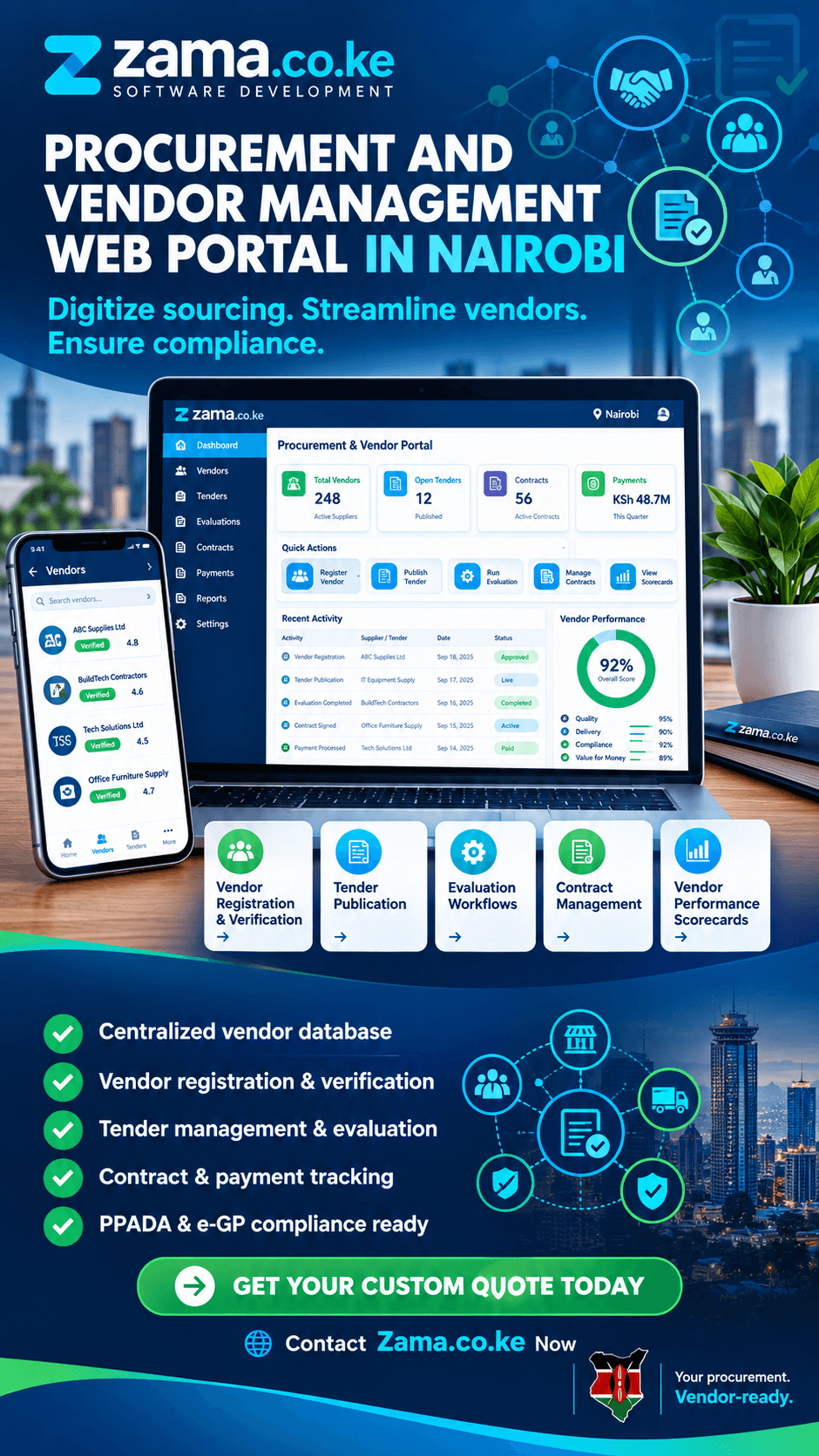
Procurement and vendor management web portal in Nairobi is a question that every procurement director, finance manager, and operations leader must answer in 2026. With the government’s Electronic Government Procurement system now mandatory for all public entities, more than 900 public entities migrated to the platform, over 33,000 suppliers registered, and the Kenya Public Expenditure Review estimating that improved procurement efficiency could deliver about Sh85.9 billion in savings, the pressure to digitize procurement and vendor management has never been greater. At zama.co.ke, we’ve helped numerous organizations across Nairobi implement custom procurement and vendor management web portals that streamline sourcing, automate vendor onboarding, and ensure regulatory compliance. This comprehensive guide explores procurement and vendor management web portal in Nairobi, from understanding what these portals do to selecting the right development approach for your organization.
What a Procurement and Vendor Management Web Portal Actually Does
Before diving into procurement and vendor management web portal in Nairobi, it’s essential to understand what this technology actually does. A procurement and vendor management web portal is a browser-based platform that automates the entire procurement lifecycle—from planning and sourcing through vendor registration, tender management, evaluation, contract execution, and payment—while maintaining a complete vendor database with performance tracking and compliance verification.
A proper procurement and vendor management web portal in Nairobi does far more than digitize paper forms. It connects procurement to budgeting, ensures compliance with the Public Procurement and Asset Disposal Act, enforces approval hierarchies, tracks vendor performance, automates contract management, and provides real-time visibility into spending. It eliminates the manual processes, fragmented records, and compliance gaps that plague procurement and vendor operations.
For a Nairobi organization, the practical definition of procurement and vendor management web portal in Nairobi is this: the web-based platform that tells you exactly what you are buying, exactly who you are buying it from, exactly how vendors are performing, exactly where every procurement request stands, and exactly how your procurement and vendor management compares to policy—all in real time, from any device.
Why Nairobi Organizations Need Procurement and Vendor Management Portals
When evaluating procurement and vendor management web portal in Nairobi, it’s important to understand the regulatory and operational pressures driving adoption.
The Cost of Fragmented Procurement and Vendor Management
Most Nairobi organizations manage procurement through email chains, spreadsheets, and paper files. Vendor records are scattered across departments. Tender documents are stored in shared drives. Approval trails exist only in email threads. This fragmentation creates significant problems:
Vendor Duplication: The same vendor is registered multiple times by different departments, with different details, creating confusion and compliance risks.
Inconsistent Vendor Performance: Without a central vendor database, there is no way to track performance across contracts, identify problematic vendors, or recognize reliable suppliers.
Approval Bottlenecks: Procurement requests get stuck in email chains, with no visibility into who is holding up the process.
Compliance Gaps: Manual records make it difficult to demonstrate compliance with PPADA requirements, special group reservations, or e-GP integration.
Audit Failures: When auditors request procurement records, staff spend days searching through emails, shared drives, and paper files.
A proper procurement and vendor management web portal in Nairobi addresses these challenges systematically. It centralizes vendor records, automates approval workflows, maintains complete audit trails, and provides real-time visibility into procurement and vendor performance.
Government Digitization Mandate
The most urgent driver for procurement and vendor management web portal in Nairobi is the government’s e-Government Procurement initiative. The e-GP system was officially rolled out for use by both National and County Governments. The system is designed to digitize the entire lifecycle of public procurement, from planning and sourcing to contract management and payment. More than 900 public entities have adopted and migrated to the e-GP system, with over 33,000 suppliers registered.
For public entities, a custom procurement and vendor management portal must integrate with e-GP, exchanging procurement plans, tender notices, and award information as required.
Vendor Performance and Risk Management
Vendor performance directly impacts organizational success. A vendor that delivers late disrupts operations. A vendor that provides substandard goods creates quality problems. A vendor that fails to comply with tax or regulatory requirements exposes the organization to risk.
A comprehensive procurement and vendor management web portal in Nairobi tracks vendor performance across contracts, monitors compliance with tax and regulatory requirements, and provides scorecards that inform future procurement decisions. It alerts procurement teams when vendor certifications expire, when insurance lapses, or when performance issues emerge.
Transparency and Accountability
A modern procurement and vendor management web portal in Nairobi improves oversight because it becomes easier to track actions, timelines, and decision points, enabling earlier detection of red flags such as repeated awards to the same vendor, single bid tenders, unusual submission patterns, and repeated cancellations and re-tendering.
For private sector organizations, a custom portal provides similar benefits: clean audit trails, reduced fraud risk, better vendor performance, and improved cost control.
Essential Features of a Procurement and Vendor Management Web Portal in Nairobi
When evaluating procurement and vendor management web portal in Nairobi, focus on these core features:
1. Vendor Registration and Onboarding
The foundation of vendor management is a centralized vendor database. A proper system should support vendor self-registration with document upload, verification against business registration and tax compliance systems, vendor categorization by goods, works, and services, and vendor prequalification workflows.
For Kenyan organizations, vendor verification against government systems is essential. The portal should verify business registration, tax compliance, and beneficial ownership records, ensuring that only legitimate, compliant vendors are onboarded.
2. Vendor Performance Tracking
Vendor performance directly impacts procurement outcomes. A comprehensive procurement and vendor management web portal in Nairobi tracks performance across contracts, including delivery timeliness, quality, compliance with terms, and responsiveness. It generates vendor scorecards that inform future procurement decisions.
The portal should track historical performance, identify problematic vendors, and recognize reliable suppliers. It should alert procurement teams when vendor performance falls below thresholds.
3. Procurement Planning and Budgeting
The foundation of any procurement system is planning. A proper system should support annual procurement planning with budget integration, user department requisition submission, verification and aggregation of demands against budgets, capture of special group reservations, approval workflows for consolidated procurement plans, and integration with financial management systems.
4. Tender Publication and Bid Management
Digital tendering is the core of any procurement system. A robust system should support electronic tender publication with open access for all qualified vendors, digital bid submission with secure document handling, automated bid opening and recording, and standardized evaluation workflows with scoring criteria.
5. Evaluation and Award Workflows
The evaluation stage is where corruption risks are highest. A proper system should enforce structured evaluation criteria with automated scoring, provide independent evaluation workflows with role-based access, document all evaluation decisions with audit trails, and support award recommendations with justifications.
6. Contract Management
Procurement does not end with award. A comprehensive system should manage contract creation and execution, track deliverables and milestones, manage contract variations and amendments, monitor vendor performance against contract terms, and provide alerts for contract expiry and renewal.
7. Payment Tracking and Reconciliation
Financial integration is essential. A quality system should link procurement to payment processing, track invoice receipt and verification, reconcile payments against contracts, and integrate with M-Pesa and bank payment systems for efficient vendor payment.
8. Vendor Portal
Vendors should have self-service access to the procurement system. A proper procurement and vendor management web portal in Nairobi should include a vendor portal where suppliers can register, update their profiles, submit bids, track tender status, view contract details, and submit invoices. This self-service approach reduces administrative burden on procurement staff while improving vendor experience.
9. Reporting and Analytics
Real-time visibility is a primary benefit of digitization. A comprehensive system should generate procurement performance reports, spending analytics by category and vendor, compliance reports for PPRA and other regulators, and vendor performance dashboards.
10. Multi-Currency and Local Payment Integration
For organizations procuring from international vendors, multi-currency support is essential. The system should track procurement in multiple currencies, including foreign exchange rates and import duties. For local payments, M-Pesa integration enables efficient vendor payment and automated reconciliation.
What Makes a Procurement and Vendor Management Web Portal in Nairobi Different
procurement and vendor management web portal in Nairobi has unique characteristics that global solutions often lack:
PPADA Compliance
The Public Procurement and Asset Disposal Act and its accompanying regulations govern public procurement in Kenya. Any procurement portal must support the specific requirements of this legislation, including procurement methods, thresholds, evaluation criteria, and reporting obligations.
e-GP Integration
For public entities, integration with the government’s e-GP system is mandatory. The e-GP system has been developed using Open Contracting Data Standards for transparency, data sharing, and analysis. A custom portal must be able to exchange data with e-GP, submitting procurement plans, tender notices, and award information as required.
Special Group Reservations
Kenyan procurement law requires reservations for special groups. A compliant portal must capture 30% reservation to special groups (women, youth, and persons with disabilities) and 20% to local contractors at county level.
M-Pesa Integration
For vendor payments, M-Pesa integration is essential. A modern procurement portal should support STK Push prompts, C2B PayBill confirmations, B2C payouts to vendors, and automatic invoice matching.
IFMIS and Financial System Integration
For public entities, integration with the Integrated Financial Management Information System is critical. Approved procurement plans must be shared with IFMIS, and procurement transactions must flow into the financial management system.
Multi-Level Approval Hierarchies
Nairobi organizations often have complex approval hierarchies with different thresholds for different procurement values. A custom portal must model these hierarchies precisely.
Vendor Verification Against Government Systems
For compliance and fraud prevention, the portal should verify vendor details against government systems—business registration, tax compliance, and beneficial ownership records.
Procurement and Vendor Management Web Portal Use Cases in Nairobi
Public Sector Procurement
Government ministries, departments, and agencies use procurement and vendor management portals to manage procurement in compliance with PPADA and e-GP requirements. The portal handles procurement planning, tender publication, bid evaluation, contract management, and payment tracking.
County Governments
County governments use procurement portals to manage procurement for county services. The portal supports special group reservations at county level, local contractor preferences, and integration with county financial management systems.
Manufacturing and Distribution
Manufacturers and distributors use procurement portals to manage raw material procurement, vendor management, and contract execution. The portal integrates with production planning and inventory management.
Banking and Financial Services
Banks and financial institutions use procurement portals to manage vendor onboarding, contract management, and payment processing. Integration with core banking systems ensures that payments are processed efficiently.
Healthcare Facilities
Hospitals and healthcare facilities use procurement portals to manage medical supplies, pharmaceuticals, and equipment procurement. Integration with hospital management systems ensures that procurement aligns with clinical needs.
Educational Institutions
Schools and universities use procurement portals to manage procurement of supplies, equipment, and services. Integration with financial management systems ensures that procurement stays within budget.
NGOs and Development Organizations
NGOs use procurement portals to manage procurement for program activities. Integration with donor reporting requirements ensures that procurement is transparent and auditable.
The Zama.co.ke Approach to Procurement and Vendor Management Web Portal Development in Nairobi
When considering procurement and vendor management web portal in Nairobi, zama.co.ke follows a structured approach:
Requirements Discovery
We map your procurement and vendor management workflows: categories, vendor base, approval hierarchies, compliance requirements, and integration needs. This includes understanding your current challenges and defining success metrics.
Portal Design
We design the portal architecture—user interfaces, vendor database, workflow engine, integration points, and reporting dashboards. The design supports your specific procurement categories and vendor management requirements.
Development and Integration
We develop the portal, build integrations with existing systems (financial management, eTIMS, IFMIS, payment systems, government registries), and configure procurement workflows, approval hierarchies, and vendor scorecards.
Vendor Data Migration
We migrate existing vendor data into the new system. We validate data accuracy before migration and ensure that historical vendor performance records are preserved.
Training and Support
We provide role-specific training for procurement staff, approvers, vendors, and administrators. We remain available for ongoing support, maintenance, and portal upgrades.
Post-Launch Optimization
After go-live, we monitor performance, gather user feedback, and refine the portal to improve procurement efficiency and vendor management.
The ROI of a Procurement and Vendor Management Web Portal in Nairobi
When evaluating procurement and vendor management web portal in Nairobi, the ROI is compelling:
Cost Savings: Improved procurement efficiency and vendor competition can deliver significant cost reductions.
Reduced Vendor Risk: Vendor verification and performance tracking reduce the risk of working with non-compliant or underperforming vendors.
Faster Procurement Cycles: Standardized, automated workflows reduce procurement timelines from weeks to days.
Improved Vendor Performance: Vendor scorecards and performance tracking ensure vendors deliver on time and to specification.
Better Budget Control: Integration with budgeting and financial systems ensures procurement stays within approved budgets.
Audit Readiness: Complete digital records make audits faster, cheaper, and less disruptive.
Compliance Protection: Automated PPADA and e-GP compliance reduces legal and regulatory risk.
Implementation Considerations for Nairobi Organizations
When implementing a procurement and vendor management web portal, consider these factors:
Assess Your Current Processes
Before selecting a portal, map your current procurement and vendor management workflows. Identify pain points, bottlenecks, and compliance gaps. Understand your procurement categories, vendor base, approval hierarchies, and reporting requirements.
Choose the Right Solution
The best portal for your organization depends on whether you are a public entity requiring e-GP compliance, a private company needing vendor management and cost control, or a hybrid.
Plan for Vendor Data Migration
Migrating vendor records requires careful validation. Ensure vendor details, tax IDs, contract terms, and performance records are accurate before migration.
Train Procurement Staff and Vendors
Procurement staff, approvers, and vendors need training on the new portal. Role-specific training using real procurement scenarios produces higher adoption.
Ensure Regulatory Compliance
Configure the portal to comply with PPADA requirements. For public entities, ensure full e-GP integration and IFMIS connectivity.
Test Thoroughly
Test all scenarios: vendor registration, tender publication, bid submission, evaluation, award, contract management, and payment. Ensure the portal works correctly when connectivity is lost.
Consider a Phased Rollout
For large organizations, consider a phased rollout. Start with vendor registration and procurement planning, prove the portal works, then expand to tendering, contract management, and payment.
The Cost of Delaying Procurement and Vendor Management Portal Implementation
While organizations evaluate procurement and vendor management web portal in Nairobi, the cost of inaction compounds daily. Every month of manual procurement represents compliance risk—PPRA penalties for non-compliant procurement can be substantial. Every month of fragmented vendor records represents audit risk—missing documentation leads to audit queries and delays. Every month of inefficient vendor management represents financial loss—inflated prices, delayed deliveries, and missed savings opportunities.
Meanwhile, organizations that have implemented procurement and vendor management portals are achieving compliance, reducing costs, and improving vendor performance. The competitive gap widens with every passing month.
Why Contact Zama.co.ke for Procurement and Vendor Management Web Portal Development in Nairobi
When researching procurement and vendor management web portal in Nairobi, organizations should contact zama.co.ke because:
Local Expertise: We understand Kenyan regulatory requirements, including PPADA compliance, e-GP integration, and special group reservations.
Custom Development: We build portals tailored to your specific procurement categories, vendor management requirements, and approval hierarchies, not generic solutions.
Integration Capabilities: We connect portals to financial systems, IFMIS, eTIMS, vendor registries, and payment systems.
Transparent Pricing: No hidden fees, clear milestone timelines, and full source-code ownership.
Ongoing Support: We remain available for maintenance, troubleshooting, and portal upgrades as your procurement needs evolve.
For a custom quote based on your organization’s specific requirements, contact zama.co.ke today.
Procurement and vendor management web portal in Nairobi is essential for any organization seeking to digitize sourcing, streamline vendor onboarding, ensure regulatory compliance, and reduce procurement costs. From vendor registration and performance tracking to tender management and contract execution, the right portal transforms how organizations procure goods, works, and services.
At zama.co.ke, we’ve helped organizations across Nairobi implement procurement and vendor management portals that deliver measurable results. Our approach ensures you get exactly what your organization needs—nothing more, nothing less.
Don’t let the complexity of procurement and vendor management web portal in Nairobi hold you back. Whether you’re a public entity requiring e-GP compliance or a private company seeking procurement excellence, we have the expertise to guide you through every step.
Contact zama.co.ke today for a custom quote based on your organization’s specific requirements.