
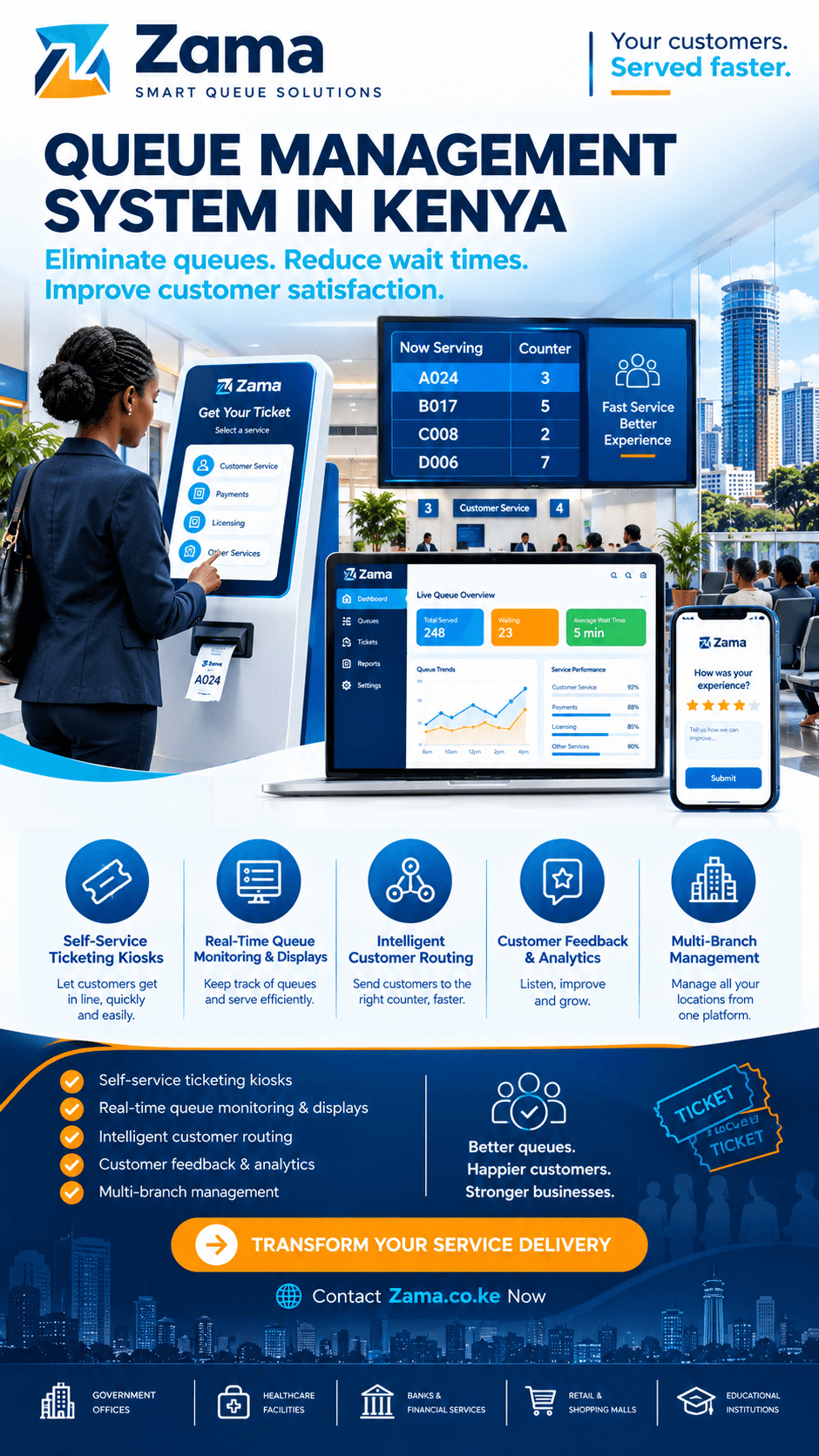
Queue management system in Kenya is a question that every facility manager, business owner, and service delivery director must answer in 2026. With Kenya’s service sector expanding across healthcare, banking, government, retail, and telecommunications, the need for organized customer flow has never been greater. At zama.co.ke, we’ve helped numerous organizations across Kenya implement queue management systems that eliminate disorderly queues, dramatically reduce waiting times, and enhance the overall customer experience. This comprehensive guide explores queue management system in Kenya, from understanding core features to selecting the right solution for your facility.
What a Queue Management System Actually Does
Before diving into queue management system in Kenya, it’s essential to understand what this technology actually does. A queue management system is a digital platform that organizes, monitors, and optimizes customer flow in service environments. It replaces manual, disorderly queues with intelligent token-based processes where customers receive digital tickets, track their queue positions on displays, and are automatically called to the next available service counter.
A proper queue management system in Kenya replaces paper tickets and chaotic lines with self-service kiosks, real-time counter displays, centralized management dashboards, and automated customer routing. Manual queue management has been found to cost five times more than digital systems while discouraging customers due to long queues.
For a Kenyan business or institution, the practical definition of queue management system in Kenya is this: the system that tells you exactly how many customers are waiting, exactly how long they have been waiting, exactly which counters are available, and exactly how service is performing—all in real time, from a single dashboard accessible on any device.
Why Kenyan Organizations Are Adopting Queue Management Systems
When evaluating queue management system in Kenya, consider the compelling reasons for adoption:
The Cost of Manual Queues
Manual queue management systems discourage customers due to long queues. Without systematic tools to streamline service delivery, the overall experience remains suboptimal. Crowded waiting areas and unpredictable service times create frustration for both customers and employees.
Long waiting times have been considered frustrating to customers and a significant cause of dissatisfaction. Research has shown that with patients aged 60+ reporting 96% higher satisfaction due to reduced physical queuing demands.
The Business Case for Digital Queuing
Queue management systems are essential for optimizing customer flow, reducing wait times, and enhancing service efficiency in retail stores, banks, healthcare facilities, and government offices in Kenya. The global queue management system market was valued at USD 541.90 million in 2024 and is projected to reach USD 907.78 million by 2033. Kenya and other East African nations together account for close to 60% of regional demand for virtual queuing systems.
Essential Features of a Queue Management System in Kenya
When evaluating queue management system in Kenya, focus on these core features:
1. Self-Service Ticketing Kiosks
Self-service kiosks are the frontline of any modern queue management system in Kenya. Patients check in via kiosks and receive digital queue numbers. Self-service stations allow customers to pick digital tickets and receive queue numbers, eliminating manual ticketing systems completely. Intuitive ticketing kiosks enable customers to select services and receive queue tickets.
2. Real-Time Display Screens
Wall-mounted display screens show current queue positions and call customers to the next available counter automatically, reducing confusion. Counter LED displays show current queue numbers, providing transparency and reducing customer anxiety during waits. Digital signage at key areas displays current queue statuses, serving numbers, and educational content.
3. Intelligent Customer Routing
A comprehensive queue management system in Kenya automatically routes customers to the appropriate service counters based on service type, customer category, and staff availability. The system routes patients to the next available staff member automatically based on category. When service counters become free, the system assigns appropriate tickets without manual intervention. Support for overflow routing ensures no customer group experiences unnecessary delays.
4. Centralized Management Dashboard
The centralized dashboard offers real-time queue visibility, customer loads, counter activity, average wait times, and staff responsiveness. Management can monitor customer flow and service operations effectively across multiple locations. Real-time monitoring of patient loads, counter activity, wait times, and staff responsiveness across networks enables data-driven decision-making.
5. Customer Experience and Feedback Portal
A comprehensive queue management system in Kenya includes feedback collection capabilities. Customers can share satisfaction ratings and comments through in-branch kiosks or mobile device links. The platform collects feedback through in-branch kiosks and post-visit SMS links, monitoring satisfaction with actionable insights. Feedback portals provide a platform to collect and analyse customer feedback. The system can be integrated with existing systems, automatically pushing feedback requests to customers after service delivery completion.
6. Multi-Branch Management
For organizations with multiple locations, a queue management system in Kenya provides centralized visibility across all branches. The system can manage patient flow across outpatient, emergency, maternity, and specialist departments efficiently across multiple facilities. Centralized monitoring across seven branches has enabled consistent quality standards.
7. SMS and Mobile Integration
SMS-based feedback systems enable customers to submit satisfaction ratings and comments via mobile devices post-service for convenience. Automated feedback collection sends surveys to members post-transaction.
Queue Management Systems Across Kenyan Sectors
Healthcare
Kenya’s healthcare sector has been a primary adopter of queue management system in Kenya:
Lifecare Hospitals partnered with Marezi to implement a smart, scalable, data-driven hospital queue management system across seven branches serving hundreds of daily patients. Patients check in via kiosks and receive digital queue numbers with automatic routing.
RFH Healthcare has deployed the Marezi Queue Management System across 10 facilities to streamline patient flow, improve service coordination, and enhance the overall patient experience. The implementation features ticketing kiosks, LED counter displays, and real-time queue monitoring.
The Nairobi Hospital implemented a comprehensive queue management system across multiple departments, transforming patient experience and operational efficiency.
Equity Afia deployed a comprehensive queue management system and self-service kiosks across medical centers, replacing manual queuing processes with intelligent digital systems managing patient flow across consultation, dental, optical, laboratory, and specialized clinic departments.
Lifecare Hospitals partnered with Marezi to implement smart, scalable, data-driven hospital queue management systems, with self-service check-in kiosks and centralized management dashboards.
Banking and Financial Services
Financial institutions have embraced queue management system in Kenya:
Newforties SACCO deployed a comprehensive Bank Queue Management System and Customer Experience platform, transforming from manual queuing to intelligent, data-driven member flow management. Self-service QMS kiosks enable members to select services and receive queue tickets. The digital queue management system has dramatically reduced waiting within banking halls, with members now experiencing organized, transparent queues instead of congested manual experiences.
Stima DT SACCO deployed a data-driven queue management system with synchronized lobby and counter displays, and a lightweight feedback portal designed specifically with Kenya’s data-protection requirements in mind.
Government Services
Government institutions are adopting queue management system in Kenya to improve service delivery:
Business Registration Service (BRS) operationalized a queue management system serving more than 5,000 customers monthly. The system issues digital tickets and directs customers to the next available service counter automatically, eliminating disorganised customer flow and significantly improving service turnaround time. BRS managers can track satisfaction levels over time to identify areas for improvement.
Kenya Power (KPLC) installed queue management and customer experience feedback systems at eight key regional service centres spanning Nairobi, Mombasa, Kisii, and Thika. Customers simply pick digital tickets, track their queue positions on wall-mounted screens, and automatically get called to the next available counter.
The Judiciary of Kenya partnered with WAVETEC to implement an Enterprise Queue Management System aimed at improving service efficiency and visitor experience across its facilities. The EQMS solution is designed to support high-traffic environments through intelligent ticketing, real-time monitoring, and actionable insights.
Other Sectors
Matatu industry: QueueTrack is a Smart Matatu Queue Management System designed to digitize the entire stage experience with a live navigation dashboard to see queue status in real-time.
Mombasa County Government: Plans to install smart traffic lights with intelligent queue management systems where sections of roads are given priority by the length of traffic congestion.
Queue Management System Providers in Kenya
Several providers offer queue management system in Kenya solutions:
RIANA Group is a leading business technology solutions provider based in Nairobi, Kenya, with solutions including queue management systems, centralized digital signage, customer experience portals, visitor management systems, and electronic security systems.
Q-SYS, a RIANA Group subsidiary, is a trusted provider of smart queue management systems in Africa, serving businesses across Kenya, Uganda, Nigeria, Congo, Zimbabwe, and Tanzania. Q-SYS is an Electronic Queue Management System that allows you to track, monitor, regulate and control visitor movements within your facility.
Marezi, a RIANA Group subsidiary specialising in customer experience solutions, has deployed queue management systems at Lifecare Hospitals, RFH Healthcare, The Nairobi Hospital, Kenya Power, BRS, Newforties SACCO, Stima DT SACCO, and Equity Afia.
WAVETEC has partnered with the Judiciary of Kenya through local partner Blue Eagle Precision Limited to implement an Enterprise Queue Management System.
dPOS offers queue management systems that let you issue digital tickets, display queue status on screens, and route customers to the right service counter.
Hanmak Technologies provides patient queue management systems alongside integrated healthcare management information systems and electronic medical records software.
The ROI of a Queue Management System in Kenya
When evaluating a queue management system in Kenya, the ROI is compelling:
Reduced Waiting Times: Shorter wait times and improved customer movement result from smarter counter utilization achieved through automatic ticket assignment and overflow logic. Patient turnaround time decreased significantly with systematic queue management eliminating bottlenecks.
Improved Customer Satisfaction: Electronic queue management systems enhance customer satisfaction which makes them loyal to the institution. Waiting area congestion reduced dramatically as patients received accurate wait time information.
Operational Efficiency: Management gained increased visibility and performance monitoring through real-time dashboards. The system has improved staff productivity, allowed faster customer service turnaround time, and eased tracking of all transactions in real time.
Data-Driven Decisions: Real-time visibility into queue activity and customer flow patterns enables evidence-based decision-making.
Scalability: The system can scale up staff capacity when need arises.
Implementation Considerations for Kenyan Organizations
When implementing a queue management system in Kenya, consider these factors:
Assess Your Facility’s Needs
Evaluate your specific requirements: customer volume, service types, peak hours, and integration with existing systems. Healthcare facilities may prioritize patient flow across multiple departments, while banks may need to handle different transaction types.
Choose the Right Provider
The best queue management system provider in Kenya understands the unique challenges of the local market. Look for providers with proven implementations in similar facilities. Marezi’s solutions have been deployed across seven Lifecare Hospitals branches, 10 RFH facilities, and eight Kenya Power regional service centres.
Plan for Data Protection Compliance
Ensure your system complies with Kenya’s Data Protection Act. The solution should be designed with data-protection requirements in mind.
Consider Integration
Plan for integration with existing systems such as Hospital Management Information Systems (HMIS), customer relationship management, and feedback collection platforms.
Train Staff and Users
Provide training for all staff members. Staff across all locations should receive hands-on training and full system handover, ensuring every team member fully leverages the new technology.
The Zama.co.ke Approach
When considering a queue management system in Kenya, zama.co.ke follows a structured approach:
Facility Assessment
We evaluate your facility’s requirements: customer volume, service types, peak hours, integration needs, and compliance obligations.
System Design
We design a queue management solution tailored to your specific facility—whether it’s a hospital, bank, government office, or retail outlet.
Installation and Configuration
We handle all aspects of installation, including kiosk setup, display mounting, network configuration, software configuration, and integration with existing systems.
Training and Support
We provide role-specific training for all staff members and administrators, including system monitoring, reporting, and troubleshooting.
Post-Installation Support
We remain available for maintenance, system optimization, and upgrades as your facility evolves.
Queue management system in Kenya is essential for any organization seeking to eliminate disorderly queues, reduce waiting times, and enhance customer satisfaction. From Lifecare Hospitals and RFH Healthcare to Kenya Power, the Business Registration Service, and the Judiciary, the benefits are proven and substantial.
At zama.co.ke, we’ve helped organizations across Kenya implement queue management systems that deliver measurable results. Our approach ensures you get exactly what your facility needs—nothing more, nothing less.
Don’t let the complexity of queue management system in Kenya hold you back. Whether you’re managing a hospital, bank, government office, or retail outlet, we have the expertise to guide you through every step.
Contact zama.co.ke today and let us help you build a queue management system that transforms your service operations.