
Queue Management System Kenya solution helps organizations serve customers faster, organize waiting lines, reduce congestion and monitor service performance from one central platform.
Long physical queues remain a major challenge in hospitals, banks, clinics, government offices, SACCOs, customer care centres, universities and other busy service environments. When customers are forced to stand in an unorganized line, the result can be frustration, overcrowding, slow service delivery and difficulty measuring staff performance.
A modern Queue Management System replaces the traditional physical line with an organized digital customer journey.
Customers can receive a ticket from a self-service kiosk, receptionist, QR code or online portal. They then wait comfortably while digital screens, SMS alerts or audio announcements tell them when and where they will be served.
For organizations operating in Kenya, implementing a smart queue system can improve both customer experience and operational efficiency.
 What Is a Queue Management System?
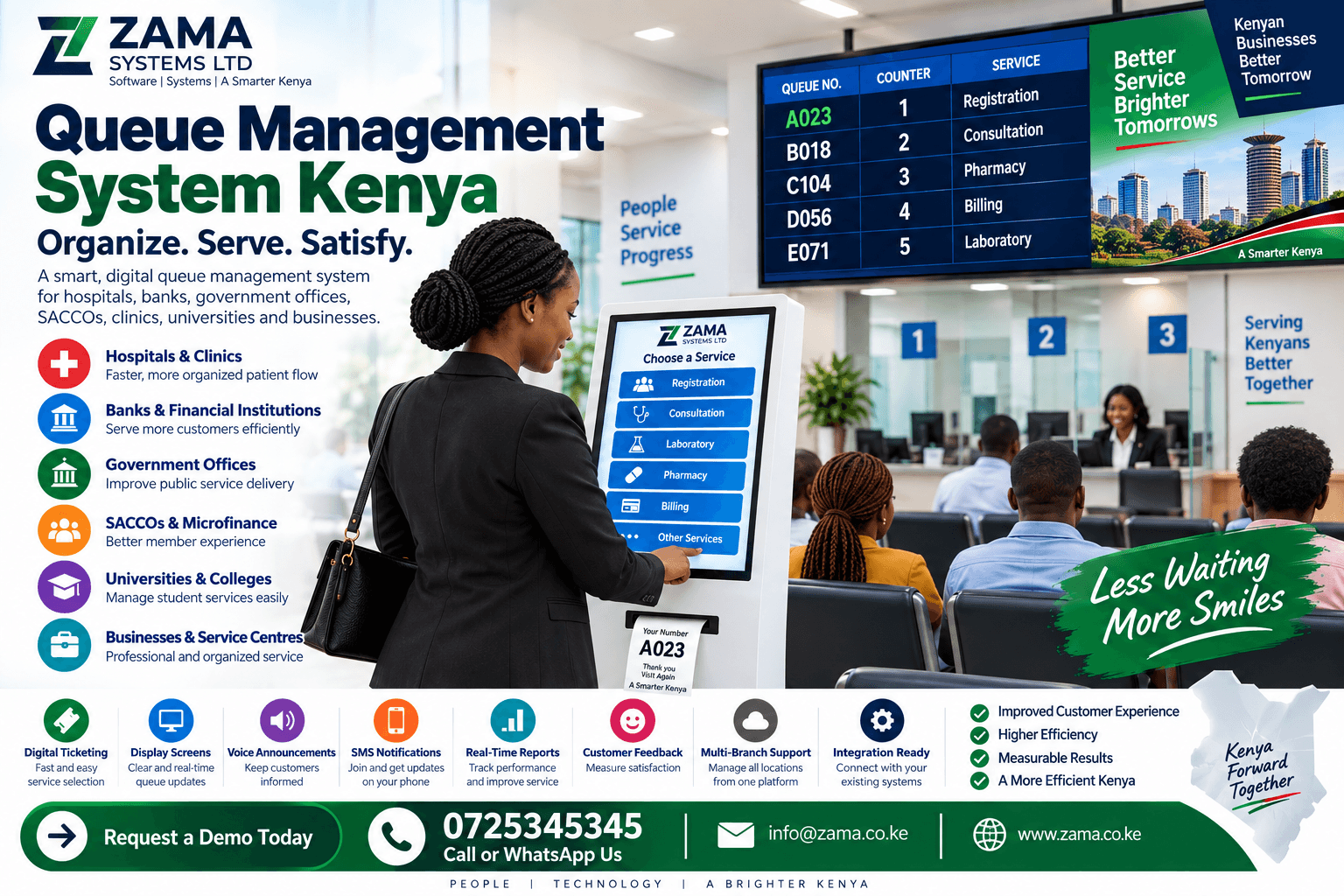
A Queue Management System (QMS) is a combination of software and optional hardware used to organize, monitor and control how customers move through different service points.
Instead of customers trying to determine who arrived first, the system automatically creates an orderly queue.
A typical customer journey works like this:
- Customer arrives at the organization.
- Customer selects the required service.
- The system issues a digital or printed queue ticket.
- The customer waits for their number.
- A staff member calls the next customer.
- The customer’s number appears on a display screen.
- The customer proceeds to the assigned counter, room or department.
- The system records waiting time and service time.
- Management reviews performance using reports and dashboards.
This makes customer flow easier to manage, especially in organizations handling hundreds or thousands of visitors every day.
Why Businesses Need a Queue Management System in Kenya
Customer expectations have changed.
People increasingly expect organizations to provide faster, clearer and more convenient services. Long queues without information about waiting time can quickly create a poor customer experience.
A Queue Management System in Kenya gives organizations greater control over customer flow.
Instead of simply managing a line of people, management can understand:
- How many customers visited today
- Which services customers requested
- Average waiting time
- Average service time
- Number of customers served by each employee
- Number of customers waiting
- Peak service hours
- Most requested services
- Customer abandonment rates
- Counter performance
- Branch performance
These insights can help management make better staffing and operational decisions.
Key Features of a Queue Management System Kenya
When selecting a Queue Management System Kenya, organizations should look beyond basic ticket printing.
A modern system should support the entire customer journey.
1. Self-Service Ticket Kiosk
Customers can select the service they need using a touchscreen kiosk.
For example, a hospital kiosk may show:
- Registration
- Consultation
- Laboratory
- Pharmacy
- Billing
- Insurance
- Radiology
The system then creates the appropriate queue number.
2. Queue Ticket Printing
The system can print a ticket showing information such as:
- Queue number
- Service selected
- Date
- Time
- Branch
- Estimated waiting time
Paperless ticketing can also be implemented where required.
3. Digital Queue Display Screen
Large screens can display queue numbers being served.
For example:
A023 → Counter 4
B018 → Room 7
C104 → Cashier 2
The screen helps customers know where they should go without repeatedly asking staff.
Organizations can also use the same screens for announcements, advertisements, educational information or corporate messages.
4. Voice Announcements
The system can automatically announce queue numbers when customers are called.
For example:
“Ticket number A023, please proceed to Counter Four.”
Voice announcements are useful in large waiting areas and busy institutions.
5. Staff Calling Dashboard
Staff members can access the Queue Management System through a computer or browser.
Depending on permissions, staff can:
- Call next customer
- Recall customer
- Transfer customer
- Skip a ticket
- Place ticket on hold
- Redirect customer
- Complete service
- Add service notes
Everything can be recorded for reporting purposes.
6. Central Management Dashboard
Managers need visibility beyond what customers see on the queue display.
A central dashboard can show:
- Customers currently waiting
- Active counters
- Closed counters
- Average waiting time
- Customers served today
- Service duration
- Staff productivity
- Queue length
- Branch performance
This information allows supervisors to respond to congestion before it becomes a serious problem.
Hospital Queue Management System Kenya
Healthcare facilities are one of the strongest use cases for queue management technology.
A Hospital Queue Management System can organize patient movement across multiple departments instead of creating separate uncontrolled queues.
A patient’s journey may include:
Registration → Triage → Consultation → Laboratory → Pharmacy → Billing.
The system can automatically transfer the patient between the relevant queues.
This is particularly valuable for:
- Hospitals
- Medical centres
- Clinics
- Dental clinics
- Diagnostic centres
- Eye clinics
- Laboratories
- Pharmacies
Benefits of Queue Management in Hospitals
A hospital queue system can help healthcare facilities:
- Reduce overcrowding
- Organize patient movement
- Prioritize emergency cases
- Monitor patient waiting times
- Improve reception efficiency
- Track departmental performance
- Separate appointment and walk-in queues
- Improve communication with patients
- Identify service bottlenecks
Priority rules can also be configured for specific categories of patients where the facility’s procedures require them.
Queue Management System for Banks
Banks and financial institutions regularly serve customers requiring different services.
These may include:
- Deposits
- Withdrawals
- Account opening
- Customer service
- Loans
- Cards
- Foreign exchange
- Business banking
A smart Queue Management System can direct each customer to the appropriate service point.
Management can then identify which services create the longest waiting times and allocate additional employees where necessary.
A multi-branch bank can also monitor queue performance centrally instead of relying only on individual branch reports.
Queue Management System for Government Offices
Government institutions often handle very high numbers of citizens.
A government queue management system can organize citizens according to the services they require.
The system can be useful for:
- County offices
- Government agencies
- Licensing centres
- Registration centres
- Public hospitals
- Revenue offices
- Public service centres
Instead of maintaining several physical queues, citizens can receive a number and wait until called.
Management can also measure demand and service performance more accurately.
Queue Management System for SACCOs
SACCOs and microfinance institutions frequently have busy customer service environments.
Customers may visit for:
- Deposits
- Withdrawals
- Loan applications
- Loan enquiries
- Statements
- Account updates
- Customer service
A Queue Management System Kenya can separate these services while maintaining one coordinated customer journey.
Reports can reveal which services consume the most staff time and which periods experience the highest customer traffic.
Queue Management System for Clinics
Smaller clinics may not require the same infrastructure as large hospitals.
A web based queue management system can provide a simpler setup.
Patients can be registered from reception, receive a queue number and move through consultation, laboratory, pharmacy and cashier services.
Because the system is web based, authorized employees can access it using existing computers or tablets depending on the deployment.
Virtual Queue Management System
Customers should not always have to sit physically inside a waiting area.
A Virtual Queue Management System allows customers to join a queue remotely or receive updates through their phones.
Depending on the implementation, customers can:
- Scan a QR code
- Join through a website
- Book an appointment
- Receive a digital ticket
- View queue position
- Receive SMS notifications
- Return when their turn approaches
Virtual queuing is particularly valuable where organizations want to reduce congestion.
WhatsApp and SMS Queue Notifications
Mobile communication can significantly improve the queue experience.
For example, a customer may receive:
“Your queue number is A045. There are 6 customers ahead of you.”
Another message can be sent when the customer’s turn approaches.
This gives customers greater flexibility instead of requiring them to watch a screen continuously.
Organizations can integrate SMS or supported messaging channels according to their communication requirements.
Appointment and Queue Management System
Appointments and walk-in queues should ideally work together.
Consider a hospital where some patients have appointments while others arrive without bookings.
A modern system can manage:
- Scheduled appointments
- Walk-in customers
- Priority customers
- Rescheduled appointments
- Missed appointments
- Different departments
- Multiple service counters
When customers arrive for appointments, they can check in and automatically enter the correct service queue.
This creates a smoother experience than maintaining separate appointment books and physical queues.
Multi-Branch Queue Management System
Large organizations may have several branches throughout Kenya.
Managing each branch independently makes it difficult for head office to understand overall service performance.
A multi-branch Queue Management System Kenya can provide a central dashboard showing information from all locations.
Management can compare:
- Nairobi branch
- Mombasa branch
- Kisumu branch
- Nakuru branch
- Eldoret branch
Reports can show customer volumes, waiting time, employee performance and service trends across every location.
Queue Management System Kenya
One major advantage of digital queue management is data.
Traditional queues provide very little information.
Managers may see many customers waiting but still not know exactly why delays are happening.
A digital system records every stage.
Important reports can include:
Customer Traffic Report
Shows how many customers visited during a selected period.
Waiting Time Report
Shows how long customers waited before being served.
Service Time Report
Shows how long employees spent serving customers.
Counter Performance Report
Shows performance across different counters.
Employee Performance Report
Shows the number of customers handled by individual staff members.
Service Performance Report
Shows demand and waiting times by service type.
Branch Comparison Report
Useful for organizations with several branches.
Peak Hours Report
Identifies the busiest periods of the day, week or month.
These reports help organizations make decisions based on real operational information.
Customer Feedback Integration
Serving a customer quickly does not automatically mean the customer had a good experience.
A Queue Management System can therefore integrate customer feedback.
After service, customers may rate their experience using:
- Touchscreen terminal
- QR code
- SMS survey
- Web feedback form
Questions may include:
“How would you rate today’s service?”
This connects queue performance with actual customer satisfaction.
Queue Management System Integration
A queue solution should not necessarily operate as an isolated system.
Depending on the organization’s requirements, it can integrate with existing systems.
Possible integrations include:
- Hospital Management Systems
- Electronic Medical Record systems
- ERP software
- CRM systems
- Appointment systems
- Customer databases
- SMS gateways
- Active Directory
- Reporting platforms
- Mobile applications
- Business Intelligence dashboards
Integration can reduce duplicate data entry and create a smoother workflow for employees.
Cloud vs On-Premise Queue Management System
Organizations can choose different deployment models.
Cloud Queue Management System
The system is hosted online and accessed securely through the internet.
Potential advantages include:
- Easier multi-branch deployment
- Centralized updates
- Remote reporting
- Lower server infrastructure requirements
On-Premise Queue Management System
The software is deployed on the organization’s own infrastructure.
This may be preferred by organizations that require greater control over where their operational data is hosted.
The appropriate architecture should depend on security, connectivity, compliance, integration and operational requirements.
Queue Management System Kenya
A complete queue system may include:
- Touchscreen kiosk
- Thermal ticket printer
- TV or LED display
- Mini computer or media player
- Counter display
- Speaker
- Network equipment
- QR scanner
- Customer feedback terminal
However, organizations do not always need every hardware component.
A smaller clinic might operate a browser-based queue system using existing computers and a TV screen.
A busy hospital or banking hall may require multiple kiosks, displays and service counters.
Queue Management System Kenya
The Queue Management System price in Kenya depends on the complexity of the implementation.
There is no single price that fits every organization because requirements differ considerably.
Factors influencing the cost include:
- Number of branches
- Number of counters
- Number of departments
- Number of kiosks
- Ticket printers
- Number of display screens
- SMS integration
- Appointment booking
- Customer feedback
- System integrations
- Custom reporting
- Cloud or on-premise deployment
- Installation requirements
- Training
- Technical support
For this reason, organizations should request a needs assessment and detailed quotation based on the actual service environment.
How to Choose a Queue Management System Provider in Kenya
Before selecting a provider, evaluate more than the initial software price.
Ask whether the provider can support:
Custom Workflow Configuration
Your organization should not have to redesign its operations around generic software.
The system should accommodate your actual departments, services and customer journey.
Local Implementation Support
Installation is only one part of the project.
Training, configuration and technical support are equally important.
Integration Capability
Choose a platform that can communicate with existing business systems where integration is required.
Scalability
The system should support growth from a few service counters to multiple departments and branches.
Reporting
Management should have access to detailed operational analytics.
Security
Role-based access, authentication, audit trails and appropriate data protection controls should be considered.
Support and Maintenance
Understand how updates, technical support, troubleshooting and future enhancements will be handled.
Benefits of Queue Management Systems
Organizations implementing digital queue management can gain several advantages.
Better Customer Experience
Customers understand their position and know where to go.
Reduced Physical Congestion
Customers can sit comfortably instead of standing in long lines.
Improved Staff Productivity
Employees spend less time manually organizing customers.
Better Management Visibility
Managers can monitor customer flow in real time.
Measurable Service Levels
Waiting and service times become measurable rather than assumptions.
Better Resource Allocation
Organizations can increase staffing during high-demand periods.
Greater Accountability
System records provide management with information about service performance.
Consistent Service Across Branches
Organizations can implement similar service standards in multiple locations.
Industries That Can Use Queue Management Systems in Kenya
Queue management technology is useful anywhere customers wait for service.
Common applications include:
- Hospitals
- Clinics
- Banks
- SACCOs
- Government offices
- County offices
- Universities
- Colleges
- Embassies
- Insurance companies
- Telecommunications companies
- Retail stores
- Customer care centres
- Utility companies
- Corporate reception areas
- Service centres
- Laboratories
- Pharmacies
Each environment can have its own queue rules and customer journey.
Smart Queue Management System Kenya
Modern queue management is moving beyond ticket numbers.
A Smart Queue Management System Kenya can combine:
- Physical queues
- Virtual queues
- Online appointments
- QR check-in
- SMS notifications
- Digital signage
- Customer feedback
- Centralized analytics
- Multi-branch monitoring
- API integrations
The objective is to manage the entire customer journey rather than simply issuing tickets.
Why Implement a Queue Management System?
Organizations should consider queue management when they experience:
- Long customer queues
- Congested waiting areas
- Customer complaints
- Unclear waiting times
- Customers jumping queues
- Slow service
- Difficulty monitoring staff
- Multiple departments
- High visitor volumes
- Multiple branches
- Difficulty measuring service levels
Digital queue management creates visibility into these problems so management can improve them using measurable information.
Queue Management System Kenya for Growing Organizations
A good Queue Management System Kenya should be capable of starting small and expanding as an organization grows.
For example, an organization could initially implement:
- Reception ticketing
- Two service counters
- One queue display
- Basic reporting
It could later expand into:
- Multiple departments
- Appointment booking
- SMS notifications
- Virtual queuing
- Customer feedback
- Multiple branches
- Central dashboards
- ERP or CRM integration
This approach helps organizations invest according to their operational requirements.
Queue Management System Kenya – Request a Demo
If your hospital, clinic, bank, SACCO, government institution or business experiences long queues, a digital queue management platform can help create a more organized customer journey.
Zama Systems Ltd provides customizable queue management solutions designed around an organization’s actual workflow.
Solutions can include:
- Queue management software
- Self-service kiosks
- Queue ticketing
- Digital display screens
- Staff calling dashboards
- Appointment management
- SMS notifications
- Virtual queues
- Customer feedback
- Reporting and analytics
- Multi-branch dashboards
- Integration with existing systems
Contact Zama Systems Ltd to discuss your requirements, request a demonstration and receive a customized Queue Management System quotation.
Frequently Asked Questions About Queue Management System Kenya
What is a Queue Management System?
A Queue Management System is software, sometimes combined with kiosks, printers and displays, that organizes customers waiting for services. It assigns queue numbers, calls customers to the correct service point and records waiting and service times.
What is the best Queue Management System in Kenya?
The appropriate system depends on the organization’s number of customers, branches, departments, counters, integrations and reporting requirements. Hospitals, banks and government offices may require more advanced workflows than smaller clinics or service centres.
How much does a Queue Management System cost in Kenya?
Queue Management System prices vary according to software requirements, number of counters, kiosks, displays, branches, integrations, installation and support. A requirements assessment is normally required before providing an accurate quotation.
Can a Queue Management System work in hospitals?
Yes. A Hospital Queue Management System can coordinate registration, triage, consultation, laboratory, pharmacy, cashier and other departments while tracking patient waiting times.
Can customers join a queue using their phones?
Yes. Virtual queue systems can allow customers to join through a website or QR code and receive updates through supported mobile communication channels.
Can a Queue Management System send SMS notifications?
Yes. SMS gateways can be integrated to send queue numbers, appointment reminders and notifications when a customer’s turn approaches.
Can the system support several branches?
Yes. A multi-branch Queue Management System can centrally monitor customer volumes, waiting times, employees and counters across different branches.
Can queue management integrate with existing software?
Yes. Depending on available APIs and system architecture, queue management software can integrate with hospital systems, ERP platforms, CRM systems, appointment systems and other business applications.
What businesses need Queue Management Systems?
Queue management is suitable for hospitals, banks, clinics, government offices, SACCOs, universities, customer service centres, insurance companies, retail outlets and other organizations handling walk-in customers.
Is a Queue Management System web based?
Modern solutions can be web based, cloud hosted, on-premise or hybrid depending on operational, security and connectivity requirements.
A Queue Management System Kenya is no longer simply a machine that prints ticket numbers. Modern queue management connects customers, employees, service counters, appointments, notifications, digital displays and management reports into one coordinated customer journey.
For hospitals, banks, government institutions, SACCOs, clinics and growing businesses, the right system can make waiting more organized while giving management valuable information about customer traffic, service times and operational performance.
Organizations looking to modernize customer service should therefore consider a system that supports digital queuing, virtual queues, appointments, SMS notifications, analytics, multi-branch management and integration with existing business software.
For a customized Queue Management System in Kenya, contact Zama Systems Ltd for consultation, system demonstration and implementation requirements.