
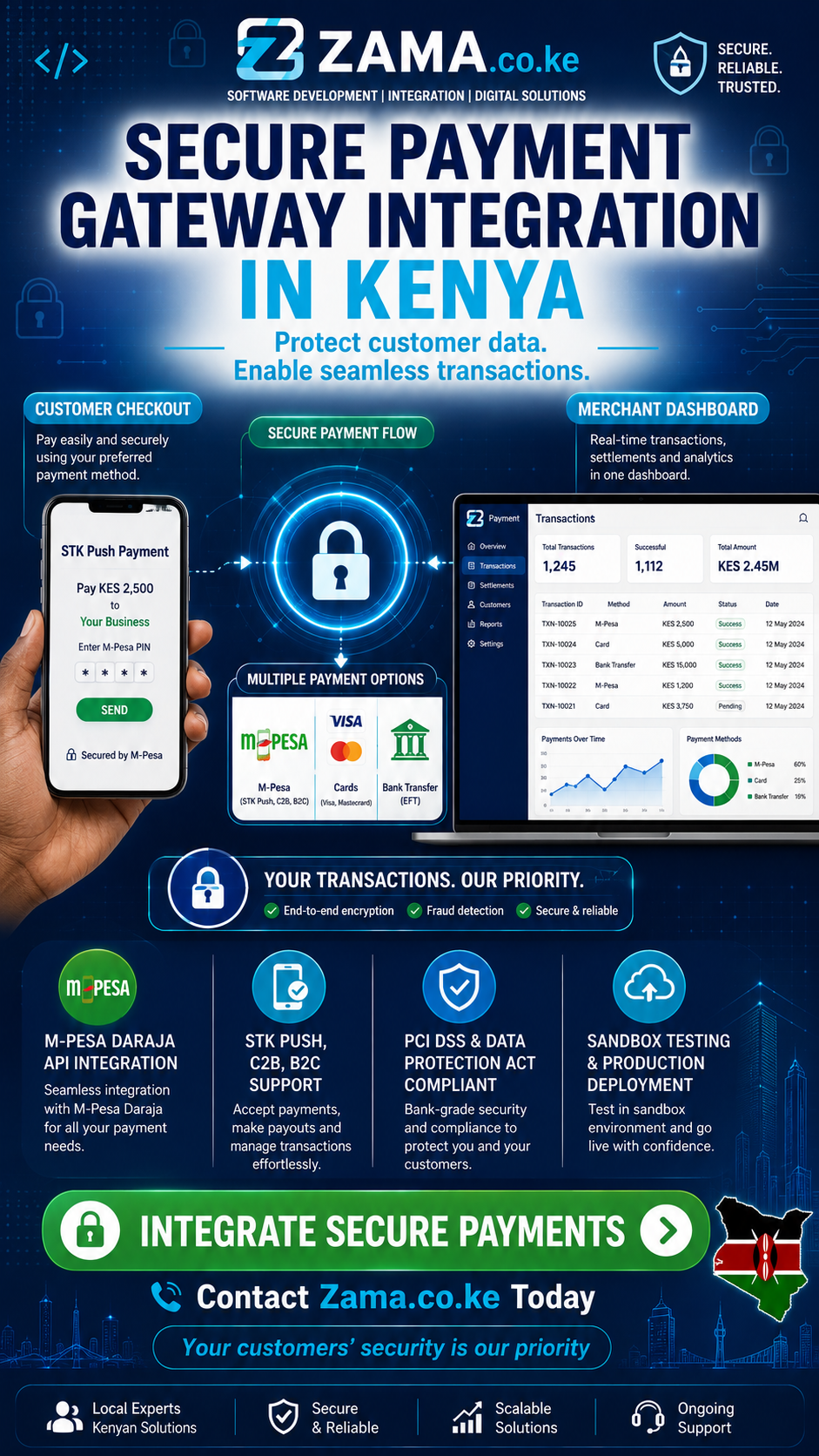
Secure payment gateway integration in Kenya is a question that every e-commerce business owner, fintech startup founder, and operations manager must answer in 2026. With mobile money transactions in Kenya surpassing 2 trillion shillings annually and the country leading the world in mobile money adoption, the ability to securely process digital payments has become a competitive necessity, not a luxury. At zama.co.ke, we’ve helped numerous businesses across Kenya integrate secure payment gateways that protect customer data, ensure regulatory compliance, and enable seamless transactions. This comprehensive guide explores secure payment gateway integration in Kenya, from understanding the payment landscape to selecting the right integration partner.
Understanding Kenya’s Payment Landscape
Before diving into secure payment gateway integration in Kenya, it’s essential to understand the current payments ecosystem. Kenya has one of the most advanced mobile money markets globally, with M-Pesa serving over 30 million active users . The dominance of mobile money means that businesses must prioritize mobile payment integration while also supporting other payment methods like cards, bank transfers, and emerging fintech solutions.
The integration of payment gateways requires careful attention to security, as Kenyan businesses must comply with various regulations including the Data Protection Act and KRA eTIMS requirements. When evaluating secure payment gateway integration in Kenya, businesses must prioritize solutions that protect sensitive financial data while offering a seamless customer experience .
What Is a Payment Gateway and Why Does Security Matter?
A payment gateway is a technology solution that securely transmits transaction data between a customer, a merchant, and the financial institutions involved in processing payments. In the Kenyan context, payment gateways typically handle mobile money transactions (M-Pesa, Airtel Money), card payments (Visa, Mastercard), and bank transfers.
Secure payment gateway integration in Kenya is particularly important because:
Financial Data Sensitivity: Payment transactions involve sensitive customer financial information. A security breach can result in significant financial losses, legal liability, and reputational damage.
Regulatory Compliance: Kenya’s Data Protection Act imposes strict requirements for handling personal data, including payment information. Non-compliance can result in substantial fines and legal consequences.
Fraud Prevention: Payment gateways must incorporate fraud detection and prevention mechanisms to protect businesses from chargebacks and fraudulent transactions.
Customer Trust: Security is fundamental to customer confidence. Customers are less likely to complete transactions if they perceive the payment process as insecure.
KRA Compliance: With KRA’s eTIMS requirements, payment gateways must support proper tax documentation and reconciliation .
When considering secure payment gateway integration in Kenya, these factors must be central to your decision-making process.
Payment Methods Available in Kenya
M-Pesa Integration
M-Pesa is the dominant mobile money platform in Kenya, making its integration essential for any business seeking to process payments. M-Pesa integration typically uses Safaricom’s Daraja API, which supports several transaction types :
STK Push (Lipa Na M-Pesa Online): This is the most common payment method for online businesses. The system sends a payment prompt to the customer’s M-Pesa registered phone, and the customer authorizes the transaction by entering their PIN. The business never handles the customer’s financial details, enhancing security .
C2B (Customer to Business): This allows customers to pay businesses via PayBill or Till numbers. When considering secure payment gateway integration in Kenya, C2B integration is essential for businesses that receive payments through PayBill or Till numbers. The system automatically updates the business when a payment is received .
B2C (Business to Customer): This enables businesses to send money to customers, useful for refunds, salary payments, or disbursements. B2C requires additional security credentials including an encrypted password using Safaricom’s public certificate .
The Daraja API requires authentication via OAuth 2.0, where businesses obtain a Consumer Key and Consumer Secret from the Safaricom Developer Portal. For production environments, additional credentials like passkeys and security certificates are required .
Card Payment Gateways
Card payments are increasingly common in Kenya, particularly for international transactions or premium services. Secure payment gateway integration in Kenya for card payments must ensure:
PCI DSS Compliance: Payment Card Industry Data Security Standard compliance is mandatory for handling card payments. Solutions that meet SAQ A level of PCI Compliance reduce the security burden on merchants.
Tokenization: Sensitive card data should be replaced with tokens to prevent data theft. When a customer’s card details are entered, they should not be stored on the merchant’s servers.
SSL/TLS Encryption: All payment data must be encrypted in transit using strong encryption protocols.
3D Secure: Additional authentication for card payments helps prevent fraud.
Providers like Pesapal support multiple payment methods including cards and M-Pesa, offering unified integration for businesses seeking secure payment gateway integration in Kenya .
Emerging Payment Methods
Klasha: Klasha provides cross-border payment solutions supporting M-Pesa, credit cards, and bank transfers across Kenya and other African countries .
KCB M-Pesa Express: KCB’s M-Pesa Express API is widely used in Kenya, enabling direct STK Push payments through KCB’s banking infrastructure. Solutions like the KCB M-Pesa Express WooCommerce Gateway fill the gap for businesses needing official WooCommerce integration .
Implementation Approaches for Secure Payment Gateway Integration in Kenya
Using SDKs and Development Kits
Several SDKs simplify secure payment gateway integration in Kenya by abstracting complex API interactions:
Daraja-v3 (Python SDK): A production-ready Python SDK with zero external dependencies, type annotations, and Stripe-quality error handling. It handles token caching, automatic phone number normalization, and provides typed results. The SDK supports STK Push, STK Query, B2C, C2B Register, Account Balance, and webhook parsing .
Key features include:
Token caching to avoid burning requests on expired tokens
Composable exceptions for granular error handling
Automatic phone number normalization
Webhook parsing for callback handling
@charleslit/payment-gateway-kenya: A TypeScript-first payment gateway package supporting multiple providers including Pesapal and M-Pesa. It offers environment-based configuration, full TypeScript support, and a plugin architecture for adding new payment providers .
mpesakit: A Python SDK that eliminates the complexity of M-Pesa integration with zero-config setup, automatic authentication handling, and seamless environment switching between sandbox and production. It supports STK Push, C2B, B2C, account balance queries, transaction reversal, and tax remittance .
n8n-nodes-mpesa-daraja: An n8n integration enabling automated M-Pesa payments, balance checks, transaction status queries, and webhook handling in workflow automation .
When implementing secure payment gateway integration in Kenya, these SDKs can significantly reduce development time and improve security by handling authentication, encryption, and error handling automatically.
E-commerce Platform Integration
For businesses using e-commerce platforms, specialized plugins enable secure payment gateway integration in Kenya:
WooCommerce M-Pesa Payment Gateway: This plugin integrates Safaricom’s Daraja API with WooCommerce, providing STK Push integration, real-time payment processing via callbacks, and comprehensive transaction logging. It includes security features like data encryption, callback validation, and IP whitelisting .
Magento 2 Lipa Na M-Pesa: This extension integrates the Lipa Na M-Pesa payment gateway with Magento 2 stores. It does not require storing customer sensitive data on the Magento 2 server, meeting SAQ A level of PCI Compliance. The extension supports sandbox mode, custom titles, and phone number entry at checkout .
Moodle M-Pesa Gateway: For educational institutions, the mpesaKenya plugin integrates M-Pesa with Moodle’s payment system, supporting both sandbox and production environments with comprehensive transaction logging .
Framework-Agnostic Integration
For custom applications, secure payment gateway integration in Kenya requires careful attention to the flow:
Authentication: Every request to payment APIs requires an access token. The system must generate and refresh tokens appropriately .
Callback Handling: Payment gateways send transaction results to callback URLs. Callback endpoints must be publicly accessible, idempotent, secure, and logged for debugging .
Webhook Validation: Incoming webhooks should be validated to ensure they are genuine payment notifications .
Transaction Logging: Comprehensive logging helps with debugging, reconciliation, and audit trails.
Data Encryption: Sensitive data must be encrypted in transit and at rest.
Security Best Practices
When implementing secure payment gateway integration in Kenya, these security practices are essential:
Credential Management
Never commit credentials to version control
Use environment variables for sensitive data
Store API keys, passkeys, and security credentials securely
Implement regular credential rotation
Webhook Security
Validate incoming webhooks to ensure they are from legitimate sources
Implement signature verification where supported
Use HTTPS for all callback URLs
Implement IP whitelisting for callback endpoints
Rate Limiting and Monitoring
Implement rate limiting to prevent abuse
Monitor transaction patterns for anomalies
Set up alerts for suspicious activity
Log all transactions for audit trails
Data Protection Compliance
Ensure compliance with Kenya’s Data Protection Act
Implement data minimization principles
Ensure customer data is not stored unnecessarily
Maintain proper consent mechanisms
PCI Compliance
For card payments, ensure PCI DSS compliance
Use payment gateway solutions that reduce PCI scope
Consider tokenization and hosted payment pages
Sandbox Testing
Testing is essential for any secure payment gateway integration in Kenya. Safaricom provides a sandbox environment with test credentials, enabling businesses to test their integration before going live :
Set Up: Create an account on the Safaricom Developer Portal, create a sandbox app, and obtain Consumer Key, Consumer Secret, and test shortcode.
Test Credentials: Use provided test phone numbers and transaction values.
Callbacks: Use tools like ngrok to expose local callback endpoints for testing .
Simulation: Use the C2B simulation tool available on the Daraja portal to test customer-to-business payments.
The sandbox environment allows testing of all success paths, failed transactions, retries, and callback handling before moving to production .
Common Integration Challenges and Solutions
When implementing secure payment gateway integration in Kenya, businesses often encounter challenges:
Challenge 1: Token Expiry
Problem: Access tokens expire and cause authentication failures.
Solution: Use SDKs that handle token caching and refresh automatically, or implement your own token management system .
Challenge 2: Phone Number Formats
Problem: Customers provide phone numbers in various formats.
Solution: Normalize all phone numbers to the canonical
2547xxxxxxxx
or
2541xxxxxxxx
format expected by payment gateways .
Challenge 3: Callback Reliability
Problem: Callback URLs may not receive notifications due to network issues.
Solution: Implement a transaction status query fallback and verify payment status after a timeout period .
Challenge 4: Testing Complexity
Problem: Testing real transactions is expensive and risky.
Solution: Thoroughly test in sandbox environments before moving to production .
Challenge 5: Security Vulnerabilities
Problem: Improper credential storage or callback validation can expose the system.
Solution: Use environment variables, validate incoming callbacks, and implement proper logging without exposing sensitive data .
The Zama.co.ke Approach
When considering secure payment gateway integration in Kenya, zama.co.ke follows a structured approach:
Payment Flow Discovery
We define the user journey, transaction states, callback behavior, and business actions that should happen after payment events occur. This ensures your integration supports your actual business processes.
Security and Compliance Design
We map how transaction data should connect to invoices, accounts, orders, or service records, and ensure all compliance requirements—Data Protection Act, KRA eTIMS, PCI DSS—are built in from the start.
Integration Build
The payment connection, callback processing, account updates, notifications, and operational workflows are implemented in a controlled build sequence. We use best practices for credential management, webhook validation, and transaction logging.
Testing and Go-Live Preparation
We test success paths, failed transactions, retries, reporting behavior, and the business logic tied to each payment outcome before launch.
Post-Launch Support
After payments begin flowing through the platform, we support monitoring, issue response, and later refinements to improve reliability and visibility.
Secure payment gateway integration in Kenya is essential for any business operating in 2026. From M-Pesa integration using Safaricom’s Daraja API to card payment processing and emerging fintech solutions, the right integration transforms how businesses collect payments, reconcile transactions, and serve customers.
At zama.co.ke, we’ve helped businesses across Kenya build secure payment integrations that protect customer data, ensure regulatory compliance, and enable seamless transactions. Our approach ensures you get exactly what your business needs—nothing more, nothing less.
Don’t let the complexity of secure payment gateway integration in Kenya hold you back. Whether you’re starting from scratch or optimizing an existing integration, we have the expertise to guide you through every step.
Contact zama.co.ke today and let us help you build a secure payment gateway integration that transforms your business operations.