
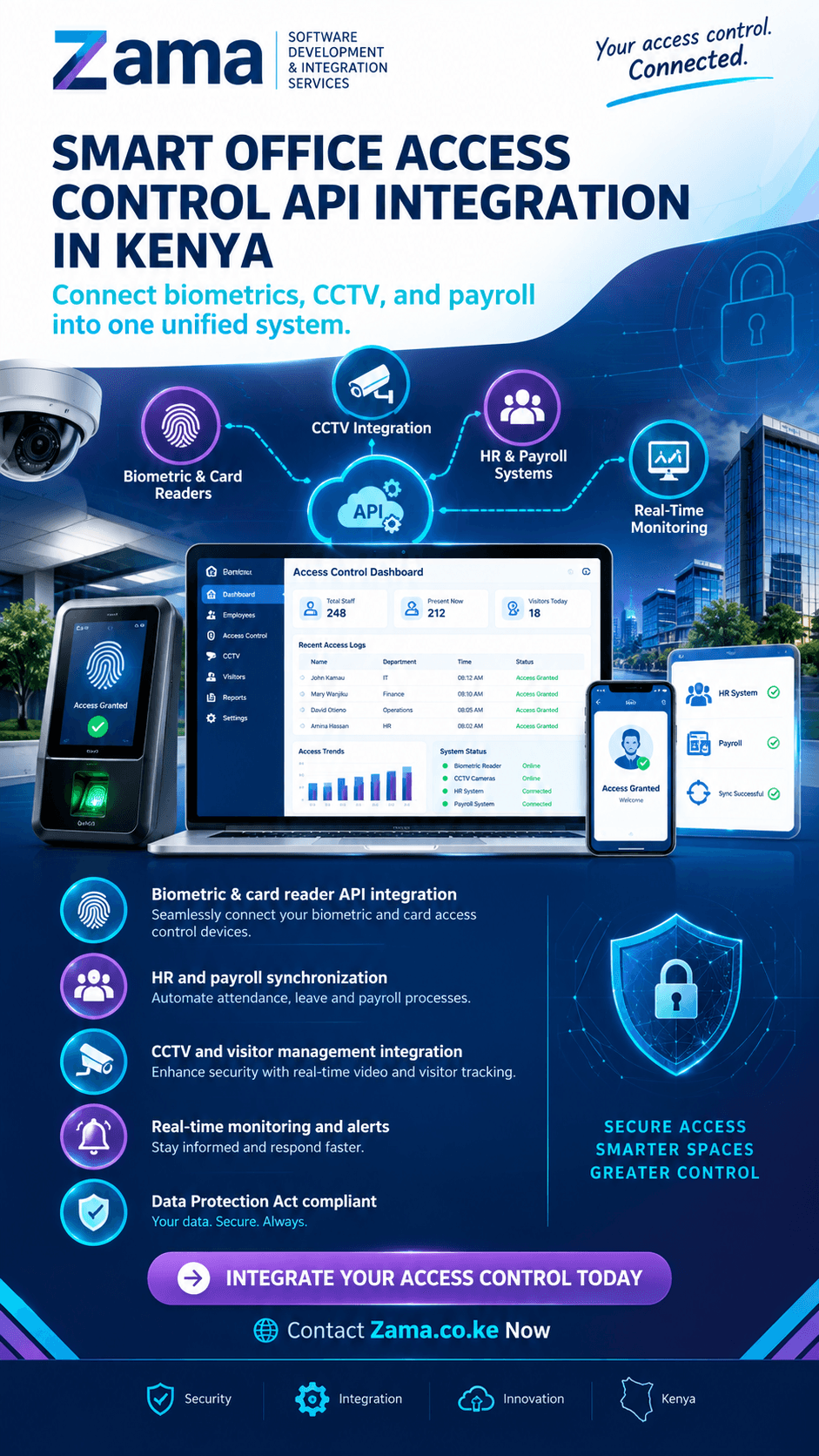
Smart office access control API integration in Kenya is a question that every facility manager, IT director, and security consultant must answer in 2026. With Kenyan offices increasingly adopting biometric readers, facial recognition terminals, smart locks, and cloud-based security platforms, the ability to connect these systems through APIs has become essential for operational efficiency. At zama.co.ke, we’ve helped numerous organizations across Kenya implement API-driven access control systems that eliminate manual processes, automate attendance tracking, and create unified security ecosystems. This comprehensive guide explores smart office access control API integration in Kenya, from understanding what API integration actually does to selecting the right solution for your facility.
What Smart Office Access Control API Integration Actually Does
Before diving into smart office access control API integration in Kenya, it’s essential to understand what this technology actually does. An access control API (Application Programming Interface) is a set of protocols and tools that allow different software systems to communicate with your access control hardware and software. It enables your biometric readers, card readers, turnstiles, smart locks, and door controllers to exchange data with other business systems—HR platforms, payroll software, CCTV systems, visitor management platforms, and building management systems.
A proper smart office access control API integration in Kenya does far more than simply unlock a door. It automates employee onboarding and offboarding, synchronizes attendance data with payroll, triggers CCTV recording when unauthorized access is attempted, sends real-time alerts to security teams, and provides audit trails for compliance. According to industry research, companies using smart access control API integration have reduced security breaches by 70 percent while cutting administrative overhead by 50 percent.
For a Kenyan business, the practical definition of smart office access control API integration in Kenya is this: the system that connects your access control hardware to every other business system that needs identity, attendance, or security data—eliminating manual data entry, reducing errors, and creating a unified security and operations platform.
Why Kenyan Businesses Need Access Control API Integration
When evaluating smart office access control API integration in Kenya, consider the compelling reasons for adoption:
The Cost of Disconnected Systems
Most Kenyan offices operate with fragmented security infrastructure. A biometric reader at the main entrance records attendance. A separate system controls the server room door. A third system manages parking access. A fourth handles visitor check-ins. These systems don’t talk to each other, creating significant operational inefficiency.
The average Kenyan enterprise with 300 employees spends 40-60 hours monthly manually reconciling access logs, attendance records, and payroll data. When these systems are connected through APIs, that manual work disappears. Data flows automatically between systems, and discrepancies are flagged in real time.
A proper smart office access control API integration in Kenya eliminates these inefficiencies by creating a single source of identity truth. When HR adds a new employee, the access control system is updated automatically. When an employee leaves, their access is revoked instantly across all doors, turnstiles, and parking barriers. When someone works overtime, their extra hours flow into payroll without manual entry.
The Growth of Smart Buildings in Kenya
Kenya’s commercial real estate sector is rapidly adopting smart building technologies. Modern office developments in Westlands, Upper Hill, Kilimani, and Two Rivers are being built with integrated building management systems that control HVAC, lighting, security, and access from a single platform. For these buildings, smart office access control API integration in Kenya is not an add-on—it’s a core requirement.
Tenants increasingly expect smart building features. They want employees to access offices with their phones, visitors to receive QR-code credentials automatically, and security teams to monitor all access points from a unified dashboard. Buildings that cannot provide these capabilities are losing premium tenants to competitors with modern infrastructure.
Data Protection Act Compliance
Kenya’s Data Protection Act imposes strict requirements on how businesses handle personal data, including biometric data. A proper smart office access control API integration in Kenya makes compliance easier by centralizing consent management, enforcing access permissions, maintaining audit trails, and supporting data subject rights such as access and erasure requests.
When access control systems are integrated through APIs, organizations can demonstrate exactly who accessed which personal data, when, and why. This level of traceability is impossible with disconnected systems.
Essential Features of Smart Office Access Control API Integration in Kenya
When evaluating smart office access control API integration in Kenya, focus on these core features:
1. Identity Management Synchronization
The foundation of any API integration is identity synchronization. A proper smart office access control API integration in Kenya should support:
HR System Integration: When an employee is hired, their credentials are provisioned automatically. When they leave, their access is revoked instantly. Role changes trigger automatic access permission updates.
Directory Service Integration: Connection to Microsoft Active Directory or LDAP allows employees to use existing credentials for physical access, eliminating separate systems and reducing password fatigue.
Single Sign-On Support: Employees use the same identity for physical access, network login, and application access, with security policies applied consistently across all channels.
2. Biometric and Card Reader Integration
A comprehensive smart office access control API integration in Kenya should connect all access control hardware through open APIs:
Biometric Readers: Fingerprint, face recognition, and palm vein readers exchange authentication data with the central system in real time.
Card Readers: RFID, NFC, and mobile credential readers authenticate employees and visitors against a unified access policy.
Smart Locks: Wireless locks connect to the central system, enabling remote management, temporary access grants, and audit trails.
Turnstiles and Barriers: Entry barriers and turnstiles respond to authentication events and report usage data to the central platform.
3. Attendance and Payroll Integration
One of the most valuable features of smart office access control API integration in Kenya is the ability to synchronize attendance data with payroll systems:
Automated Attendance Tracking: Every entry and exit event is timestamped and recorded, creating an accurate attendance record.
Overtime Calculation: The system can automatically calculate overtime hours based on configured rules, eliminating manual calculations.
Leave Management Integration: When employees request leave, the system knows not to expect them, reducing false late-arrival flags.
Payroll Synchronization: Attendance data flows directly into payroll systems, reducing manual entry and eliminating errors.
4. CCTV and Video Management Integration
For enhanced security, smart office access control API integration in Kenya should connect access control to video surveillance:
Event-Triggered Recording: When an access event occurs—whether authorized or denied—the connected CCTV system can automatically record and tag the footage.
Video Verification: Security teams can instantly view video of any access event, verifying identity and behavior.
Retention Management: Video associated with access events can be retained according to policy requirements, supporting investigations and compliance.
5. Visitor Management Integration
A proper smart office access control API integration in Kenya should connect visitor management to physical access:
Pre-Registration: Visitors receive QR-code credentials via email before arrival, allowing instant access upon check-in.
Host Notifications: When visitors arrive, their hosts receive automatic notifications via email, SMS, or messaging apps.
Temporary Access: Visitors receive time-limited access to specific areas, automatically revoked when their visit ends.
Audit Trails: Every visitor access event is logged, supporting security investigations and compliance reporting.
6. Real-Time Monitoring and Alerts
Integration enables real-time visibility that disconnected systems cannot provide. A comprehensive smart office access control API integration in Kenya should support:
Instant Alerts: When unauthorized access is attempted or when doors are held open beyond policy limits, security teams receive immediate notifications.
Dashboard Monitoring: All access points, events, and alerts are visible from a single dashboard, whether on-premise or mobile.
Geofencing: Access permissions can be tied to geographic location, ensuring credentials work only in authorized locations.
Emergency Response: During fire alarms or other emergencies, the system can automatically unlock all doors to facilitate evacuation.
7. API Security and Authentication
When implementing smart office access control API integration in Kenya, security is paramount:
OAuth 2.0 and JWT: Modern API authentication standards ensure only authorized systems can access data.
Encryption: All API communications should be encrypted using TLS, with data encrypted at rest.
Rate Limiting: API endpoints should have rate limits to prevent abuse and denial-of-service attacks.
Audit Logging: Every API call should be logged, providing a complete record of system interactions.
Role-Based Access: API permissions should follow the principle of least privilege, with different systems having different access rights.
What Makes Smart Office Access Control API Integration in Kenya Different
Smart office access control API integration in Kenya has unique characteristics that global solutions often lack:
M-Pesa and Local Payment Integration
Kenyan access control systems often need to integrate with payment systems for visitor parking, event attendance, or canteen purchases. A proper integration should support M-Pesa STK Push for immediate payments and automated reconciliation. When visitors pay for parking through M-Pesa, the access control system should automatically grant exit permission once payment is confirmed.
Multi-Tenant Building Support
Kenya’s commercial buildings often house multiple tenants, each with their own employees, visitors, and security requirements. A proper smart office access control API integration in Kenya must support multi-tenant scenarios where each tenant manages their own users while the building owner retains overall security control.
Offline Capability
Kenyan offices face power fluctuations and internet outages. Access control systems must continue functioning when the network goes down, storing access events locally and synchronizing when connectivity returns. API integrations should be designed for this reality, not assuming constant connectivity.
Local Regulatory Compliance
Beyond the Data Protection Act, Kenyan access control systems may need to comply with sector-specific regulations. Financial institutions require audit trails for all access to sensitive areas. Healthcare facilities require controlled access to patient records and medication storage. Government facilities require integration with national security protocols.
Cloud and On-Premise Flexibility
While cloud-based access control is growing in popularity, many Kenyan organizations—particularly government entities and financial institutions—require on-premise or hybrid deployments for data sovereignty reasons. A proper integration must support both deployment models without compromising functionality.
Common API Integration Scenarios for Kenyan Offices
Scenario 1: Employee Onboarding Automation
When HR adds a new employee, the access control system should automatically:
Create a user profile with appropriate access permissions
Generate credentials (biometric enrolment, card assignment, mobile credential)
Configure access schedules based on the employee’s role and department
Send welcome notifications with access instructions
Log the provisioning event for audit purposes
Scenario 2: Contractor and Visitor Access Management
For temporary workers and visitors, integration enables:
Time-limited access credentials that expire automatically
Zone-specific permissions limiting access to relevant areas
Automatic notifications to hosts when visitors arrive
Real-time monitoring of visitor locations
Automatic credential revocation when visits end
Scenario 3: Emergency Lockdown and Evacuation
During emergencies, integration enables:
Instant lockdown of all doors or selected zones
Automatic unlocking for evacuation when fire alarms trigger
Real-time accountability of who is in the building
Coordination with emergency services through shared dashboards
Scenario 4: Security Incident Investigation
When incidents occur, integration provides:
Complete audit trails of all access events
Video footage linked to specific access events
Timeline reconstruction showing who went where and when
Export capabilities for law enforcement or insurance purposes
The Zama.co.ke Approach
When considering smart office access control API integration in Kenya, zama.co.ke follows a structured approach:
Security Assessment
We evaluate your current access control infrastructure, identify integration requirements, and document the business processes that need automation. This includes mapping all doors, readers, and credentials, understanding HR and payroll workflows, and defining security policies.
Integration Design
We design the API integration architecture, ensuring compatibility between all systems. This includes defining data flows, authentication protocols, error handling, and fallback mechanisms for connectivity issues.
Build and Configure
We develop the API connectors, configure the access control system, and integrate with HR, payroll, CCTV, and visitor management platforms. We test all scenarios—normal operations, edge cases, and failure modes—before deployment.
Security Hardening
We implement security best practices including encryption, rate limiting, audit logging, and role-based access controls. We ensure compliance with the Data Protection Act and industry-specific regulations.
Training and Support
We provide training for security teams, IT administrators, and HR staff, ensuring everyone understands the integrated system. We remain available for ongoing support, maintenance, and system upgrades.
The ROI of Smart Office Access Control API Integration in Kenya
When evaluating smart office access control API integration in Kenya, the ROI is compelling:
Administrative Cost Reduction: Automated onboarding and offboarding eliminates manual data entry, saving HR and IT teams hours every week. Organizations report 50 percent reductions in administrative overhead.
Security Incident Reduction: Real-time monitoring and automated alerts prevent unauthorized access before incidents occur. Companies report 70 percent reductions in security breaches.
Payroll Accuracy Improvement: Automated attendance tracking eliminates buddy punching and manual timesheet errors. Payroll processing time drops by 60 percent while accuracy improves.
Compliance Cost Avoidance: Automated audit trails and consent management reduce Data Protection Act compliance costs and potential penalties.
Operational Efficiency: Unified dashboards and automated workflows enable security teams to manage more access points with fewer staff.
Scalability: API-driven integration allows new doors, readers, and systems to be added without replacing existing infrastructure.
Implementation Considerations for Kenyan Organizations
When implementing smart office access control API integration in Kenya, consider these factors:
Assess Your Current Infrastructure
Before selecting an integration solution, document your existing access control hardware, software, and the systems you need to connect. Identify which systems have open APIs and which require custom development.
Choose Open Standards
Prioritize access control systems that support open standards and documented APIs. Proprietary systems with closed APIs create vendor lock-in and limit future integration options.
Plan for Data Migration
Migrating user records, access permissions, and audit logs from legacy systems requires careful planning. Ensure data is validated before migration and that audit trails are preserved.
Train Your Team
Security teams, IT administrators, and HR staff need training on the integrated system. Role-specific training ensures everyone understands their responsibilities and capabilities.
Test Thoroughly
Test all integration scenarios, including normal operations, edge cases, and failure modes. Ensure the system works correctly when individual components fail or connectivity is lost.
Ensure Compliance
Configure the integration to comply with the Data Protection Act and any industry-specific regulations. Implement consent management, access controls, and audit logging from day one.
Smart office access control API integration in Kenya is essential for any organization seeking to eliminate manual processes, enhance security, ensure compliance, and create unified operational platforms. From automated employee onboarding and payroll synchronization to real-time security monitoring and emergency response, the benefits are proven and substantial.
At zama.co.ke, we’ve helped organizations across Kenya implement API-driven access control systems that deliver measurable results. Our approach ensures you get exactly what your organization needs—nothing more, nothing less.
Don’t let the complexity of smart office access control API integration in Kenya hold you back. Whether you’re a small office or a large multi-tenant building, we have the expertise to guide you through every step.
Contact zama.co.ke today and let us help you build a smart access control integration that transforms your security operations.