
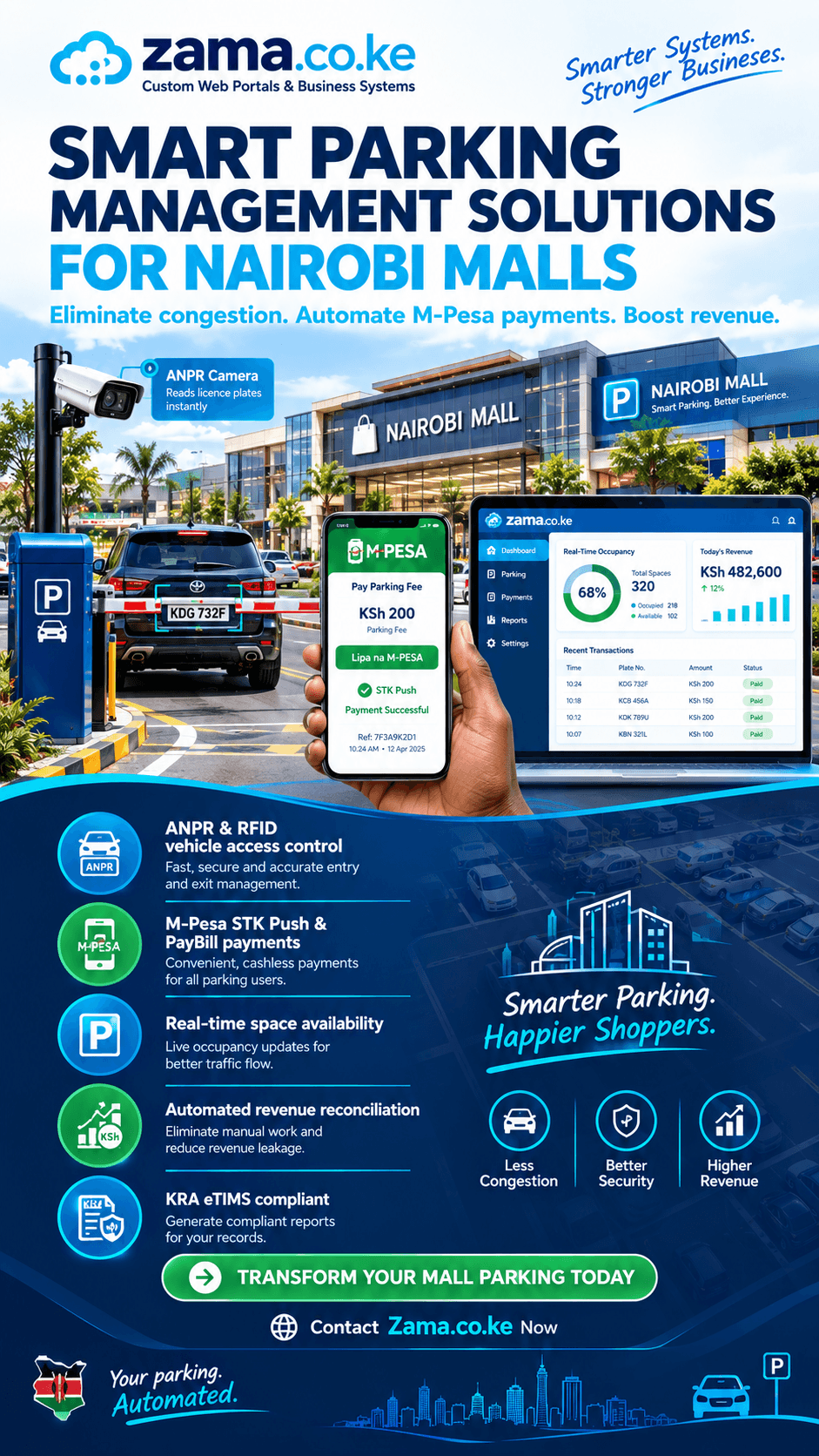
Smart parking management solutions for Nairobi malls is a question that every mall manager, facility director, and property owner in Kenya’s capital must answer in 2026. With Nairobi hosting over 50 major shopping malls, vehicle ownership rising steadily, and motorists expecting the same seamless digital experiences they get from M-Pesa and ride-hailing apps, the pressure to modernize parking operations has never been greater. At zama.co.ke, we’ve helped numerous commercial properties across Nairobi implement smart parking systems that eliminate congestion, automate payments, and transform the shopping experience. This comprehensive guide explores smart parking management solutions for Nairobi malls, from understanding the unique challenges mall operators face to selecting the right technology for your facility.
The Parking Crisis Facing Nairobi Malls
Before diving into smart parking management solutions for Nairobi malls, it’s essential to understand the scale of the problem. Nairobi’s malls face a parking paradox: they have parking capacity, but they cannot efficiently match available spaces with the vehicles that need them.
Congestion at Entry and Exit: Manual ticketing and cash payment create bottlenecks that frustrate shoppers and reduce the number of vehicles a mall can serve per hour. During peak periods—weekends, public holidays, and evening shopping hours—queues at entry and exit points stretch for hundreds of metres. Motorists spend 10 to 20 minutes simply waiting to enter or leave, time that could be spent shopping, dining, or using mall services.
Revenue Leakage: Cash-based parking operations are notoriously difficult to control. Uncollected fees, under-reported transactions, and outright theft erode parking revenue. Without automated reconciliation, mall management has no way to verify that every vehicle that entered actually paid. A single lane processing 200 vehicles daily at KES 100 per vehicle represents KES 20,000 in potential daily revenue—multiply that across multiple lanes and the annual leakage becomes substantial.
Poor Customer Experience: Motorists circle parking levels searching for spaces, unaware that available spots exist on another level. They queue at payment machines during peak exit times. They fumble for cash when they could be paying with M-Pesa in seconds. Each friction point degrades the shopping experience and reduces the likelihood of repeat visits.
Security Blind Spots: Without automatic vehicle logging, mall security cannot track which vehicles entered, when they left, or whether unauthorized vehicles are present. Investigating theft, vandalism, or incidents becomes nearly impossible without a complete audit trail.
Operational Inefficiency: Manual parking operations require cashiers at every entry and exit point, 24 hours a day. Staffing costs, shift management, and cash handling add operational overhead that automated systems eliminate. Mall management also lacks real-time visibility into occupancy, revenue, and traffic patterns—data that would enable smarter pricing, staffing, and capacity decisions.
Understanding these realities is the first step in identifying smart parking management solutions for Nairobi malls that actually work.
What Smart Parking Management Solutions Actually Do
A smart parking management solution is an integrated system of hardware and software that automates vehicle access, payment collection, and parking monitoring. It replaces manual barriers, cash payments, and paper tickets with ANPR cameras, RFID readers, automatic barriers, M-Pesa payment integration, and centralized management dashboards.
A proper smart parking management solutions for Nairobi malls answers the operational questions that manual systems cannot: exactly how many vehicles are in the mall right now, exactly which spaces are available on each level, exactly how much revenue has been collected, and exactly how to manage entry and exit without cashiers or manual intervention.
For a Nairobi mall operator, the practical definition of smart parking management solutions for Nairobi malls is this: the system that tells you exactly which vehicles are parked, exactly how long they have been there, exactly how much they have paid, and exactly how to move vehicles in and out as quickly as possible—all from a single dashboard accessible on any device.
Core Technologies Behind Smart Parking Management Solutions
When evaluating smart parking management solutions for Nairobi malls, understanding the underlying technologies is essential:
Automatic Number Plate Recognition (ANPR)
ANPR cameras capture vehicle number plates as vehicles approach entry and exit points. The system matches plates against registered vehicles—staff, tenants, season ticket holders—and opens the barrier automatically for authorized vehicles. For visitors, the system logs the plate and creates a virtual parking session that links to the eventual payment.
ANPR eliminates the need for paper tickets, reduces entry times to seconds, and creates a complete photographic record of every vehicle that enters and exits the facility. Modern ANPR systems deployed in Kenyan malls recognize all local plate formats, including the new digital number plates, and perform accurately under varied lighting and weather conditions.
RFID Vehicle Access
For frequent users—mall staff, tenant employees, and season ticket holders—RFID tags provide hands-free access. Long-range RFID readers detect vehicle tags from several metres away, opening the barrier without the vehicle stopping. This is particularly valuable for staff parking areas and tenant-designated spaces where speed and convenience are paramount.
Automatic Boom Barriers
The system integrates with intelligent boom barriers that open automatically after successful vehicle verification or payment confirmation. Quality barriers open in 2 to 3 seconds and include loop detectors, anti-crash protection, and weatherproof housing suitable for Nairobi’s climate. Spike barriers can be added at entry points for enhanced security, preventing tailgating and unauthorized access.
M-Pesa Payment Integration
M-Pesa integration is the cornerstone of smart parking management solutions for Nairobi malls. The system automatically calculates parking charges based on time spent and applicable tariffs. Motorists pay via M-Pesa STK Push, PayBill, or QR code. Once payment is confirmed, the system releases the exit barrier automatically—no cash, no cards, no queues at payment machines.
The system supports multiple payment methods including M-Pesa Paybill, Till Number, QR code payment, and mobile app payment. Automated reconciliation ensures every payment is matched to the correct parking session, eliminating manual accounting and providing complete revenue visibility.
Centralized Management Dashboard
The parking management software provides complete visibility into parking operations. Mall management can monitor live occupancy across all levels, view vehicle entry and exit logs, track revenue in real time, analyze peak usage patterns, and generate reports for finance and operations teams.
Essential Features of Smart Parking Management Solutions for Nairobi Malls
When evaluating smart parking management solutions for Nairobi malls, focus on these core features:
1. Seamless Entry and Exit
The system should process vehicles in seconds, not minutes. For registered vehicles, ANPR or RFID enables barrier-free access. For visitors, the system logs the plate and issues a virtual ticket—no paper, no fumbling for coins. The system should handle multiple lanes simultaneously, with each lane operating independently while feeding data to the central dashboard.
2. Real-Time Space Availability
Motorists should know where to park before they enter. Smart parking systems can display available space counts on digital signage at entry points and on each level. In more advanced deployments, sensors in each parking bay can guide motorists directly to available spaces, reducing circling time and improving the shopping experience.
3. Flexible Tariff Management
Mall parking pricing is rarely simple. The system should support multiple tariff structures: hourly rates, flat rates for evening shopping, validated parking for cinema-goers or diners, free parking for the first hour, and special rates for staff and tenants. All tariffs should be configurable by mall management without technical intervention.
4. Validation and Integration with Mall Services
A key advantage of smart parking for malls is the ability to integrate parking validation with mall services. When a shopper spends above a certain amount at participating stores, their parking fee can be automatically reduced or waived. Cinema tickets can include free parking. Restaurant receipts can trigger validation. This integration drives spending and improves customer satisfaction.
5. Multi-Lane and Multi-Level Support
Nairobi malls often have multiple parking levels and multiple entry and exit lanes. The system must support this complexity: each lane has its own ANPR camera, barrier, and payment terminal, but all data feeds into a single management dashboard. Level-specific occupancy data helps motorists find spaces faster.
6. Security and Audit Trails
Every entry and exit is logged with vehicle plate, timestamp, and photographic evidence. This creates a complete audit trail for security investigations. The system can flag unauthorized vehicles, alert security to suspicious activity, and provide evidence for incident investigations.
7. Revenue Reporting and Reconciliation
The system should generate comprehensive revenue reports: daily, weekly, and monthly totals, revenue by lane, revenue by payment method, and reconciliation reports that match M-Pesa payments to parking sessions. For mall management, this provides the financial visibility needed to optimize pricing and improve profitability.
8. Offline Capability
Nairobi’s infrastructure can be unpredictable. Power fluctuations and internet outages happen. A robust smart parking management solutions for Nairobi malls should continue functioning during connectivity issues—storing transactions locally and syncing when connection returns. Barriers should continue to operate, and payment records should not be lost.
What Makes Smart Parking Solutions for Nairobi Malls Different
Smart parking management solutions for Nairobi malls have unique characteristics that generic international systems often lack:
M-Pesa First Design
Kenyan motorists overwhelmingly prefer M-Pesa. A smart parking system for Nairobi malls must be designed around M-Pesa as the primary payment channel. The system must integrate directly with Safaricom’s Daraja API for STK Push, C2B, and B2B transactions. Credit card-first systems designed for other markets fail to meet local expectations.
KRA eTIMS Compliance
Kenya Revenue Authority requires all VAT-registered businesses to transmit invoices electronically through eTIMS. A compliant smart parking system must generate eTIMS-compliant tax invoices for every parking transaction and transmit them to KRA automatically. This eliminates manual tax reporting and ensures compliance.
Nairobi Traffic Patterns
Nairobi mall traffic is not uniform. Weekday mornings are quiet; weekends are busy. Evening shopping peaks create surge demand. Holiday periods bring unprecedented volumes. The system must be designed to handle these peaks without degradation, with scalable infrastructure that can accommodate traffic spikes.
Local Plate Formats
ANPR systems must recognize all Kenyan plate formats—including the new digital number plates, older formats, and diplomatic plates. Generic ANPR systems trained only on foreign plates fail in Nairobi conditions.
Multi-Tenant Complexity
Nairobi malls house multiple tenants, each with their own staff, customers, and parking requirements. The system must support tenant-specific access rules, validation workflows, and reporting—all within a unified parking management platform.
Integration with Existing Infrastructure
Many Nairobi malls have existing boom barriers, payment kiosks, and security systems. A smart parking solution should integrate with existing infrastructure where possible, reducing the cost and disruption of upgrade.
The ROI of Smart Parking Management Solutions for Nairobi Malls
When evaluating smart parking management solutions for Nairobi malls, the ROI is compelling:
Eliminate Revenue Leakage: Cashless M-Pesa payments and automated reconciliation ensure every transaction is recorded. Malls typically see parking revenue increases of 20 to 30 percent after switching from cash to automated billing. For a mall collecting KES 500,000 monthly in parking fees, this represents an additional KES 100,000 to KES 150,000 per month—KES 1.2 to 1.8 million annually.
Reduce Staffing Costs: Automated entry and exit reduce or eliminate the need for cashiers at every lane. A mall with four entry and exit lanes might employ eight cashiers across shifts; automation can reduce this to two or three security staff monitoring the system. Annual savings can reach KES 1.5 to 2 million.
Increase Throughput: Faster entry and exit times mean the mall can serve more vehicles per hour. During peak periods, this translates to more shoppers, more spending, and higher tenant satisfaction. Malls with smart parking can process 300 to 400 vehicles per hour per lane, compared to 80 to 120 with manual systems.
Improve Customer Experience: Cashless payments, quick exits, and real-time space availability transform the parking experience. Shoppers spend less time parking and more time in the mall. Repeat visits increase, and customer satisfaction scores improve.
Enhance Security: ANPR and RFID access control prevents unauthorized vehicle entry. Complete audit trails support incident investigation and deter criminal activity. Security teams have complete visibility into who is in the parking facility at all times.
Data-Driven Decisions: Real-time occupancy data and revenue reporting support dynamic pricing, capacity planning, and operational decisions. Mall management can identify peak periods, optimize staffing, and adjust pricing to maximize revenue.
Compliance Protection: Automated eTIMS integration ensures KRA compliance, eliminating penalties and audit risks. Finance teams spend less time on tax reporting and more time on strategic initiatives.
Smart Parking Implementation Considerations for Nairobi Malls
When implementing smart parking management solutions for Nairobi malls, consider these factors:
Assess Your Facility
Before selecting a system, document your parking facility’s layout. How many levels? How many entry and exit lanes? How many parking spaces? What types of users park at the mall—staff, tenants, shoppers, cinema-goers, hotel guests? What are the peak traffic patterns? This assessment forms the foundation for system design.
Choose the Right Technology Mix
Not every mall needs every technology. A small mall with 100 spaces and two lanes may be well-served by ANPR entry and M-Pesa exit payment. A large mall with 1,000 spaces, five levels, and multiple entry points may need ANPR, RFID for staff, space sensors, and digital guidance signage. The right mix depends on your specific facility and customer base.
Plan for Power and Connectivity
Nairobi’s power and internet infrastructure can be unpredictable. Ensure your system includes UPS backup for critical components and offline capability for payment processing. Barriers should have manual override for emergency situations.
Integrate with Mall Systems
The parking system should integrate with mall systems where possible. Tenant management platforms can manage staff parking allocations. POS systems can trigger parking validation. Marketing platforms can use parking data for customer insights. The more integrated the system, the greater its value.
Train Security and Finance Teams
Security staff need to understand exception handling—what to do when a vehicle cannot exit, when ANPR fails to recognize a plate, or when payment fails. Finance teams need to understand revenue reports and eTIMS compliance. Role-specific training ensures smooth operations.
Test Thoroughly
Test all scenarios: registered and unregistered vehicles, ANPR recognition in different lighting conditions, M-Pesa payment success and failure, offline mode, barrier operation during power fluctuations, and exception handling. Thorough testing prevents surprises after go-live.
Phase Your Rollout
For large malls, consider a phased rollout. Start with one entry and exit lane, prove the system works, then expand to other lanes. This approach catches issues early and builds confidence among staff and customers.
The Zama.co.ke Approach to Smart Parking Solutions
When considering smart parking management solutions for Nairobi malls, zama.co.ke follows a structured approach:
Facility Assessment
We evaluate your mall’s parking infrastructure, traffic patterns, user types, payment preferences, and integration requirements. This includes understanding current pain points, revenue leakage, and customer feedback about parking.
Solution Design
We design a smart parking solution tailored to your mall’s specific needs—whether it’s a single-lane upgrade or a full multi-level deployment. We recommend the right mix of ANPR, RFID, barriers, payment terminals, and management software.
Hardware Selection and Installation
We recommend and supply the right hardware for your environment—ANPR cameras, RFID readers, boom barriers, payment kiosks, and exit terminals—with installation and configuration included. We ensure all hardware works seamlessly with M-Pesa and your management dashboard.
M-Pesa Integration
We integrate the system directly with Safaricom’s Daraja API for STK Push, C2B, and B2B transactions. We configure tariff structures, validation workflows, and automated reconciliation.
Management Dashboard Configuration
We configure the centralized management dashboard with real-time occupancy monitoring, revenue reporting, user management, and audit trails. We customize reports to match your specific management requirements.
Training and Support
We provide role-specific training for facility managers, security staff, and finance teams. We remain available for ongoing support, maintenance, and system upgrades.
The Cost of Delaying Smart Parking Implementation
While mall operators evaluate smart parking management solutions for Nairobi malls, the cost of inaction compounds daily. Every month of manual parking operations represents lost revenue, unnecessary staffing costs, and customer frustration that drives shoppers to competitors. For a mall collecting KES 500,000 monthly in parking fees, the revenue leakage alone could be KES 100,000 to KES 150,000 per month—KES 1.2 to 1.8 million annually that never reaches the bottom line.
Meanwhile, malls that have implemented smart parking are processing vehicles faster, collecting more revenue, and offering shoppers a superior experience. The competitive gap widens with every passing month.
Smart parking management solutions for Nairobi malls are essential for any mall seeking to eliminate congestion, automate revenue collection, enhance security, and deliver the seamless experience that modern shoppers expect. From ANPR and RFID vehicle recognition to M-Pesa STK Push payment and automated reconciliation, the right system transforms how mall parking operates.
At zama.co.ke, we’ve helped commercial properties across Nairobi implement smart parking solutions that deliver measurable results. Our approach ensures you get exactly what your mall needs—nothing more, nothing less.
Don’t let the complexity of smart parking management solutions for Nairobi malls hold you back. Whether you’re managing a small retail centre or a large multi-level shopping destination, we have the expertise to guide you through every step.
Contact zama.co.ke today and let us help you build a smart parking system that transforms your mall’s operations.