
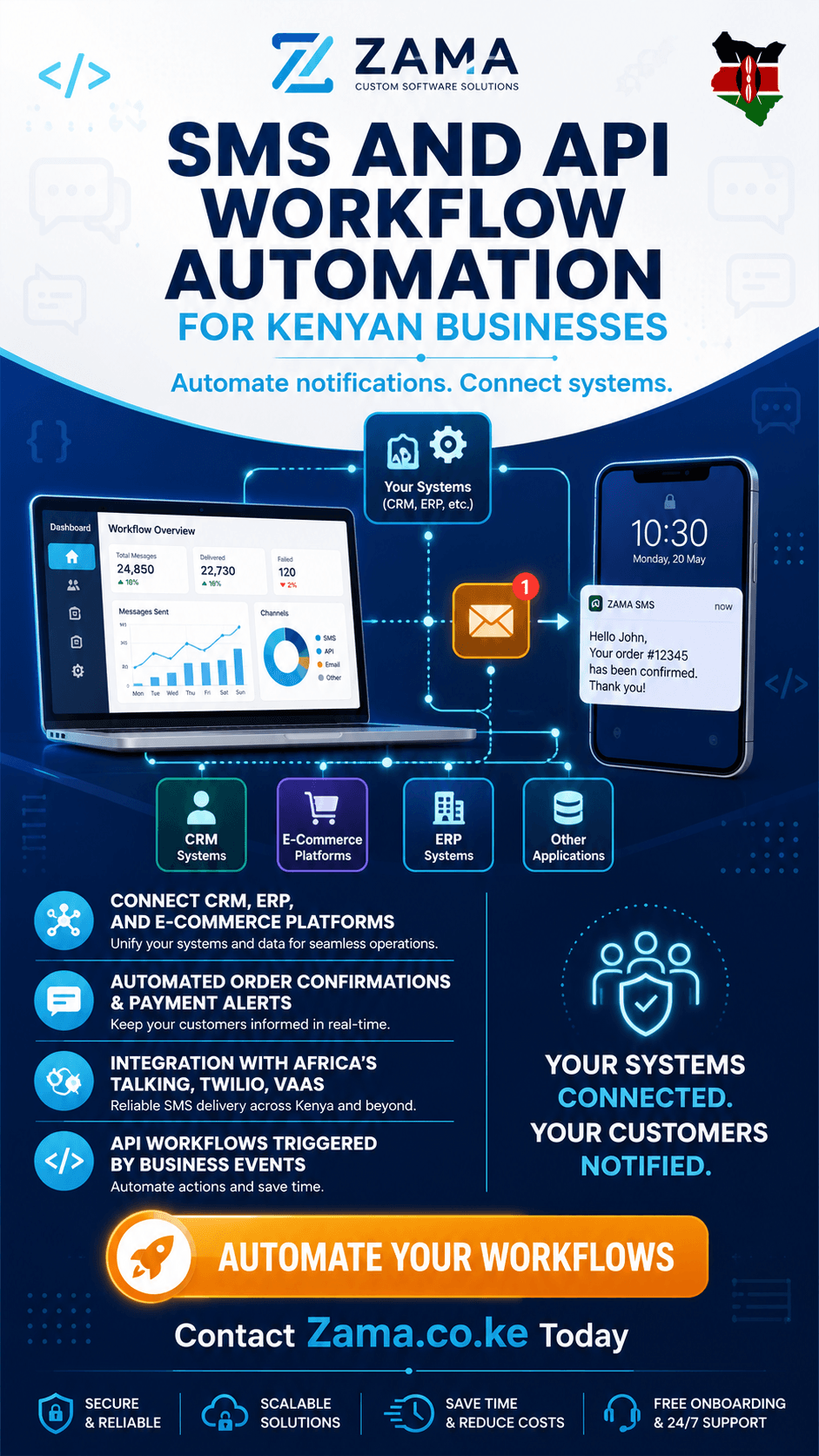
SMS and API workflow automation for Kenyan businesses is a question that every operations manager, business owner, and IT decision-maker must answer in 2026. With over 60 million active mobile subscribers in Kenya and businesses increasingly relying on real-time communication, the ability to automate SMS notifications and integrate systems through APIs has become essential for operational efficiency. At zama.co.ke, we’ve helped numerous businesses across Kenya implement SMS and API workflow automation that reduces manual effort, improves customer communication, and accelerates business processes. This comprehensive guide explores SMS and API workflow automation for Kenyan businesses, from understanding the fundamentals to implementing solutions that deliver measurable results.
Understanding SMS and API Workflow Automation
Before diving into SMS and API workflow automation for Kenyan businesses, it’s essential to understand what this actually means. SMS and API workflow automation involves using Application Programming Interfaces (APIs) to connect different software systems and trigger automated SMS communications based on specific events or conditions within those systems.
SMS (Short Message Service) remains one of the most effective communication channels in Kenya, with open rates exceeding 90% and most messages being read within three minutes. This makes SMS an ideal channel for time-sensitive communications. API (Application Programming Interface) refers to the connection points between software systems that allow them to exchange data and trigger actions. When considering SMS and API workflow automation for Kenyan businesses, the combination of these technologies enables businesses to automate everything from customer notifications to internal alerts without manual intervention.
Businesses can connect their CRM, ERP, e-commerce platforms, or custom applications to SMS gateways through APIs, creating workflows that send automatic messages when specific events occur. For example, when a customer places an order, the system automatically sends an order confirmation SMS. When a payment is received, the system sends a receipt. When inventory falls below a threshold, the system alerts the procurement team. This is the essence of SMS and API workflow automation for Kenyan businesses, where technology handles routine communications, freeing staff for higher-value work.
The SMS Landscape in Kenya
Before implementing SMS and API workflow automation for Kenyan businesses, it’s important to understand the local SMS ecosystem:
Leading SMS Service Providers
Several established SMS gateway providers serve the Kenyan market :
Africa’s Talking: One of the largest providers, offering high-quality SMS delivery with competitive pricing and excellent customer support. They provide both direct business SMS and two-factor authentication services.
Safaricom (VaaS): Offers SMS notification services for businesses registered with their M-PESA Paybill. VaaS guarantees message delivery within seconds to any Safaricom subscriber.
Tecno Mobile: Provides end-to-end SMS services and efficient support for businesses.
Vaspro: Offers global SMS services with routing across international networks.
Konnect Africa: Formerly known as Wireless Connect, provides mobile value-added services including SMS solutions.
M360: A digital communications company with over 13 years of experience, offering advanced SMS, voice, and USSD services.
GMS: A licensed application-to-person (A2P) provider with a direct connection to Safaricom.
M-Kazi: Offers airtime, data bundles, SMS, and USSD services for businesses.
Quick Sms: A cloud-based platform for sending bulk SMS messages.
TwiSMS: A cloud-based SMS provider with a focus on security and reliability.
TextIt: Provides SMS and mobile engagement capabilities with a visual workflow builder.
Twilio: A global communications platform with SMS, WhatsApp, and voice API capabilities.
RapidSMS: An open-source framework for SMS-based applications.
Popular SMS Use Cases
Kenyan businesses use SMS and API workflow automation for numerous purposes :
Order confirmations and shipping alerts
Appointment reminders and booking confirmations
Payment receipts and invoice notifications
Marketing promotions and offers
Two-factor authentication (2FA) and security alerts
Survey and feedback collection
Employee alerts and internal communications
Emergency and outage notifications
Delivery and dispatch updates
Balance and transaction alerts
Key Components of SMS and API Workflow Automation
When evaluating SMS and API workflow automation for Kenyan businesses, several components work together:
SMS Gateway Integration
The SMS gateway is the bridge between your business systems and mobile networks. When implementing SMS and API workflow automation for Kenyan businesses, you must integrate with one or more SMS gateways:
Direct Integration: Connect your systems directly to SMS gateway APIs like Africa’s Talking, Twilio, or Safaricom VaaS. This approach gives you full control over messaging content and timing but requires development effort.
Third-Party SMS Services: Use services like TextIt or M-Kazi that provide user-friendly interfaces for managing SMS campaigns without coding.
Bulk SMS Platforms: Services like Quick Sms and GMS offer bulk messaging capabilities for marketing campaigns and broadcast communications.
SMS APIs for Developers: Providers like Twilio and Africa’s Talking offer developer-friendly APIs with comprehensive documentation and SDKs.
API Integration
APIs enable the flow of data between systems. In SMS and API workflow automation for Kenyan businesses, APIs connect your CRM, ERP, e-commerce platform, or custom application to your SMS gateway. Common integration scenarios include:
CRM Integration: When a lead status changes, trigger a follow-up SMS.
E-commerce Integration: When an order is placed, send order confirmation and shipping updates.
Payment Integration: When a payment is received, send a receipt SMS.
Helpdesk Integration: When a ticket is resolved, send a notification.
Inventory Integration: When stock is low, alert procurement.
Workflow Automation Engines
The automation engine defines the rules that trigger SMS messages. For SMS and API workflow automation for Kenyan businesses, workflow engines can be:
Custom Code: Built into your applications using programming languages like Python, Node.js, or PHP.
Workflow Automation Platforms: Tools like n8n, Make, or Zapier that provide visual workflow builders with SMS action steps.
ERP or CRM Built-in Automation: Many business systems include workflow automation capabilities that can trigger SMS through integration.
SMS Provider Webhooks: Many SMS providers offer webhook-based automation where systems can trigger SMS without custom coding.
Message Templates and Personalization
Effective SMS and API workflow automation for Kenyan businesses requires well-designed message templates:
Dynamic Content: Use placeholders to personalize messages with customer names, order numbers, amounts, and other variables.
Brand Consistency: Maintain a consistent brand voice across all automated SMS communications.
Opt-Out Mechanisms: Include instructions for customers to opt out of future SMS communications.
Character Limits: SMS messages are limited to 160 characters per segment; plan accordingly.
URL Shortening: Use URL shorteners to track clicks in SMS messages.
Implementation Approaches
Using SMS Provider SDKs
Most SMS providers offer SDKs that simplify SMS and API workflow automation for Kenyan businesses. These SDKs handle authentication, API calls, and error handling:
Africa’s Talking Python SDK: Provides simple methods for sending SMS, checking delivery status, and managing subscriptions. The SDK supports both sandbox and production environments.
Twilio API and SDKs: Twilio offers comprehensive SDKs for Python, Node.js, PHP, Java, and other languages, enabling businesses to build sophisticated SMS workflows with detailed analytics.
Safaricom VaaS Integration: For businesses using VaaS, integration requires registration and API access through Safaricom.
Workflow Automation Tools
Several workflow automation tools support SMS and API workflow automation for Kenyan businesses without extensive coding:
n8n: An open-source workflow automation tool with nodes for HTTP requests, enabling integration with any SMS provider’s API. n8n can be self-hosted for data privacy.
Zapier: A popular workflow automation platform with integrations for SMS providers like Twilio and Africa’s Talking.
Make (formerly Integromat): Another workflow automation tool that supports SMS actions through API connections.
Power Automate: Microsoft’s workflow automation platform with integration capabilities.
Custom Application Integration
For businesses with unique workflows, custom application integration offers the most flexibility for SMS and API workflow automation for Kenyan businesses:
API Endpoints: Create custom endpoints in your application that accept trigger events and send SMS messages.
Webhook Consumers: Receive webhooks from other systems and send appropriate SMS notifications.
Scheduled Tasks: Use cron jobs or background workers to send SMS notifications at scheduled times.
Event Listeners: Attach SMS sending logic to specific events in your application.
Security and Compliance
When implementing SMS and API workflow automation for Kenyan businesses, security and compliance are paramount:
Authentication and Authorization
Use API keys or OAuth for secure authentication
Implement role-based access control for SMS actions
Ensure only authorized systems can trigger messages
Rotate API keys and credentials regularly
Data Privacy and DPA Compliance
Obtain consent before sending marketing SMS
Provide opt-out mechanisms in every message
Store customer consent records
Ensure data minimization in message content
Message Content Compliance
Avoid sending SPAM or unsolicited messages
Include sender identification (business name)
Comply with Communications Authority of Kenya regulations
Secure Credential Storage
Use environment variables for credentials, never hardcode
Encrypt sensitive data in transit and at rest
Implement proper logging without exposing sensitive information
Common Use Cases for Kenyan Businesses
E-commerce and Retail
For e-commerce businesses, SMS and API workflow automation for Kenyan businesses can handle:
Order Confirmation: Automatically send order confirmations with order numbers and delivery estimates.
Shipping Updates: Notify customers when orders are dispatched with tracking information.
Payment Receipts: Send payment confirmation and receipt details.
Delivery Notifications: Notify customers when deliveries are scheduled or completed.
Abandoned Cart Reminders: Send SMS reminders for abandoned carts with links to complete purchases.
Healthcare
Healthcare providers can use SMS and API workflow automation for Kenyan businesses for:
Appointment Reminders: Send SMS reminders for upcoming appointments to reduce no-shows.
Test Results Notifications: Notify patients when test results are available.
Medication Reminders: Send reminders for medication schedules.
Bill Payment Reminders: Notify patients about outstanding balances.
Financial Services
Financial institutions can implement SMS and API workflow automation for Kenyan businesses for:
Transaction Alerts: Send real-time notifications for account activity.
Payment Confirmations: Confirm receipt of payments.
Loan Approval Notifications: Notify customers of loan approvals.
Balance Notifications: Send periodic balance updates.
Fraud Alerts: Alert customers about suspicious activities.
Education
Schools and training institutions can automate:
Fee Payment Reminders: Send reminders for upcoming fee payments.
Schedule Notifications: Notify parents about schedule changes or school events.
Result Notifications: Send exam results.
Attendance Alerts: Notify parents of student absences.
The Zama.co.ke Approach
When considering SMS and API workflow automation for Kenyan businesses, zama.co.ke follows a structured approach:
Workflow Discovery
We define your business workflows, identifying which events should trigger SMS notifications and what systems need to be connected.
Provider Selection
We recommend the most appropriate SMS providers based on your volume, use cases, and budget. This may include Africa’s Talking for cost-effective bulk SMS, Twilio for advanced features, or VaaS for Safaricom-specific needs.
Integration Design
We design the integration architecture, selecting the right combination of APIs, webhooks, and workflow automation tools to support your use cases.
Implementation
We build the workflows, configure the integrations, and implement the necessary business logic.
Testing and Validation
We test the workflows in sandbox environments, ensuring message delivery, content accuracy, and trigger reliability.
Post-Launch Support
We monitor the workflows, handle exceptions, and refine the automation as your business evolves.
SMS and API workflow automation for Kenyan businesses is essential for organizations seeking to improve efficiency, enhance customer communication, and scale operations without proportional increases in manual effort.
At zama.co.ke, we’ve helped businesses across Kenya implement SMS and API workflow automation that reduces manual effort, improves customer communication, and accelerates business processes. Our approach ensures you get exactly what your business needs—nothing more, nothing less.
Contact zama.co.ke today and let us help you build an SMS and API workflow automation solution that transforms your business operations.