
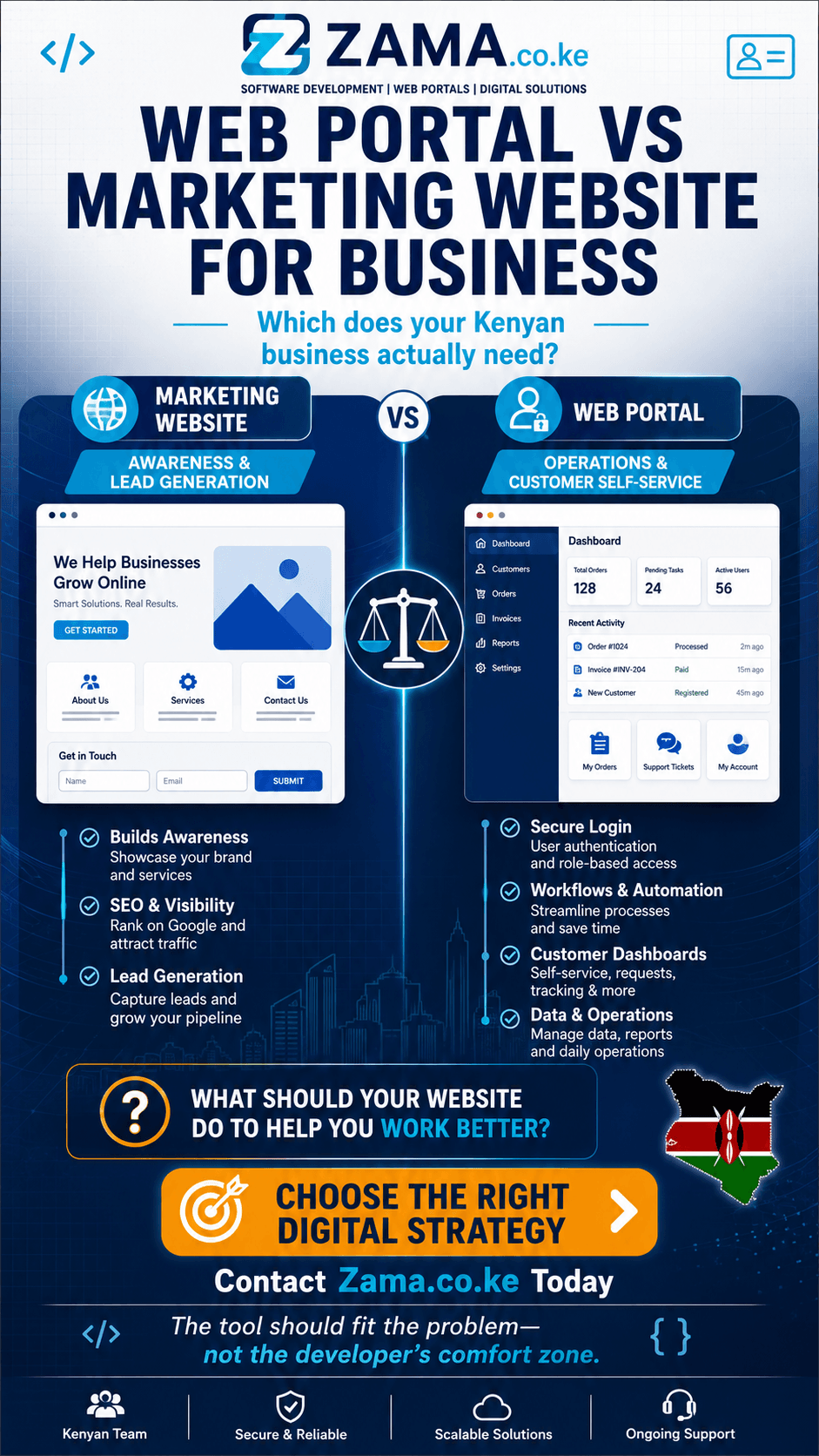
Web portal vs marketing website for business is a question that every entrepreneur, operations manager, and business owner in Kenya must answer in 2026. With the digital landscape evolving rapidly across Nairobi, Mombasa, Kisumu, and other commercial hubs, understanding the distinction between these two digital assets has become critical for success. At zama.co.ke, we’ve helped numerous businesses across Kenya build both marketing websites and web portals, and we understand the unique considerations for the Kenyan market. This comprehensive guide explores web portal vs marketing website for business, providing a practical framework to help you make the right decision for your organization.
Understanding the Core Difference
Before diving into web portal vs marketing website for business, it’s essential to understand what each term actually means. Many businesses refer to everything online as “the website,” but in reality, there are very different types of digital presences, and confusing them leads to poor results .
Websites are primarily designed for driving traffic and building awareness. They are public-facing platforms that anyone can access and are generally designed for a broader audience . A marketing website focuses on awareness and lead generation—its primary goals are to explain services, build credibility, present branding, capture inquiries, and support SEO and content .
Web portals, on the other hand, are designed to limit traffic to specific user groups. Most web portals require users to log in, which allows the site to deliver more specific content and services based on who that user is . A portal is an advanced website designed to support complex functions and allow users to actively interact through private areas, client or supplier logins, online bookings, document uploads, custom forms, and automations .
The fundamental difference lies in scope: a marketing website focuses on the entry point, while an operations platform supports the full lifecycle of customer engagement . When evaluating web portal vs marketing website for business, you’re really asking whether you need a digital brochure or a digital operating system.
What a Marketing Website Is Designed to Do
A marketing website is like a digital brochure: it presents your company, tells who you are, what you do, and how to contact you . When considering web portal vs marketing website for business, understand that marketing websites are typically linear—visitors arrive, read, and either contact the business or leave .
Benefits of a Marketing Website
Search Engine Dominance: When someone searches for “best plumbers in Nairobi” or “wholesale textiles Kenya,” they aren’t looking in the App Store. They are using Google. If you don’t have a fast, SEO-optimized website, you are invisible .
Low Friction Entry: A website allows a customer to find you, see your prices, and click a WhatsApp button or an M-Pesa prompt without having to download anything. In a country where data costs are high, nobody wants to waste MBs downloading an app they might only use once .
The Trust Factor: A professional website acts as your digital headquarters. It proves to the Kenya Revenue Authority, your suppliers, and your high-end clients that you are a legitimate, organized entity .
Low Barrier to Entry: For many early-stage businesses, a marketing website is enough. It works well for local businesses, professionals, consultants, and small commercial firms that don’t need to manage complex interactions with users .
When Marketing Websites Start to Break Down
As businesses grow, marketing websites often struggle because they are not designed to handle what comes next . Common limitations include:
Contact forms that don’t qualify leads
No internal visibility into inquiries
Manual handoff to operations
No support for staff workflows
No customer access or updates
Disconnected tools and systems
At this stage, the website becomes a bottleneck instead of a support system . This is often when businesses begin evaluating web portal vs marketing website for business more seriously.
What a Web Portal Is Designed to Do
A web portal goes beyond marketing. It is designed to support how the business actually runs . When considering web portal vs marketing website for business, understand that portals are ideal for companies that need to digitize internal processes, manage databases, sell courses, deliver personalized experiences, or offer recurring services .
Benefits of a Web Portal
Structured Lead Intake and Qualification: Portals go beyond simply capturing inquiries—they manage the entire process from initial contact through to service delivery .
Role-Based Access for Staff and Admins: Different users see different information based on their role. A portal allows for granular control over what each user can access .
Customer Portals or Dashboards: Customers can log in, view their history, track orders, download documents, and manage their interactions without contacting support .
Internal Workflows and Automation: Portals automate repetitive tasks, reducing manual data entry and improving efficiency .
Centralized Data and Reporting: Instead of fragmented data across multiple systems, portals consolidate information into a single source of truth .
Use Cases for Web Portals
Client and User Management Portals: These systems rely on accounts and permissions rather than public access. They feature personal dashboards with relevant data and actions, role-based access to services, documents, or tools, and continuous interaction rather than one-time visits .
Internal Business and Operational Portals: Many companies use portals to support internal workflows and team coordination, managing internal processes and approvals, supporting collaboration between departments, and centralizing tools, data, and documentation .
Data-Driven and Service Platforms: These include service-oriented and data-driven platforms with integrations to external systems or APIs, structured processing of complex data flows, and scalability without constant re-design .
The Key Difference: Lifecycle vs Entry Point
When evaluating web portal vs marketing website for business, the fundamental difference is scope :
A marketing website focuses on the entry point—attracting visitors and generating leads
A web portal supports the full lifecycle—from initial inquiry through service delivery and ongoing relationship management
For service businesses, this lifecycle often includes sales, scheduling, delivery, updates, and follow-up—not just the first contact . Marketing attracts attention, but operations platforms sustain growth .
When Businesses Need to Make the Shift
Businesses typically need to move beyond a marketing website when :
Lead volume increases
Services vary in complexity
Multiple team members are involved
Customers expect transparency
Internal coordination becomes difficult
When considering web portal vs marketing website for business, ask yourself: “What should your website do to help you work better?”
If your answer is: “We want to be found on Google, show who we are, and get contacted,” then a well-built marketing website is the right choice.
But if you say: “We want customers to register, download documents, book services independently, or receive personalized notifications,” then you’re in portal territory .
The Kenyan Context
For Kenyan businesses, several local factors should influence your decision when evaluating web portal vs marketing website for business:
Mobile-First Reality
Over 90% of internet users in Kenya access the web via mobile phone. A fast, mobile-optimized website is non-negotiable—it’s your basecamp . But that doesn’t automatically mean you need a portal. The average Kenyan smartphone user has between 20-30 apps installed but regularly uses less than 10. Your portal must fight for a spot in that precious inner circle .
M-Pesa Integration
Whether you choose a marketing website or a web portal, integration with M-Pesa is essential. Payment collection, automated reconciliation, and payment-triggered workflows should be built into your digital strategy.
Regulatory Compliance
Both marketing websites and portals must comply with KRA eTIMS requirements and the Data Protection Act. However, portals often require more sophisticated compliance features due to the sensitive data they handle.
Infrastructure Considerations
In areas with spotty internet coverage, a well-built web portal can allow users to browse cached data, ensuring the experience never stops . This is particularly relevant for businesses serving customers outside major urban centers.
Cost Implications
Generally, a portal is more expensive than a marketing website because it requires more time, planning, and technical development . However, if it saves you time or automates processes, the ROI is real . A portal is an investment, not just an expense .
The Zama.co.ke Approach
When clients ask web portal vs marketing website for business, zama.co.ke follows a structured evaluation:
Strategic Discovery
We define what the business actually needs to achieve digitally. Is the primary goal visibility and lead generation, or is it operational efficiency and customer self-service?
Platform Recommendation
Based on the discovery, we recommend either a marketing website for awareness-driven needs or a web portal for operational requirements. We’re not locked into one approach—we choose what fits the problem.
Implementation
For marketing websites, we build fast, SEO-optimized sites that convert visitors into customers. For web portals, we architect scalable systems with proper user management, security, and integration capabilities.
Post-Launch Support
Regardless of the platform, we remain available to maintain, refine, and extend the solution after launch.
Why Templates Are Usually Marketing-Only
Most templates and page builders are designed for marketing websites. They assume :
A simple form is sufficient
Operations happen elsewhere
Staff don’t need access
Customers don’t need visibility
This works until volume, complexity, or expectations increase . Portals require a different development approach because they are business-critical systems that require reliable uptime, strong security, scalable infrastructure, and ongoing monitoring .
How Operations Platforms Improve Efficiency
By consolidating workflows into a single system, operations platforms :
Reduce manual data entry
Improve visibility across teams
Standardize processes
Improve customer communication
Support scalability without chaos
The website becomes an active part of the business, not just a marketing layer .
Web portal vs marketing website for business is not an either/or question—both have their place. The right choice depends on your business stage, goals, and customer needs.
A marketing website is the right choice when:
Your primary need is visibility and lead generation
You need to establish credibility quickly
Your sales process is relatively simple
Your budget is limited
A web portal is the right choice when:
You need to support customer self-service
You have complex internal workflows
Multiple team members are involved in service delivery
Customers expect transparency and real-time updates
You need to automate recurring processes
At zama.co.ke, we help Kenyan businesses make this decision based on their specific needs, not generic recommendations.
Don’t let the complexity of web portal vs marketing website for business hold you back. Whether you need a marketing website to build awareness or a web portal to streamline operations, we have the expertise to guide you through every step.
Contact zama.co.ke today and let us help you build the right digital solution for your business.