
Payroll and HR Software in Kenya gives businesses one central platform for managing employees from recruitment and onboarding through attendance, payroll, performance management and eventual exit.
A modern Payroll Software Kenya solution should do much more than calculate salaries.
It should connect employee records, biometric attendance, shifts, overtime, leave, payroll calculations, statutory deductions, payslips, loans, advances, performance, documents and management reports.Managing employees, attendance, leave, salaries, statutory deductions, contracts and performance using spreadsheets and paperwork becomes increasingly difficult as an organization grows.
For Kenyan SMEs, large companies, hospitals, manufacturers, transport companies, schools, NGOs and organizations operating several branches, a centralized HR and payroll platform can significantly improve visibility and reduce repetitive administrative work.
Zama Systems Ltd provides customizable HR and payroll solutions designed for businesses that need a practical way to manage their workforce.
Call or WhatsApp: 0725345345
 What Is Payroll and HR Software?
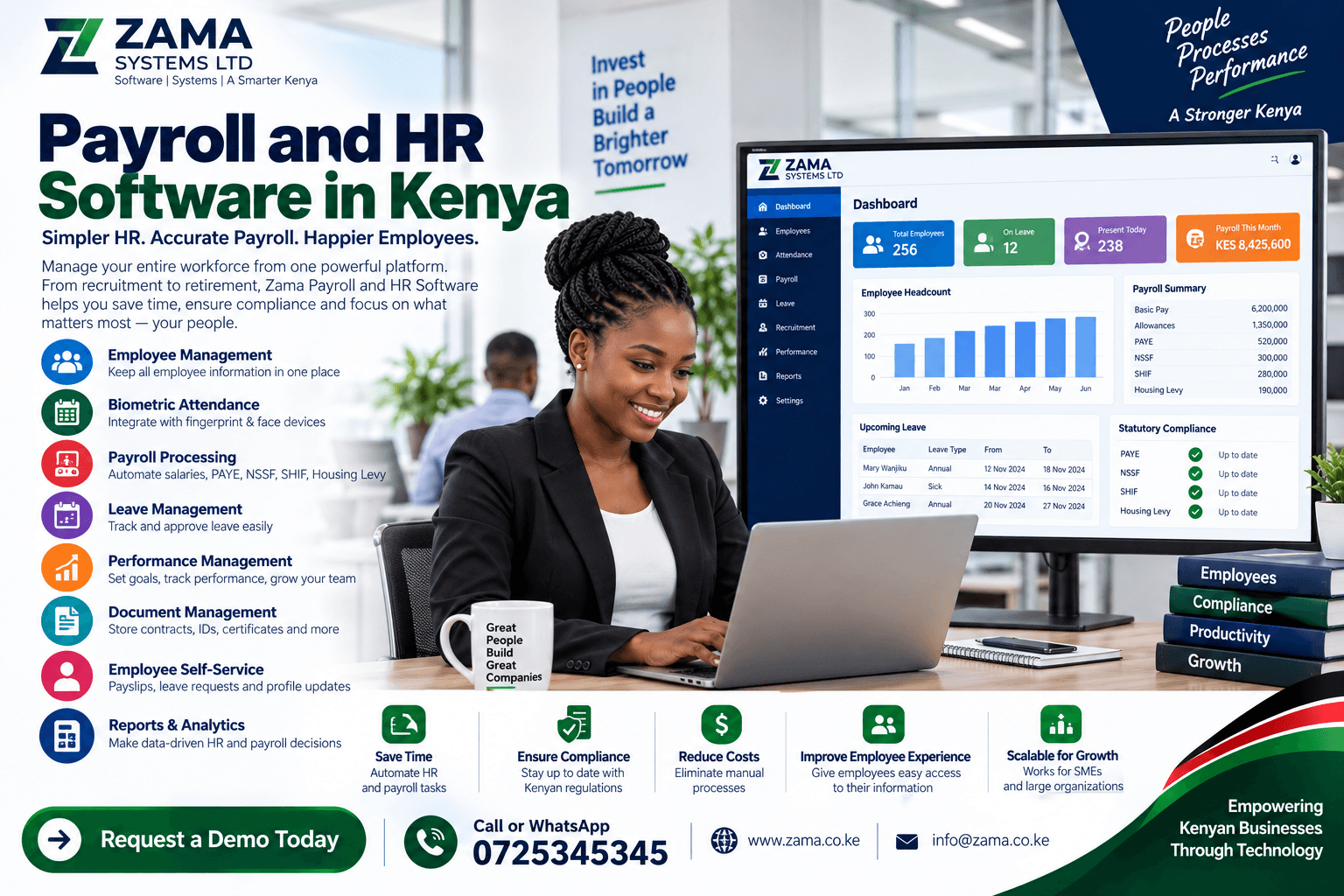
Payroll and HR software is a digital system used to manage employee information and automate human resource and salary-processing activities.
Instead of maintaining separate spreadsheets for attendance, leave, employee records and salaries, the information can be managed from one system.
A complete solution can include:
- Employee records
- Recruitment
- Employee onboarding
- Departments
- Branches
- Contracts
- Biometric attendance
- Clock-in and clock-out records
- Shifts
- Overtime
- Leave management
- Payroll
- Earnings
- Deductions
- PAYE
- NSSF
- SHIF
- Affordable Housing Levy
- Loans
- Salary advances
- Payslips
- Performance management
- Employee documents
- Disciplinary records
- Training
- Employee self-service
- HR reports
- Payroll reports
The objective is to provide management with one reliable source of employee information.
Why Businesses Need Payroll Software in Kenya
Processing payroll manually can become complex even with a relatively small workforce.
HR and accounts teams must calculate:
- Basic salary
- Allowances
- Overtime
- Bonuses
- Commissions
- Benefits
- PAYE
- Statutory deductions
- Employee loans
- Salary advances
- Absence deductions
- Other company deductions
- Net salary
Mistakes can affect employees, management reporting and statutory compliance.
A Payroll Software Kenya solution automates repeat calculations and keeps structured payroll records.
The system can calculate an employee’s earnings and deductions based on configured payroll rules and generate payroll reports for review before salaries are finalized.
Kenya Payroll Software and Statutory Payroll Management
One of the most important requirements for payroll software used in Kenya is the ability to handle local statutory payroll requirements.
A Kenyan payroll system should support relevant payroll items including:
- PAYE
- NSSF
- Social Health Insurance Fund contributions
- Affordable Housing Levy
- Pension contributions where applicable
- Other approved deductions
Employers also need payroll records that support statutory reporting.
Kenya Revenue Authority requires employers to account for PAYE, while current payroll calculations also need to consider statutory items such as SHIF and the Affordable Housing Levy.
A good payroll platform should therefore be configurable so that statutory changes can be updated without rebuilding the entire system.
Automatic PAYE Calculation
The payroll system should automatically calculate PAYE based on the configured tax rules.
This reduces manual calculations and helps the payroll administrator identify:
- Gross salary
- Taxable pay
- Applicable deductions
- Reliefs where configured
- PAYE
- Net salary
Payroll reports can then be reviewed before final posting.
NSSF Management
The system should support employee and employer NSSF contributions according to the applicable payroll configuration.
NSSF rates can change, so businesses should use software capable of being updated when statutory rules change.
SHIF Payroll Management
Modern Kenyan payroll software should include Social Health Insurance Fund processing.
Employee contributions can be calculated within payroll according to the applicable statutory requirements.
Affordable Housing Levy
The payroll platform should also support Affordable Housing Levy calculations for employees and employers according to current Kenyan requirements.
This is one reason Kenyan businesses should avoid relying entirely on outdated spreadsheets and payroll templates.
Why Businesses Need Payroll and HR Software in Kenya
Human resource management goes far beyond payroll.
HR Software in Kenya should give management a complete view of every employee throughout their relationship with the organization.
An employee profile can contain:
- Employee number
- Full name
- National ID
- KRA PIN
- NSSF number
- SHA details
- Phone number
- Physical address
- Department
- Branch
- Job title
- Employment type
- Date hired
- Contract information
- Supervisor
- Salary information
- Bank details
- Emergency contact
- Documents
- Qualifications
- Attendance
- Leave
- Performance history
Instead of searching through physical personnel files, authorized HR personnel can retrieve information from one platform.
Payroll and HR Software in Kenya Employee Management Software Kenya
Every employee should have a central digital profile.
This creates an organized employee database rather than maintaining disconnected files.
Employees can be categorized by:
- Branch
- Department
- Position
- Employment type
- Supervisor
- Cost centre
- Project
- Location
This makes HR reports much easier to prepare.
For example, management can request:
How many employees work in Nairobi?
How many casual workers are active?
Which employee contracts expire next month?
How many staff work in each department?
Which employees were absent today?
The system can answer these questions using existing employee data.
Biometric Attendance and Payroll Software Kenya
Attendance is one of the most valuable integrations between HR and payroll.
Businesses frequently use biometric devices to record when employees report to and leave work.
The system can connect employee attendance with payroll calculations.
Attendance records can include:
- Clock-in time
- Clock-out time
- Breaks
- Multiple IN/OUT records
- Late arrival
- Early departure
- Absence
- Overtime
- Shift
- Department
- Branch
This creates a clearer attendance record than relying on paper registers.
Fingerprint Attendance System Integration
A company may use fingerprint attendance terminals at office entrances, factories, warehouses or branches.
When an employee clocks in, the transaction can be associated with their employee profile.
The HR team can then review:
- Employees present
- Employees absent
- Late employees
- Employees who left early
- Hours worked
- Overtime
- Attendance by department
- Attendance by branch
Where supported, approved attendance information can then feed into payroll.
Multiple Clock-In and Clock-Out Records
Some workplaces require employees to leave and return several times during one working day.
A good attendance system should not simply record the first IN and last OUT transaction.
It should be able to retain the raw biometric transactions and process multiple attendance events.
For example:
08:00 – IN
12:30 – OUT
13:30 – IN
17:30 – OUT
This provides a more accurate representation of the employee’s working day.
Shift Management Software
Businesses operating shifts require payroll and HR software capable of understanding different working schedules.
Examples include:
- Day shift
- Night shift
- Rotating shift
- Weekend shift
- Custom shift
This is especially important for:
- Manufacturing companies
- Hospitals
- Hotels
- Security companies
- Transport companies
- Warehouses
- Restaurants
- Factories
Shift rules can determine expected reporting and departure times.
Overnight Shift Management
Night shifts are more complicated because an employee may clock in on one date and clock out the following morning.
For example:
Monday 7:00 PM – IN
Tuesday 7:00 AM – OUT
A well-designed attendance system should correctly associate these transactions with the relevant shift instead of treating them as unrelated days.
Overtime Management
Businesses need clear records when employees work beyond standard hours.
An HR and payroll platform can calculate or capture:
- Normal overtime
- Weekend overtime
- Holiday overtime
- Approved overtime
- Unapproved overtime
Organizations can configure their own approval processes.
For example:
Employee overtime → Supervisor approval → HR confirmation → Payroll.
This creates better accountability than entering overtime manually at the end of every month.
Leave Management Software Kenya
Managing employee leave using paper forms can create unnecessary delays.
An HR system can digitize the entire leave process.
Employees can request leave, supervisors can approve it and HR can monitor leave balances.
Possible leave categories include:
- Annual leave
- Sick leave
- Maternity leave
- Paternity leave
- Compassionate leave
- Study leave
- Unpaid leave
- Other company-defined leave
The system can show:
- Leave entitlement
- Leave taken
- Leave pending
- Leave balance
- Leave history
Employee Self-Service Portal
An Employee Self-Service portal reduces the amount of routine work handled directly by HR.
Employees may be allowed to:
- View payslips
- Download payslips
- Request leave
- Check leave balances
- Update selected personal information
- View attendance
- Request salary advances
- View company notices
- Access HR documents
Managers can have additional approval capabilities.
This gives employees controlled access without giving them access to confidential HR administration.
Payroll Payslip Management
After payroll is approved, the system should generate employee payslips.
A payslip can contain:
- Employee name
- Employee number
- Pay period
- Basic salary
- Allowances
- Overtime
- Gross salary
- PAYE
- NSSF
- SHIF
- Housing Levy
- Other deductions
- Loans
- Net salary
Payslips can be printed, downloaded or distributed electronically according to the organization’s process.
Employee Loans and Salary Advances
Many organizations provide employee loans or salary advances.
Managing them manually makes it difficult to track outstanding balances.
The system can record:
- Employee
- Loan type
- Principal amount
- Installment
- Start date
- Balance
- Payroll deductions
- Loan status
Each payroll cycle automatically reduces the balance when configured.
Payroll for Casual Workers in Kenya
Businesses such as factories, construction companies, farms, restaurants and distribution companies often employ casual workers.
Their payroll may differ from permanent employees.
The system can support employee categories such as:
- Permanent
- Contract
- Casual
- Temporary
- Intern
- Consultant
Casual workers may be paid:
- Daily
- Weekly
- Fortnightly
- Monthly
A configurable payroll platform allows different employee groups to follow different payroll rules.
Contract Employee Management
HR teams should be able to track employment contracts.
The system can record:
- Contract start date
- Contract end date
- Probation period
- Employment category
- Renewal status
- Supporting documents
Alerts can notify HR when contracts approach expiry.
This reduces the risk of relying entirely on memory or spreadsheets.
Recruitment Management
A complete HR platform can begin before someone becomes an employee.
Recruitment functionality can manage:
- Job vacancies
- Applicants
- CV records
- Interviews
- Interview scores
- Shortlisting
- Offers
- Hiring status
Once an applicant is hired, their information can move into the employee database.
Employee Onboarding
Onboarding can be managed through a checklist.
For example:
- ID received
- KRA PIN received
- NSSF details received
- Bank details received
- Contract signed
- Employee number created
- Department assigned
- Supervisor assigned
- Biometric registration completed
- System account created
This helps HR ensure new employees complete all required steps.
Performance Management Software
Modern HR systems should help management understand employee performance rather than only process salaries.
Performance management can include:
- Goals
- KPIs
- Reviews
- Supervisor ratings
- Employee comments
- Performance periods
- Improvement plans
Management can view performance by employee, department or branch.
Daily Employee Performance Tracking
Some businesses require performance to be captured more frequently than annual appraisals.
The system can allow daily, weekly or monthly performance records.
This is particularly useful for employees involved in:
- Sales
- Delivery
- Transport
- Customer service
- Operations
- Production
- Field work
Management can compare attendance and productivity information when reviewing performance.
Employee Efficiency Management
An efficiency module can help organizations compare planned work with actual employee output.
Depending on the business, this may include:
- Tasks completed
- Hours worked
- Output
- Targets
- Attendance
- Productivity indicators
This information can be useful for management reports without replacing proper human performance reviews.
Department Management
Organizations should be able to structure employees according to departments.
For example:
- HR
- Finance
- Sales
- Operations
- IT
- Administration
- Procurement
- Customer Service
Departmental reporting can then show:
- Employee headcount
- Payroll cost
- Attendance
- Leave
- Performance
Multi-Branch HR Software Kenya
Businesses with multiple branches require centralized HR management.
Head office should be able to see organization-wide information while branch managers only see information relevant to their locations.
For example:
Nairobi Branch
Mombasa Branch
Kisumu Branch
Nakuru Branch
Eldoret Branch
Management can compare:
- Employee numbers
- Attendance
- Payroll
- Overtime
- Leave
- Staff costs
- Performance
across different branches.
Payroll Cost by Department and Branch
Payroll should not only produce payslips.
It should help management understand labour costs.
Reports can show payroll cost by:
- Branch
- Department
- Employee
- Job category
- Project
- Cost centre
This helps management understand where salary expenses are concentrated.
HR Document Management
Employee files contain important documents.
The system can store references or digital copies of:
- Contracts
- ID documents
- Certificates
- CVs
- Warning letters
- Promotion letters
- Training certificates
- Appraisal documents
- Other HR records
Access should be restricted according to user permissions.
Disciplinary Management
HR teams may need structured records for disciplinary processes.
The system can record:
- Incident
- Date
- Employee
- Description
- Supporting documents
- Action taken
- Follow-up
- Status
Keeping these records centrally helps maintain an organized employee history.
Employee Training Management
Companies invest in staff development.
Training records can include:
- Course
- Employee
- Provider
- Date
- Cost
- Certificate
- Expiry
- Skills acquired
Management can identify employees who require refresher training or certification renewal.
HR Reports in Kenya
A powerful HR system should provide reports rather than simply store information.
Useful HR reports include:
- Employee list
- Headcount
- Department report
- Branch report
- Contract expiry report
- Leave report
- Attendance report
- Late arrival report
- Absenteeism report
- Overtime report
- Employee turnover report
- Performance report
- Training report
- Disciplinary report
Reports should be filterable by period, employee, department and branch where appropriate.
Payroll Reports
Useful payroll reports can include:
- Payroll summary
- Employee payroll report
- Earnings report
- Deductions report
- PAYE report
- NSSF report
- SHIF report
- Housing Levy report
- Loan report
- Bank payment report
- Department payroll report
- Branch payroll report
- Payroll cost report
These give finance and HR teams the information required to review payroll before payment.
Bank Salary Payment Reports
Payroll systems can generate salary payment schedules for approved payrolls.
Depending on the bank and integration requirements, the software can prepare reports or export files used during salary processing.
This reduces the need to re-enter salary figures manually.
HR and Accounting Integration
Payroll has a direct impact on accounting.
Examples include:
Salary expense → General Ledger
PAYE payable → Liability
NSSF payable → Liability
SHIF payable → Liability
Housing Levy payable → Liability
Employee loan repayment → Receivable reduction
A payroll platform can integrate with an accounting or ERP system so approved payroll entries are reflected correctly in financial records.
Cloud-Based HR Software
A cloud based HR software solution allows authorized users to access the platform securely through a browser.
This can be useful for businesses with employees in different branches.
Advantages can include:
- Centralized data
- Remote access
- Multi-branch support
- Easier software updates
- Central reporting
- Controlled user permissions
Organizations may also choose on-premise deployment depending on security, infrastructure and operational requirements.
Role-Based User Permissions
HR and payroll information is sensitive.
Not every system user should see employee salaries or private HR information.
A good system should support permissions.
For example:
HR Manager
Can access employee records and HR functions.
Payroll Officer
Can process payroll.
Branch Manager
Can view employees within their branch.
Supervisor
Can approve attendance and leave.
Employee
Can access only their own authorized information.
An audit trail can record important system actions.
Payroll Data Security
Organizations should protect employee information appropriately.
Useful controls include:
- Secure login
- Password policies
- User permissions
- Audit logs
- Database backups
- Controlled payroll approvals
- Data encryption where applicable
- Restricted employee access
Sensitive payroll records should not be freely accessible to every employee.
Payroll Approval Workflow
Payroll should have a controlled process.
For example:
Payroll Officer prepares payroll → HR reviews → Finance checks → Authorized manager approves → Salary payment processed.
This reduces the risk of unauthorized changes.
Payroll Software for SMEs in Kenya
Small and medium businesses can benefit from payroll automation even with relatively few employees.
A growing SME may initially require:
- Employee register
- Attendance
- Leave
- Payroll
- Payslips
- Statutory calculations
As the business grows it can add:
- Recruitment
- Performance
- Employee self-service
- Multiple branches
- Accounting integration
- Biometric attendance
The platform should scale with the business.
Payroll Software for Large Companies
Organizations with hundreds or thousands of employees need stronger controls.
Important features include:
- Multi-company support
- Multi-branch support
- Bulk payroll processing
- Department structures
- Multiple payroll groups
- Shift management
- Overtime
- Employee self-service
- Approval workflows
- Advanced reporting
- Integration APIs
Performance becomes especially important when processing large numbers of employees.
HR and Payroll Software for Manufacturing Companies
Manufacturers commonly need:
- Biometric attendance
- Shift management
- Night shifts
- Multiple clock-ins
- Overtime
- Departments
- Casual workers
- Contract workers
- Payroll
- Employee performance
This makes integration between attendance, HR and payroll particularly valuable.
Payroll Software for Hospitals
Hospitals operate complex staffing schedules.
A hospital HR platform can manage:
- Doctors
- Nurses
- Clinical officers
- Laboratory staff
- Pharmacy employees
- Administration
- Support staff
The system can support shifts, leave, attendance, contracts, payroll and overtime.
Payroll Software for Transport and Logistics Companies
Transport businesses can manage:
- Drivers
- Operations staff
- Mechanics
- Office staff
- Attendance
- Allowances
- Payroll
- Performance
Where an organization also operates a fleet management platform, employee and driver information can be connected with wider business operations.
HR Software for Schools and Universities
Educational institutions can manage:
- Teachers
- Lecturers
- Administrative employees
- Support staff
- Contracts
- Attendance
- Leave
- Payroll
- Employee records
Multiple campuses can be managed through a centralized HR database.
Payroll Software Cost in Kenya
The price of Payroll and HR Software in Kenya varies depending on requirements.
Factors affecting cost can include:
- Number of employees
- Number of branches
- Number of users
- Payroll only or HR + payroll
- Biometric attendance
- Employee self-service
- Performance management
- Mobile access
- Integrations
- Training
- Data migration
- Cloud or on-premise deployment
- Support requirements
Businesses should therefore evaluate total requirements instead of comparing systems only using the headline licence price.
How to Choose the Best Payroll Software in Kenya
When evaluating payroll systems, businesses should ask:
Does it support Kenyan payroll requirements?
The platform should be configurable for current statutory payroll requirements.
Does it integrate HR and payroll?
Employee data should not need to be entered repeatedly into separate systems.
Can it manage biometric attendance?
This is important for businesses that want attendance and payroll to work together.
Can it manage multiple shifts?
Factories, hospitals and other 24-hour operations require flexible shift management.
Can it process casual and contract employees?
Different employment types should be supported.
Can it manage multiple branches?
Growing businesses should avoid systems that become difficult to use when new locations are added.
Does it have employee self-service?
Self-service can reduce routine HR administration.
Does it provide audit logs?
Management should be able to track important changes.
Can it integrate with accounting?
Payroll information eventually affects company accounts.
Is local support available?
Implementation, training and support can be just as important as software features.
Benefits of Payroll and HR Software
A properly implemented HR and payroll platform can provide several benefits.
Faster Payroll Processing
Repeat calculations can be automated.
Better Accuracy
Structured rules reduce reliance on manual spreadsheet formulas.
Better Employee Records
HR information is centralized.
Improved Attendance Visibility
Management can monitor attendance across employees and branches.
Better Leave Management
Employees and HR can access current leave information.
Better Payroll Reporting
Management can understand labour expenses.
Better Accountability
Approval workflows and audit logs record important actions.
Easier Growth
The platform can support more employees, departments and branches as the organization expands.
Why Zama Payroll and HR Software?
Zama Systems Ltd develops business software around the operational requirements of organizations.
A Zama HR and payroll implementation can be configured around the organization’s workflow rather than forcing every business to follow exactly the same process.
Depending on requirements, the solution can include:
- Employee management
- Payroll
- PAYE management
- NSSF
- SHIF
- Affordable Housing Levy
- Biometric attendance
- Multiple IN/OUT attendance
- Shifts
- Overnight shifts
- Overtime
- Leave
- Recruitment
- Contracts
- Casual workers
- Performance
- Employee efficiency
- Employee self-service
- Loans and advances
- Multi-branch management
- Payroll reports
- HR reports
- Accounting integration
- API integrations
- Audit trails
The objective is to create one connected platform for managing people, attendance, payroll and performance.
Request a Payroll and HR Software Demo in Kenya
If your business still manages payroll, attendance, leave and employee information using multiple spreadsheets and manual records, moving to a centralized platform can make HR administration much easier to control.
Zama Systems Ltd can assess your current payroll and HR workflow and configure a system based on your requirements.
Request a demo today.
Call or WhatsApp: 0725345345
Website: zama.co.ke
Frequently Asked Questions About Payroll and HR Software in Kenya
What is the best Payroll Software in Kenya?
The best payroll software depends on the organization’s employee numbers, payroll complexity, branches, attendance requirements, HR processes and integrations. Businesses should evaluate Kenyan statutory support, payroll accuracy, HR capabilities, reporting, security and local support.
What is Payroll Software Kenya?
Payroll Software Kenya is a payroll system configured to manage employee salaries, earnings, deductions, statutory deductions, payslips and payroll reports for organizations operating in Kenya.
Can payroll software calculate PAYE?
Yes. A properly configured payroll system can automatically calculate PAYE based on the applicable tax configuration.
Does payroll software support NSSF?
Yes. Kenyan payroll software should support applicable NSSF contribution calculations and reports.
Does payroll software support SHIF?
Modern Kenyan payroll software should support SHIF calculations according to the applicable payroll requirements.
Can the software calculate Housing Levy?
Yes. A payroll system can be configured to calculate employee and employer Affordable Housing Levy obligations according to applicable rules.
Can HR software integrate with biometric attendance?
Yes. Attendance terminals can be integrated where supported so employee clocking information can be processed within HR and attendance workflows.
Can the system manage night shifts?
Yes. A properly designed attendance platform can support overnight shifts that begin on one date and end on the next.
Can payroll software handle overtime?
Yes. Overtime records can be captured, approved and included in payroll according to company policy.
Can it manage casual employees?
Yes. The platform can support permanent, contract, casual, temporary and other employee categories.
Can employees download their payslips?
Yes. Employee self-service functionality can allow employees to access authorized payroll documents such as payslips.
Can Payroll Software work across several branches?
Yes. Multi-branch HR and payroll software can maintain centralized records while providing location-based permissions and reporting.
Can the software integrate with accounting?
Yes. Payroll information can be integrated with accounting or ERP systems where appropriate APIs or integration mechanisms are available.
Can Zama customize the system?
Zama Systems Ltd can configure or develop functionality according to an organization’s operational requirements and agreed implementation scope.
Choosing the right Payroll and HR Software in Kenya is no longer simply about calculating salaries.
Organizations need a system capable of connecting employee records, biometric attendance, shifts, leave, overtime, payroll, statutory deductions, contracts, performance and management reports.
A strong Payroll Software Kenya platform should give management a clear answer to important questions:
Who is at work?
Who is absent?
How many hours did employees work?
Which employees are on leave?
How much is payroll costing each department?
Which contracts are expiring?
What statutory deductions are due?
How are employees performing?
When HR, payroll and attendance operate within one connected system, businesses gain better visibility into their workforce.
For businesses, manufacturers, hospitals, schools, logistics companies, NGOs and growing organizations looking for HR Software in Kenya and reliable payroll management, Zama Systems Ltd provides customizable solutions designed around real business requirements.
Call or WhatsApp Zama Systems Ltd on 0725345345 to request a Payroll and HR Software demo.