
Table of Contents
ToggleEstate Management Software Development Nairobi: The Complete 2026 SEO Guide to Smart Property Management Systems
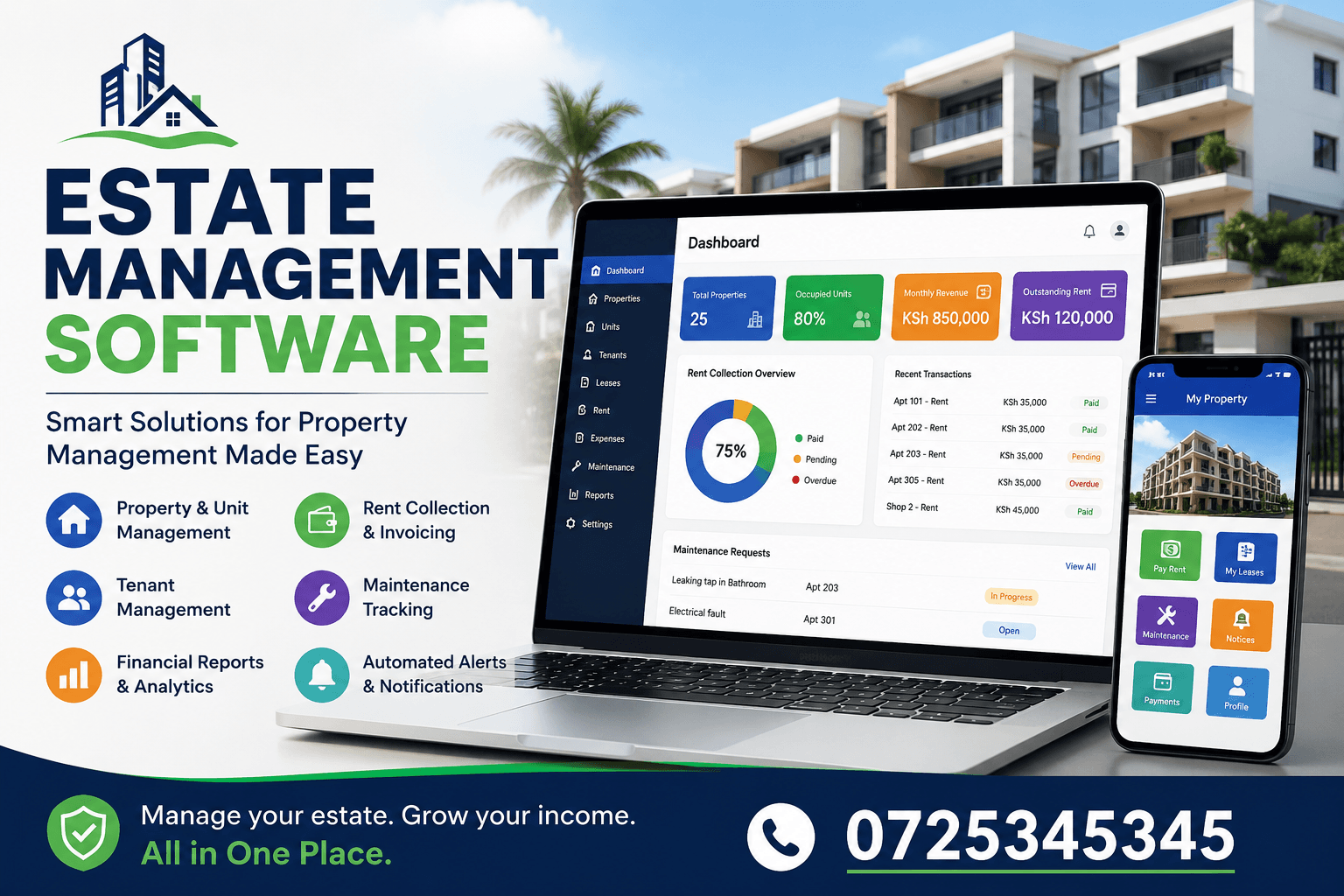
The growth of Nairobi as a leading real estate hub in East Africa has significantly increased the demand for digital transformation in property operations, making Estate Management Software Development Nairobi a critical driver of efficiency and scalability in modern housing management.
At its core, Estate Management Software Development Nairobi refers to the design and implementation of digital platforms that help landlords, property managers, and developers automate key estate operations such as rent collection, tenant management, maintenance tracking, and financial reporting within the Nairobi property market.
As urban expansion continues and rental demand rises, Estate Management Software Development Nairobi has become essential for handling large property portfolios, reducing manual inefficiencies, and ensuring real-time communication between tenants and estate administrators.
Modern real estate stakeholders are increasingly adopting Estate Management Software Development Nairobi solutions that integrate mobile payments, automated invoicing, security management, and cloud-based dashboards to improve transparency and operational control.
One of the key advantages of Estate Management Software Development Nairobi is its ability to streamline financial workflows, reduce rent arrears, improve tenant satisfaction, and provide data-driven insights that help property owners make smarter investment decisions.
In conclusion, Estate Management Software Development Nairobi is no longer just a technological upgrade but a fundamental requirement for competitive and sustainable property management in Kenya’s rapidly evolving real estate sector.
What is Estate Management Software Development Nairobi?
Estate Management Software Development Nairobi is the process of designing, building, and implementing digital systems that help landlords, property managers, real estate companies, and housing associations in Nairobi efficiently manage properties, tenants, finances, and day-to-day estate operations.
It involves creating custom software platforms that replace traditional manual methods—such as paper records, spreadsheets, and informal communication—with automated, centralized, and data-driven systems.
In a fast-growing city like Nairobi, where rental housing, gated communities, and commercial properties are expanding rapidly, this type of software development has become a key part of modern real estate operations.
Understanding It in the Nairobi Context
Nairobi’s real estate market is unique because it is:
- Highly urbanized and fast-growing
- Driven by rental housing demand
- Dominated by multi-unit apartments and estates
- Strongly supported by mobile money systems like M-Pesa
This creates a need for systems that can handle:
- High tenant volumes
- Frequent rent transactions
- Continuous maintenance requests
- Multi-property management
Estate Management Software Development Nairobi addresses these challenges by building localized digital solutions tailored to the Kenyan property ecosystem.
Core Meaning
At its core, Estate Management Software Development Nairobi refers to:
The creation of web and mobile-based systems that automate and simplify all processes involved in managing residential and commercial properties in Nairobi.
These systems act as a central digital hub for all estate activities, including tenants, payments, maintenance, communication, and reporting.
What the Software Actually Does
A properly developed estate management system in Nairobi typically handles:
Tenant Management
- Stores tenant details
- Tracks lease agreements
- Maintains occupancy records
Rent Collection
- Generates invoices
- Tracks payments
- Sends reminders
- Issues digital receipts
Maintenance Management
- Logs repair requests
- Assigns technicians
- Tracks job progress
Financial Management
- Records income and expenses
- Generates reports
- Tracks arrears
Communication
- Sends SMS/email alerts
- Issues announcements
- Provides tenant updates
Security (Advanced Systems)
- Visitor logs
- Gate pass systems
- Access control integration
Why It Matters in Nairobi
Estate Management Software Development Nairobi is important because:
1. Rapid Urban Growth
Nairobi continues to expand with new estates, apartments, and commercial buildings.
2. High Rental Demand
Most residents are tenants, creating constant management workload.
3. Multi-Property Ownership
Many landlords own several properties across different areas.
4. Digital Payment Adoption
M-Pesa makes automated rent collection essential.
5. Need for Transparency
Tenants and owners demand clear financial accountability.
Key Technologies Used
Developers in Nairobi use modern tools such as:
- React / Angular (frontend interfaces)
- Node.js / Laravel / Django (backend systems)
- MySQL / PostgreSQL (databases)
- AWS / Google Cloud (hosting)
- M-Pesa Daraja API (payments)
- JWT authentication (security systems)
Benefits of Estate Management Software Development Nairobi
- Automates rent collection and tracking
- Reduces human errors in property management
- Improves financial transparency
- Enhances tenant satisfaction
- Supports multi-property scalability
- Enables remote property management
Who Uses It?
- Individual landlords
- Property management companies
- Real estate developers
- Housing associations
- Student hostel operators
Estate Management Software Development Nairobi is the process of building modern digital platforms that transform how properties are managed in Kenya’s capital city. It replaces outdated manual systems with automated, efficient, and scalable software solutions that handle tenants, rent, maintenance, communication, and financial reporting.
As Nairobi continues to grow, this type of software development is becoming essential for landlords and real estate businesses that want to stay competitive, improve efficiency, and deliver better tenant experiences.
Ultimately, it represents the shift toward a fully digital and smart real estate management ecosystem in Nairobi.
Why Nairobi Needs Estate Management Software Development
Nairobi is one of the fastest-growing real estate markets in East Africa. Several factors are driving demand for property management software development:
1. Rapid Urbanization and Population Growth
Nairobi’s population continues to grow rapidly, leading to:
- Increased demand for rental housing
- Expansion of apartment complexes
- Growth of informal and formal settlements
- Higher tenant turnover rates
This creates complex management needs that manual systems cannot handle efficiently.
2. Expansion of Rental Housing Market
Most Nairobi residents live in rented properties. This results in:
- Continuous rent collection cycles
- Frequent tenant changes
- High administrative workload
Estate management software simplifies these processes through automation.
3. Multi-Property Ownership
Many investors now own:
- Apartments in different estates
- Commercial buildings
- Student hostels
- Mixed-use developments
Managing all of these manually is extremely difficult without centralized software.
4. M-Pesa and Digital Payments Ecosystem
Kenya’s strong mobile money system makes digital property management essential.
Estate management software integrates with:
- M-Pesa
- Bank payments
- Digital wallets
This enables instant rent collection and automated reconciliation.
5. Demand for Transparency and Accountability
Tenants and investors now expect:
- Digital receipts
- Clear billing systems
- Transparent service charges
- Real-time financial reporting
Software ensures trust and accountability.
Core Features of Estate Management Software Development Nairobi
A modern estate management system typically includes the following modules:
1. Tenant Management System
This module handles all tenant data, including:
- Personal details
- National ID or passport information
- Lease agreements
- Payment history
- Unit assignment
It ensures all tenant information is centralized and easily accessible.
2. Rent Collection and Payment Tracking
One of the most critical features includes:
- Automated invoicing
- Rent due reminders
- Payment tracking
- Arrears management
- Receipt generation
This improves cash flow and reduces late payments.
3. M-Pesa Integration System
Since most payments in Nairobi are mobile-based, integration includes:
- STK push payments
- Payment verification
- Automatic reconciliation
- Transaction tracking
This eliminates manual verification errors.
4. Maintenance Management System
This module handles property maintenance:
- Tenant complaint submission
- Technician assignment
- Work order tracking
- Completion reporting
- Maintenance cost tracking
This ensures faster issue resolution.
5. Financial Management Dashboard
Provides real-time financial insights:
- Income reports
- Expense tracking
- Profit/loss analysis
- Cash flow monitoring
- Arrears summaries
This supports better decision-making.
6. Communication System
Replaces WhatsApp and manual messaging with:
- SMS notifications
- Email alerts
- In-app messaging
- Automated announcements
This ensures structured communication.
7. Lease Management System
Handles contract lifecycle:
- Lease creation
- Renewal reminders
- Expiry tracking
- Digital document storage
8. Security and Access Control (Advanced Systems)
Some systems include:
- Visitor management
- Gate pass systems
- CCTV integration
- Access logs
9. Utility Billing System
Manages shared estate costs such as:
- Water bills
- Electricity usage
- Garbage collection
- Service charges
Architecture of Estate Management Software Systems
Most systems follow a 3-layer architecture:
1. Frontend Layer
User interfaces for:
- Tenants
- Landlords
- Administrators
Built using React, Angular, or Flutter.
2. Backend Layer
Handles:
- Business logic
- Payment processing
- Data validation
- API integration
Built using Node.js, Django, Laravel, or Spring Boot.
3. Database Layer
Stores:
- Tenant data
- Financial records
- Lease agreements
- Maintenance logs
Common databases include MySQL, PostgreSQL, or MongoDB.
Technologies Used in Nairobi Development
Developers in Nairobi use modern stacks such as:
- React.js / Vue.js (frontend)
- Node.js / Laravel / Django (backend)
- PostgreSQL / MySQL (database)
- AWS / Google Cloud (hosting)
- M-Pesa Daraja API (payments)
- JWT authentication (security)
Estate Management Software Development Process
Step 1: Requirement Analysis
Understanding:
- Client needs
- Property size
- Required features
Step 2: System Design
Includes:
- UI/UX design
- Database architecture
- System workflows
Step 3: Development
Building:
- Frontend interfaces
- Backend systems
- APIs and integrations
Step 4: Testing
Includes:
- Functional testing
- Security testing
- Performance testing
Step 5: Deployment
Hosting the system on cloud infrastructure.
Step 6: Maintenance and Updates
Continuous improvement and feature updates.
Benefits of Estate Management Software Development Nairobi
1. Increased Efficiency
Automates repetitive tasks such as rent tracking and reporting.
2. Improved Financial Control
Provides real-time income and expense visibility.
3. Reduced Human Error
Eliminates manual mistakes in record keeping.
4. Better Tenant Experience
Faster communication and digital payments improve satisfaction.
5. Scalability
Supports growth from small buildings to large portfolios.
6. Remote Access
Property owners can manage estates from anywhere.
Challenges in Development
1. High Development Costs
Custom systems require investment.
2. Integration Complexity
M-Pesa and banking APIs require technical expertise.
3. Data Security Risks
Requires strong encryption and access control.
4. User Adoption Resistance
Some landlords prefer traditional methods.
5. Maintenance Requirements
Systems require continuous updates and support.
Cost of Estate Management Software Development Nairobi
Typical costs include:
- Basic system: $3,000 – $10,000
- Mid-level system: $10,000 – $25,000
- Enterprise system: $25,000 – $100,000+
Costs depend on features, scalability, and integrations.
Future of Estate Management Software Development Nairobi
The future of Estate Management Software Development Nairobi is moving toward a fully digital, intelligent, and highly automated real estate ecosystem. As Nairobi continues to expand as a major African business and property hub, the way estates are managed is shifting from manual administration to data-driven, cloud-based, and AI-powered systems.
In the coming years, estate management software will no longer just handle rent collection and tenant records—it will become the central operating system for entire property ecosystems in Nairobi.
1. Artificial Intelligence (AI) Will Drive Smart Property Management
AI will be one of the most transformative forces in Estate Management Software Development Nairobi.
Future systems will be able to:
- Predict maintenance failures before they happen
- Forecast rental income trends
- Detect tenant payment risks early
- Recommend optimal rent pricing based on market data
- Automate customer support through chatbots
For example, instead of waiting for a tenant to report a plumbing issue, AI systems may detect unusual water usage patterns and alert management before damage occurs.
This shifts property management from reactive to predictive and preventive operations.
2. Full Integration with IoT (Smart Estates)
The Internet of Things (IoT) will play a major role in the future of estate systems in Nairobi.
Estate management platforms will connect with:
- Smart electricity meters
- Water usage sensors
- CCTV surveillance systems
- Smart gates and biometric access
- Parking management sensors
This will allow real-time monitoring of estate operations.
For instance:
- Water consumption can be tracked per unit automatically
- Security alerts can be triggered instantly
- Parking availability can be updated in real time
This creates fully connected smart estates across Nairobi.
3. Mobile-First Super Apps for Property Management
The future of Estate Management Software Development Nairobi is heavily mobile-driven.
Instead of separate systems for payments, maintenance, and communication, everything will be combined into a single super app.
Tenants and landlords will be able to:
- Pay rent instantly via mobile
- Submit maintenance requests
- Receive automated receipts
- Communicate with management
- Access digital gate passes
- Participate in estate voting
This eliminates the need for fragmented tools like WhatsApp, Excel sheets, and paper notices.
4. Blockchain for Transparency and Trust
Blockchain technology will improve transparency in Nairobi’s real estate sector.
Future systems may use blockchain to:
- Record rent payments permanently
- Store lease agreements securely
- Prevent tampering with financial records
- Enable transparent estate governance voting
This will be especially useful in large estates where disputes over funds or service charges are common.
Blockchain ensures that every transaction is secure, traceable, and tamper-proof.
5. Real-Time Financial Ecosystems
Estate management software will move from periodic reporting to real-time financial systems.
This means:
- Rent payments update instantly
- Expenses are recorded in real time
- Arrears are visible immediately
- Financial dashboards update continuously
Property owners in Nairobi will no longer wait for monthly reports—they will monitor their estates live, like a bank dashboard.
6. Advanced Security and Digital Identity Systems
Security will become a central feature in future estate systems.
Expect innovations such as:
- Facial recognition entry systems
- Digital resident ID verification
- AI-powered CCTV monitoring
- Automated visitor pre-approval
- Real-time incident reporting
Estate software will act as the identity and access control system for entire communities.
7. Cloud-Native and Highly Scalable Platforms
Future Estate Management Software Development Nairobi will be fully cloud-based.
Benefits include:
- Remote access from anywhere
- Unlimited scalability for large property portfolios
- Automatic updates and backups
- Strong disaster recovery systems
- Lower infrastructure costs
This is especially important for real estate companies managing properties across multiple Nairobi estates.
8. Data-Driven Decision Making with Advanced Analytics
Future systems will provide deep insights such as:
- Occupancy trends by location
- Tenant payment behavior patterns
- Maintenance cost forecasting
- Profitability per building or unit
- Seasonal rental demand analysis
This allows landlords and developers to make smarter investment decisions and maximize returns.
9. AI-Powered Tenant Experience
Tenant experience will become more personalized and automated.
Future systems will:
- Send personalized rent reminders
- Offer automated chatbot support
- Predict tenant needs
- Provide instant maintenance feedback loops
This will significantly improve tenant satisfaction and reduce turnover rates.
10. Integration with Smart City Infrastructure
As Nairobi moves toward becoming a smart city, estate systems will integrate with city infrastructure such as:
- Water supply systems
- Electricity grids
- Waste management services
- Emergency response networks
This will create a fully connected urban ecosystem where estates communicate directly with city services.
The future of Estate Management Software Development Nairobi is defined by intelligence, automation, connectivity, and real-time data processing. The industry is rapidly evolving beyond basic property management tools into advanced digital ecosystems powered by AI, IoT, blockchain, and cloud computing.
These innovations will transform estates in Nairobi into smart, efficient, and self-managed communities where operations are automated, decisions are data-driven, and tenants enjoy seamless digital experiences.
Ultimately, businesses that adopt these future technologies early will gain a strong competitive advantage, while those that delay digital transformation risk being left behind in an increasingly smart and competitive real estate market.
Conclusion
Estate Management Software Development Nairobi is redefining how property owners and estate managers operate in a rapidly digitizing real estate environment, especially within fast-growing urban centers like Nairobi.
The future of Estate Management Software Development Nairobi will continue to be shaped by automation, artificial intelligence, and mobile-first innovations that streamline property operations and improve tenant experiences across residential and commercial estates.
Businesses investing in Estate Management Software Development Nairobi benefit from improved efficiency, reduced operational costs, and enhanced transparency in rent collection, maintenance tracking, and financial reporting systems.
One of the key strengths of Estate Management Software Development Nairobi is its ability to centralize estate operations into a single digital platform, allowing landlords and property managers to make faster, data-driven decisions.
With automation, Estate Management Software Development Nairobi reduces human error, eliminates delays in communication, and ensures seamless integration of payment systems such as mobile money and online banking solutions.
As adoption grows in Nairobi, Estate Management Software Development Nairobi is transforming traditional property management into a fully digital ecosystem that supports scalability, accountability, and improved tenant satisfaction.
Ultimately, Estate Management Software Development Nairobi empowers real estate stakeholders to modernize their operations, increase profitability, and remain competitive in an increasingly technology-driven property market.
For developers and property managers, Estate Management Software Development Nairobi remains a cornerstone of innovation, ensuring that the future of property management in Kenya is smarter, more efficient, and fully digitized.