
Estate Management System Development Nairobi: The Complete 2026 SEO Guide
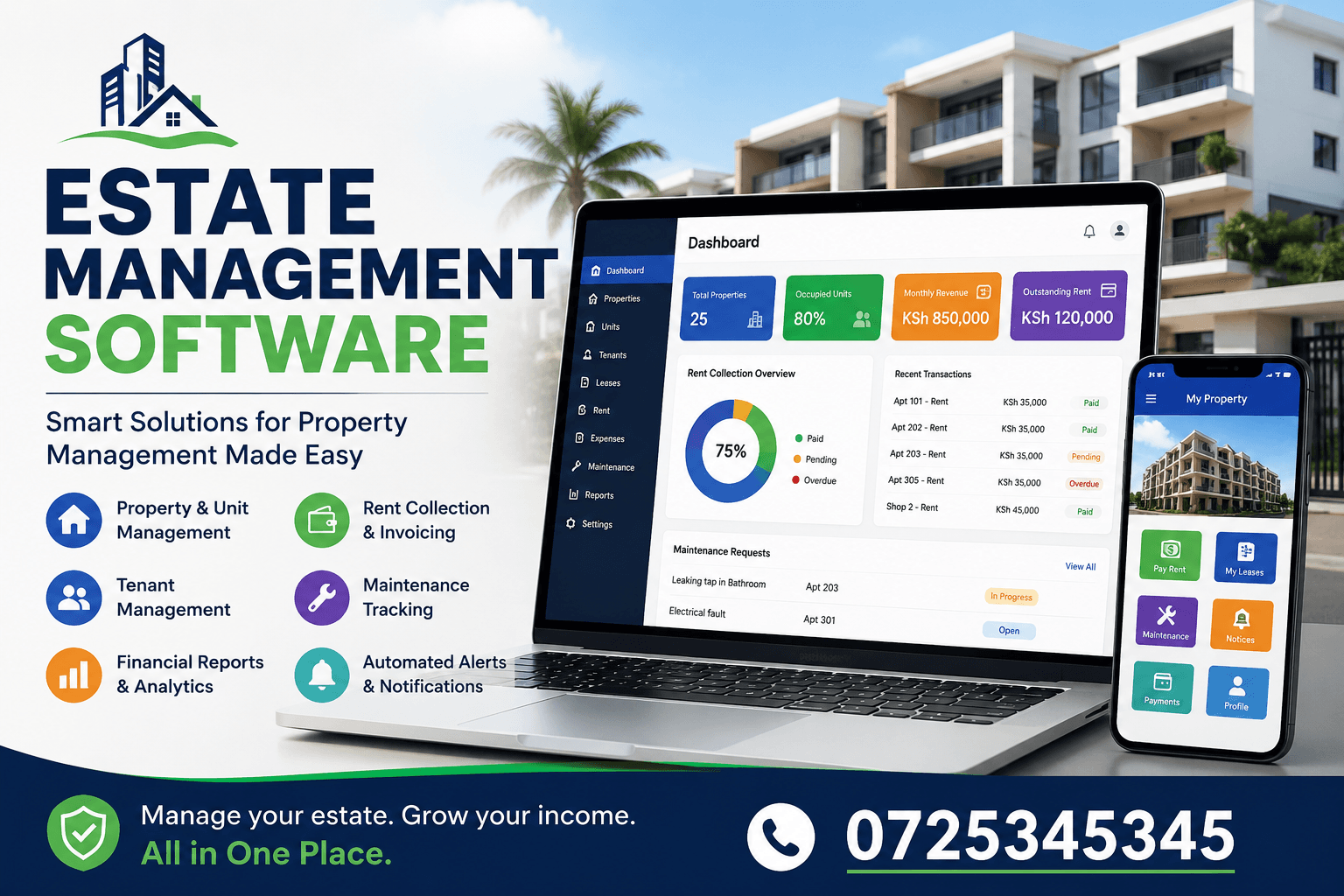
Nairobi has become one of Africa’s fastest-growing real estate and technology hubs. With rapid urbanization, increased foreign investment, and a booming rental market, the demand for efficient property management solutions has never been higher. As a result, Estate Management System Development Nairobi has emerged as a critical area of digital transformation for landlords, property managers, developers, housing associations, and real estate tech companies.
Traditional property management methods—manual rent collection, paper records, Excel spreadsheets, and WhatsApp-based communication—are no longer sufficient for managing modern estates in Nairobi’s fast-paced environment. Developers and businesses are now investing in custom estate management systems to automate operations, improve transparency, and scale property portfolios efficiently.
This detailed 4000-word guide explores everything about estate management system development in Nairobi, including features, benefits, architecture, development process, challenges, technologies, cost considerations, and future trends.
What is Estate Management System Development Nairobi?
Estate Management System Development Nairobi refers to the process of designing, building, and implementing digital software systems that help landlords, property managers, real estate companies, and housing associations manage properties more efficiently within Nairobi and its rapidly growing urban environment.
In simple terms, it is the creation of custom software solutions that replace manual property management methods—such as spreadsheets, paper records, and WhatsApp communication—with a centralized digital platform that automates and organizes all estate operations.
Understanding the Estate Management System Development Nairobi
in the Nairobi Context
Nairobi has one of the fastest-growing real estate markets in East Africa. Areas like Westlands, Kilimani, Ruaka, Roysambu, Syokimau, South B, and along Thika Road have experienced rapid expansion of:
- Apartment complexes
- Gated communities
- Student hostels
- Commercial buildings
- Mixed-use developments
With this growth, managing properties manually has become increasingly difficult. Estate Management System Development Nairobi is therefore focused on building software that solves these local challenges using technology tailored to Kenya’s real estate and payment ecosystem (especially M-Pesa integration).
Core Definition
Estate Management System Development Nairobi is the engineering and customization of digital platforms that manage all aspects of property operations, including:
- Tenant registration and records
- Rent collection and arrears tracking
- Maintenance and repair requests
- Lease and contract management
- Financial reporting and accounting
- Communication between tenants and landlords
- Utility billing and service charge management
It combines software development, database systems, cloud computing, and mobile integration to create a complete property management solution.
What the System Actually Does
A properly developed estate management system in Nairobi acts as a central control hub for all property activities.
Estate Management System Development Nairobi allows landlords and managers to:
- Track all tenants in real time
- Collect rent digitally through M-Pesa or bank transfer
- Automatically issue receipts
- Monitor outstanding balances
- Manage maintenance requests efficiently
- Generate financial reports instantly
- Communicate with tenants at scale
Instead of juggling multiple tools, everything is handled in one system.
Why Nairobi Specifically Needs Estate Management System Development Nairobi
Estate Management System Development Nairobi is shaped by unique local factors:
1. High Urban Population Growth
Nairobi continues to experience population growth, leading to increased demand for rental housing and complex estate structures.
2. Heavy Reliance on Rental Housing
A large percentage of Nairobi residents rent homes, increasing tenant turnover and management workload.
3. Multi-Property Ownership
Many landlords own multiple properties across different estates, requiring centralized control.
4. Digital Payment Ecosystem
Kenya’s strong mobile money system (especially M-Pesa) makes digital rent collection essential.
5. Rising Tenant Expectations
Tenants now expect:
- Fast communication
- Digital receipts
- Transparent billing
- Quick maintenance response
Key Components of Estate Management System Development Nairobi
1. Tenant Management Module
Stores and organizes tenant data such as:
- Identity details
- Lease agreements
- Unit allocation
- Payment history
2. Rent Collection System
Automates:
- Monthly invoicing
- Payment tracking
- Arrears alerts
- Receipt generation
3. Maintenance Management
Handles repair workflows:
- Request submission
- Technician assignment
- Progress tracking
- Completion reports
4. Financial Management System
Provides real-time insights:
- Income tracking
- Expense monitoring
- Profit analysis
- Cash flow reports
5. Communication System
Enables structured messaging:
- SMS alerts
- Email notifications
- Announcements
- Tenant updates
6. Lease Management
Tracks:
- Contract duration
- Renewal dates
- Legal documentation
- Compliance records
7. Security Integration (Advanced Systems)
May include:
- Visitor logs
- Gate passes
- CCTV integration
- Access control systems
How Estate Management System Development Works
The development process typically involves:
1. Requirement Gathering
Understanding what the property owner or company needs.
2. System Design
Creating architecture, database structure, and user interface layouts.
3. Software Development
Coding the frontend, backend, and APIs.
4. Integration
Connecting systems like:
- M-Pesa payment API
- Email/SMS services
- Accounting tools
5. Testing
Ensuring the system is secure, fast, and reliable.
6. Deployment
Launching the system on cloud servers for real-world use.
Benefits of Estate Management System Development Nairobi
1. Improved Efficiency
Automates repetitive tasks like rent tracking and reporting.
2. Better Financial Control
Provides real-time visibility of income and expenses.
3. Reduced Human Error
Eliminates mistakes from manual record-keeping.
4. Faster Rent Collection
Digital payments improve cash flow consistency.
5. Enhanced Tenant Satisfaction
Quick communication and maintenance response improve experience.
6. Scalability
Supports growth from small apartments to large property portfolios.
Who Uses These Systems in Nairobi?
- Individual landlords
- Property management companies
- Real estate developers
- Housing associations
- Student hostel operators
- Commercial property managers
Estate Management System Development Nairobi is the process of building smart digital platforms that modernize how properties are managed in Kenya’s capital city. It replaces outdated manual systems with automated, centralized, and data-driven solutions that handle tenants, rent, maintenance, communication, and financial reporting.
In a fast-growing real estate market like Nairobi, these systems are not just helpful—they are essential. They enable landlords and property managers to operate more efficiently, reduce costs, improve tenant satisfaction, and scale their property portfolios with ease.
Ultimately, Estate Management System Development Nairobi represents the future of real estate management in Kenya—smart, automated, and fully digital.
Why Nairobi Needs Estate Management System Development Nairobi More Than Ever
Nairobi is undergoing one of the fastest and most intense real estate transformations in Africa. What was once a relatively simple rental market has evolved into a highly complex, fast-moving urban property ecosystem. High-rise apartments, gated communities, student hostels, commercial buildings, and mixed-use developments are now spread across areas like Westlands, Kilimani, Ruaka, Syokimau, Roysambu, and the broader Thika Road corridor.
This rapid expansion has created a major challenge: traditional property management methods can no longer keep up. Manual rent tracking, paper records, WhatsApp communication, and spreadsheet-based accounting are increasingly inefficient, error-prone, and unsustainable.
This is why Nairobi urgently needs Estate Management System Development Nairobi more than ever—not as a luxury, but as a core operational necessity.
1. Explosive Growth of Real Estate Development
Nairobi’s skyline and suburban landscape are changing rapidly due to massive investment in residential and commercial property development.
Key trends include:
- Rapid construction of high-rise apartments
- Expansion of gated communities
- Growth of student housing near universities
- Increased mixed-use developments (residential + commercial)
This means a single landlord or developer may now manage:
- Dozens or even hundreds of tenants
- Multiple buildings across different locations
- Complex service charge structures
Manual systems cannot handle this scale effectively. Estate management systems provide centralized control, making large-scale property management possible.
2. Overwhelming Complexity of Tenant Management
In Nairobi’s rental market, tenant turnover is high due to:
- Job mobility
- Student migration
- Changing affordability levels
- Urban lifestyle shifts
This creates constant administrative tasks such as:
- New tenant onboarding
- Lease renewals
- Deposit tracking
- Exit inspections
- Record updates
Without automation, these processes become disorganized.
Estate management systems solve this by:
- Digitizing tenant records
- Tracking lease timelines automatically
- Storing documents securely
- Maintaining full tenant history
This ensures accuracy and eliminates confusion.
3. Inefficiency of Manual Rent Collection Systems
One of the biggest challenges in Nairobi’s property market is rent collection.
Traditional methods rely on:
- Cash payments
- Manual receipts
- Bank slips
- WhatsApp confirmations
- Excel spreadsheets
These methods lead to:
- Missing or duplicated records
- Delayed rent tracking
- Disputes between tenants and landlords
- Difficulty tracking arrears
Estate management systems solve this by automating:
- Rent invoicing
- Payment tracking
- Digital receipts
- Arrears notifications
- M-Pesa integration for instant payments
This significantly improves cash flow stability.
4. Heavy Reliance on M-Pesa and Digital Payments
Kenya is one of the world’s most advanced mobile money economies. In Nairobi, most rent payments are made through M-Pesa.
However, manual reconciliation of mobile payments creates problems such as:
- Fake payment screenshots
- Delayed verification
- Human error in tracking transactions
- Difficulty matching payments to tenants
Estate management systems integrate directly with M-Pesa to:
- Automatically confirm payments
- Match transactions to tenant accounts
- Generate instant receipts
- Update balances in real time
This eliminates fraud risks and improves financial transparency.
5. Poor Financial Transparency in Manual Systems
Many property owners struggle to accurately understand their financial position because manual systems do not provide real-time insights.
Common issues include:
- Unclear income tracking
- Hidden arrears
- Unrecorded expenses
- Lack of proper financial reports
Estate management systems solve this by providing:
- Real-time financial dashboards
- Automated income and expense tracking
- Profit and loss reports
- Arrears summaries
- Cash flow analysis
This enables better decision-making and investment planning.
6. Increasing Maintenance Demands in Urban Properties
As buildings age and density increases, maintenance issues become more frequent:
- Plumbing leaks
- Electrical faults
- Lift breakdowns
- Waste management problems
In manual systems, maintenance requests are often:
- Lost
- Delayed
- Poorly tracked
Estate management systems introduce structured workflows:
- Tenants submit digital requests
- Tasks are assigned to technicians
- Progress is tracked in real time
- Completion is recorded
This improves response time and tenant satisfaction.
7. Communication Breakdowns Between Stakeholders
In many Nairobi estates, communication is fragmented across:
- WhatsApp groups
- SMS messages
- Phone calls
- Physical notices
This leads to:
- Missed announcements
- Confusion among tenants
- Lack of documentation
Estate management systems centralize communication through:
- Automated notifications
- Announcement boards
- Email and SMS alerts
- In-app messaging
This ensures that everyone receives the right information at the right time.
8. Difficulty Managing Multiple Properties
Many landlords in Nairobi no longer own just one property—they manage multiple units across different locations.
Challenges include:
- Tracking rent across estates
- Managing different tenants simultaneously
- Coordinating maintenance teams
- Handling multiple financial records
Estate management systems solve this by offering:
- Multi-property dashboards
- Centralized tenant databases
- Unified financial reporting
- Cross-property analytics
This makes scaling property portfolios manageable.
9. Rising Tenant Expectations in a Digital Era
Modern tenants in Nairobi expect more than just housing—they expect a digital experience.
They now demand:
- Online rent payment options
- Instant receipts
- Fast maintenance response
- Transparent billing
- Clear communication channels
Landlords who fail to meet these expectations risk losing tenants to more tech-enabled competitors.
Estate management systems help meet these expectations by providing a professional, digital-first rental experience.
10. Security and Fraud Risks in Manual Systems
Manual systems are vulnerable to:
- Lost records
- Fraudulent payments
- Unauthorized changes
- Data manipulation
Estate management systems improve security through:
- Encrypted data storage
- Role-based access control
- Audit trails of all activities
- Secure payment integrations
This protects both landlords and tenants.
11. Need for Data-Driven Decision Making
Real estate is no longer just about collecting rent—it is about optimizing performance.
Estate management systems provide valuable insights such as:
- Occupancy rates
- Payment behavior patterns
- Maintenance cost trends
- Property profitability comparisons
This data helps landlords:
- Adjust rental prices
- Identify high-performing properties
- Reduce operational inefficiencies
- Plan future investments
12. Remote Property Management Requirements
Many Nairobi property owners live:
- Outside Nairobi
- In other counties
- Abroad (diaspora investors)
They cannot physically manage properties daily.
Estate management systems allow:
- Remote access to dashboards
- Real-time property monitoring
- Online financial reporting
- Digital communication with managers
This makes global property management possible.
Nairobi needs Estate Management System Development Nairobi more than ever because its real estate sector has become too large, too fast-moving, and too complex for manual management methods. From tenant management and rent collection to maintenance coordination, financial reporting, and communication, every aspect of property management now demands automation and digital precision.
In a city experiencing rapid urban growth and increasing competition in the rental market, estate management systems are no longer optional tools—they are essential infrastructure for modern property operations.
Ultimately, they enable landlords, developers, and property managers in Nairobi to operate more efficiently, reduce costs, improve tenant satisfaction, and scale their investments sustainably in a highly competitive environment.
Core Features of Estate Management Systems Nairobi
A modern estate management system developed in Nairobi typically includes the following features:
1. Tenant Management Module
This module stores all tenant data:
- Full name
- ID/passport details
- Contact information
- Lease agreements
- Payment history
- Unit allocation
Estate Management System Development Nairobi eliminates manual record-keeping.
2. Rent Collection System
Estate Management System Development Nairobi Automates rent processes:
- Monthly invoicing
- Payment tracking
- Arrears monitoring
- Automated reminders
- Receipt generation
Integration with M-Pesa is critical in Nairobi.
3. Maintenance Management System
Estate Management System Development Nairobi Handles all repair and maintenance requests:
- Tenant request submission
- Technician assignment
- Progress tracking
- Completion verification
- Cost tracking
This ensures faster response times.
4. Financial Management Dashboard
Estate Management System Development Nairobi Provides real-time financial insights:
- Income reports
- Expense tracking
- Profit analysis
- Cash flow statements
- Arrears reports
This improves decision-making.
5. Communication System
Estate Management System Development Nairobi Replaces WhatsApp and manual messaging:
- SMS alerts
- Email notifications
- In-app messaging
- Announcements
Ensures structured communication.
6. Lease Management System
Estate Management System Development Nairobi Tracks lease lifecycle:
- Start and end dates
- Renewal reminders
- Digital contracts
- Compliance tracking
Prevents missed renewals.
7. Security Integration
Advanced systems include:
- Visitor logs
- Gate passes
- CCTV integration
- Access control
Enhances estate safety.
8. Utility Billing System
Manages shared costs:
- Water billing
- Electricity allocation
- Garbage collection fees
- Service charges
Ensures accurate billing.
Technologies Used in Estate Management System Development Nairobi
Developers in Nairobi use modern technologies such as:
Frontend Technologies
- React.js
- Angular
- Vue.js
- Flutter (for mobile apps)
Backend Technologies
- Node.js
- Django (Python)
- Laravel (PHP)
- Spring Boot (Java)
Databases
- PostgreSQL
- MySQL
- MongoDB
Cloud Infrastructure
- AWS
- Google Cloud Platform
- Microsoft Azure
Payment Integration
- M-Pesa API (Daraja API)
- Stripe
- PayPal
Security Technologies
- JWT authentication
- OAuth2
- Data encryption (AES-256)
- Role-based access control
Architecture of Estate Management Systems
A typical system follows a three-layer architecture:
1. Frontend Layer
User interface for:
- Tenants
- Landlords
- Admins
2. Backend Layer
Handles logic such as:
- Payments
- Data processing
- Notifications
3. Database Layer
Stores:
- User data
- Transactions
- Reports
- Documents
Development Process in Nairobi
Step 1: Requirement Analysis
Understanding:
- Client needs
- Estate size
- Features required
Step 2: System Design
Creating:
- UI/UX wireframes
- Database structure
- System architecture
Step 3: Development
Coding:
- Frontend
- Backend
- APIs
Step 4: Testing
Includes:
- Security testing
- Performance testing
- User acceptance testing
Step 5: Deployment
Hosting on cloud servers for live use.
Step 6: Maintenance
Ongoing updates and improvements.
Benefits of Estate Management System Development Nairobi
1. Increased Efficiency
Automates repetitive tasks.
2. Reduced Human Error
Eliminates manual mistakes.
3. Better Financial Control
Real-time reporting improves accuracy.
4. Improved Tenant Satisfaction
Faster services and better communication.
5. Scalability
Supports growth from small to large estates.
6. Remote Access
Manage properties from anywhere.
Challenges in Estate Management System Development Nairobi
1. High Development Costs
Custom systems require investment.
2. Integration Complexity
M-Pesa and banking APIs can be complex.
3. User Adoption Resistance
Some landlords prefer manual systems.
4. Data Security Concerns
Requires strong cybersecurity measures.
Cost of Estate Management System Development in Nairobi
Costs vary depending on complexity:
- Basic system: $2,000 – $8,000
- Mid-level system: $8,000 – $20,000
- Enterprise system: $20,000 – $100,000+
Future of Estate Management System Development Nairobi
1. Artificial Intelligence
- Predictive maintenance
- Smart rent forecasting
2. IoT Integration
- Smart meters
- Smart security systems
3. Blockchain Technology
- Transparent transactions
- Secure contracts
4. Mobile-First Systems
Apps will dominate estate management.
5. Smart City Integration
Connection with Nairobi digital infrastructure.
Conclusion
In conclusion, the rapid transformation of Nairobi’s real estate sector makes it absolutely clear that Estate Management System Development Nairobi are no longer optional tools but essential infrastructure for modern property operations. The city’s growing population, expanding rental market, and increasing complexity of property portfolios have created a management environment that manual systems simply cannot handle efficiently. From high-rise apartments in Kilimani to student hostels in Roysambu and gated communities in Syokimau, the demand for structured, automated, and transparent property management has reached a critical point where digital systems must take center stage.
At the core of this transformation is the reality that Estate Management System Development Nairobi are needed to replace outdated processes that rely on spreadsheets, paper records, and informal communication channels. These traditional methods are not only inefficient but also prone to errors, fraud, and data loss. As a result, landlords and property managers are increasingly turning to Estate Management System Development Nairobi to ensure accurate rent tracking, automated invoicing, and real-time financial reporting. This shift is improving accountability and reducing disputes between tenants and property owners.
Another important reason why Estate Management System Development Nairobi are essential in Nairobi is the rise of multi-property ownership. Many investors now manage several buildings across different locations, making centralized control a necessity rather than a convenience. Without digital systems, coordinating maintenance, tracking payments, and managing tenant records across multiple estates becomes overwhelming. This is why Estate Management System Development Nairobi are being adopted to provide unified dashboards that allow property owners to monitor all operations from a single platform.
Financial transparency is another area where Estate Management System Development Nairobi are proving indispensable. In a fast-moving rental economy like Nairobi, it is easy for financial records to become inconsistent or incomplete when managed manually. Estate management software ensures that every transaction is recorded, every payment is tracked, and every expense is categorized correctly. This level of transparency strengthens trust between stakeholders and ensures that Estate Management System Development Nairobi play a key role in improving financial accountability across the real estate sector.
Tenant satisfaction is also a major driving force behind the adoption of Estate Management System Development Nairobi. Modern tenants expect digital convenience, including online rent payments, instant receipts, and fast maintenance response. Traditional systems fail to meet these expectations, leading to dissatisfaction and high tenant turnover. By implementing Estate Management System Development Nairobi, property managers can offer a seamless digital experience that improves communication, speeds up service delivery, and enhances overall tenant retention.
Operational efficiency is another critical benefit that reinforces why Estate Management System Development Nairobi are necessary in Nairobi’s real estate market. Automation of repetitive tasks such as rent reminders, lease tracking, and maintenance scheduling significantly reduces administrative workload. This allows property managers to focus on strategic decision-making rather than manual data entry. As estates continue to grow in size and complexity, Estate Management System Development Nairobi provide the scalability needed to manage expanding portfolios without increasing operational strain.
Security and data protection further highlight why Estate Management System Development Nairobi are essential. Manual systems are vulnerable to loss, manipulation, and unauthorized access, while digital systems provide encryption, access controls, and audit trails that safeguard sensitive tenant and financial data. In an era where data integrity is crucial, Estate Management System Development Nairobir ensure that property information remains secure, accurate, and easily retrievable when needed.
Looking at the broader picture, it is evident that Nairobi’s real estate future will be shaped by digital transformation, and Estate Management System Development Nairobi will sit at the center of this evolution. As urban development accelerates and competition increases, landlords who fail to adopt modern systems risk falling behind in efficiency, profitability, and tenant satisfaction. On the other hand, those who embrace Estate Management System Development Nairobi More Than Ever will benefit from improved cash flow, better decision-making, and long-term operational sustainability.
Ultimately, the conclusion is clear: Nairobi’s property market has outgrown manual management methods, and Estate Management System Development Nairobiare the foundation for its next phase of growth. Whether for small landlords or large real estate firms, the adoption of Estate Management System Development Nairobi ensures better organization, stronger financial control, and enhanced tenant experiences. As the city continues to expand, the importance of Estate Management System Development Nairobi will only increase, making them a permanent and necessary part of modern real estate management in Nairobi.