
Estate Management Software Development: The Complete 2026 Guide to Building Smart Property Management Systems
Introduction
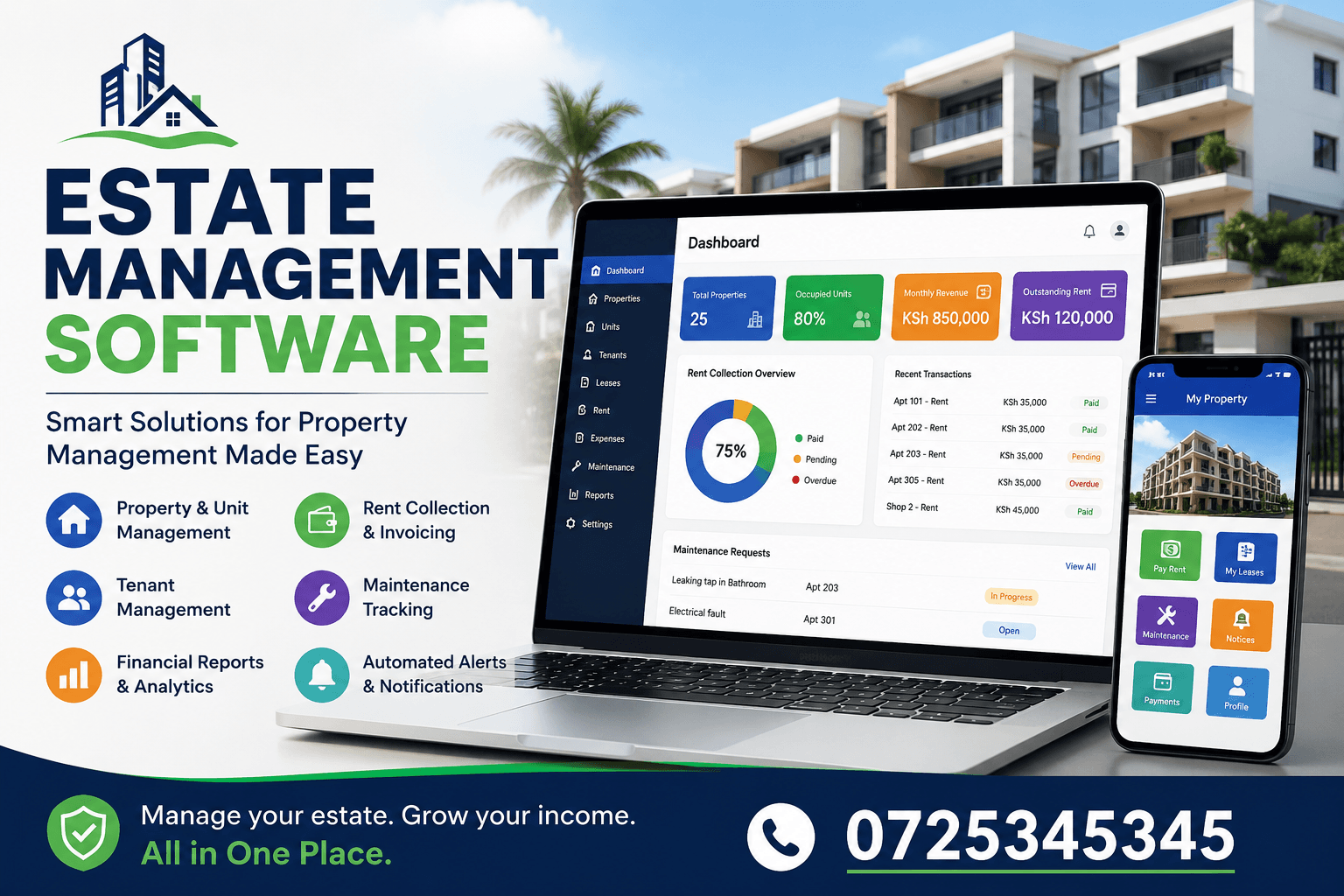
The real estate industry is undergoing a massive digital transformation. Property owners, estate managers, landlords, and real estate agencies are rapidly shifting from manual processes to automated, cloud-based solutions. At the center of this transformation is Estate Management Software Development—the process of designing, building, and deploying intelligent systems that simplify property operations.
From rent collection and tenant management to maintenance tracking and financial reporting, estate management software is reshaping how properties are managed across the world, especially in fast-growing urban markets like Kenya, Nigeria, South Africa, and the Middle East.
In this guide, we will explore everything you need to know about estate management software development, including features, architecture, technologies, benefits, development process, costs, and future trends.
What is Estate Management Software Development?
Estate Management Software Development refers to the creation of digital platforms that help property managers and landlords efficiently manage residential, commercial, and mixed-use properties.
These systems automate core estate operations such as:
- Rent collection and invoicing
- Tenant onboarding and management
- Maintenance request tracking
- Financial reporting and accounting
- Lease management
- Communication between tenants and landlords
- Security and access control integration
In simple terms, it is the engineering process of building software that replaces manual paperwork and spreadsheets in property management.
Why Estate Management Software is Important in 2026
The real estate sector is growing rapidly, especially in urban regions. However, traditional property management methods are inefficient and error-prone.
Here are key reasons why estate management software development is essential today:
1. Increasing Number of Rental Properties
Urbanization has led to a rise in apartments, gated communities, and commercial buildings requiring structured management systems.
2. Demand for Automation
Manual rent collection and bookkeeping are outdated. Automation reduces errors and saves time.
3. Transparency Requirements
Property owners now demand real-time financial reporting and accountability.
4. Digital Payments Adoption
Systems like M-Pesa, mobile banking, and online payments require integration with software platforms.
5. Tenant Expectations
Modern tenants expect digital communication, online payment options, and quick maintenance responses.
Core Features of Estate Management Software
A successful estate management system must include powerful, scalable features. Below are the essential modules developed during estate management software development.
1. Tenant Management System
This module handles all tenant-related data including:
- Tenant registration
- Identity verification
- Lease agreements
- Rent history
- Communication logs
It helps property managers maintain organized tenant records and reduce paperwork.
2. Rent Collection & Payment Automation
One of the most critical features is automated rent processing.
Key functions include:
- Monthly rent invoicing
- Automated payment reminders
- Mobile money integration (e.g., M-Pesa)
- Online payment gateways
- Receipt generation
This eliminates delays and improves cash flow.
3. Maintenance Management System
Tenants can report issues directly through the system.
Features include:
- Maintenance request submission
- Ticket tracking system
- Assignment to technicians
- Repair status updates
- Cost tracking
This improves response time and tenant satisfaction.
4. Accounting & Financial Reporting
Estate management software development includes financial tools such as:
- Income and expense tracking
- Profit and loss statements
- Tax reports
- Budget planning tools
- Automated billing reports
This ensures financial transparency and accountability.
5. Lease Management
This module manages rental agreements:
- Lease creation and renewal
- Digital contract signing
- Expiry reminders
- Penalty automation
It reduces legal risks and missed renewals.
6. Communication System
Built-in messaging systems allow:
- Tenant-landlord communication
- SMS/email notifications
- Announcement broadcasting
- Emergency alerts
7. Security Management Integration
Advanced systems include:
- Access control integration
- Visitor management systems
- CCTV system integration
- Gate pass generation
8. Analytics and Reporting Dashboard
A real-time dashboard provides insights such as:
- Occupancy rates
- Revenue performance
- Maintenance costs
- Tenant satisfaction metrics
Types of Estate Management Software Systems
During development, different types of systems can be built depending on business needs.
1. Residential Property Management Systems
Designed for apartments, flats, and gated communities.
2. Commercial Property Management Systems
Used for offices, malls, and business parks.
3. Mixed-Use Systems
Combine residential and commercial management features.
4. Cloud-Based SaaS Platforms
Subscription-based platforms accessible anywhere.
5. On-Premise Systems
Installed locally on company servers.
Estate Management Software Architecture
A strong architecture ensures scalability and performance.
1. Frontend Layer
Built using:
- React.js
- Angular
- Vue.js
This is what users interact with.
2. Backend Layer
Handles business logic:
- Node.js
- Django (Python)
- Laravel (PHP)
3. Database Layer
Stores all property data:
- MySQL
- PostgreSQL
- MongoDB
4. Cloud Infrastructure
Hosting and scaling:
- AWS
- Google Cloud
- Azure
5. API Integration Layer
Connects external services like:
- M-Pesa APIs
- Banking systems
- SMS gateways
- Email services
Estate Management Software Development Process
Building a robust system requires a structured approach.
Step 1: Requirement Analysis
Understand client needs:
- Number of properties
- Type of tenants
- Required features
- Payment systems
Step 2: System Design
Create wireframes and architecture plans.
Step 3: UI/UX Design
Focus on:
- User-friendly dashboards
- Mobile responsiveness
- Easy navigation
Step 4: Backend Development
Build:
- Databases
- APIs
- Business logic
Step 5: Frontend Development
Develop user interfaces for:
- Admins
- Tenants
- Property managers
Step 6: Integration
Connect:
- Payment systems
- SMS/email systems
- Accounting tools
Step 7: Testing
Ensure:
- Security testing
- Performance testing
- Bug fixing
Step 8: Deployment
Launch on cloud or local servers.
Step 9: Maintenance & Updates
Continuous updates ensure system stability.
Technologies Used in Estate Management Software Development
Modern systems use advanced technologies such as:
Programming Languages
- JavaScript
- Python
- PHP
- Java
Frameworks
- Laravel
- Django
- Express.js
- React
Databases
- MySQL
- PostgreSQL
- Firebase
APIs
- M-Pesa Daraja API
- Stripe
- PayPal
Benefits of Estate Management Software Development
1. Improved Efficiency
Automates repetitive tasks.
2. Reduced Operational Costs
Less manual labor required.
3. Better Financial Control
Accurate tracking of all transactions.
4. Enhanced Tenant Experience
Faster communication and issue resolution.
5. Real-Time Insights
Data-driven decision-making.
6. Scalability
Easily manage multiple properties.
Challenges in Estate Management Software Development
Despite its advantages, development comes with challenges:
1. Integration Complexity
Connecting payment systems and APIs can be difficult.
2. Data Security Risks
Property and financial data must be protected.
3. High Development Costs
Advanced systems require skilled developers.
4. User Adoption
Some landlords resist digital transformation.
5. Maintenance Requirements
Continuous updates are necessary.
Cost of Estate Management Software Development
Costs vary depending on complexity:
Basic System
- $3,000 – $10,000
- Limited features
Mid-Level System
- $10,000 – $30,000
- Includes automation and dashboards
Advanced Enterprise System
- $30,000 – $100,000+
- AI, analytics, mobile apps, integrations
Future Trends in Estate Management Software Development
The future of Estate Management Software Development is being shaped by rapid advances in technology, changing tenant expectations, and the growing complexity of modern real estate portfolios. As estates evolve into smarter, more connected communities, software development in this space is shifting from basic automation tools to fully intelligent, predictive, and integrated property ecosystems.
In 2026 and beyond, estate management systems will no longer just handle rent collection and tenant records—they will become central intelligence platforms for entire property ecosystems. Below are the most important future trends shaping this transformation.
1. Artificial Intelligence (AI) and Predictive Property Management
Artificial Intelligence will be one of the most powerful forces in estate management software development.
Future systems will use AI to:
- Predict maintenance issues before they occur
- Forecast rental income trends
- Identify tenants likely to default on payments
- Recommend optimal rent pricing
- Detect unusual financial or security activity
For example, AI could analyze repeated plumbing complaints in a building and predict a major system failure before it happens, allowing preventive maintenance.
This shifts estate management from reactive operations to predictive and preventive management, reducing costs and improving efficiency.
2. Fully Automated Financial Ecosystems
Future estate software will move beyond basic reporting into fully automated financial ecosystems.
This will include:
- Real-time rent updates
- Automatic expense categorization
- Smart budgeting based on historical data
- AI-generated financial forecasts
- Automated penalty and billing adjustments
Instead of waiting for monthly reports, property managers will have live financial dashboards showing exactly how each property is performing at any moment.
This level of automation will dramatically improve transparency and financial control.
3. Integration with IoT (Internet of Things)
The Internet of Things (IoT) will play a major role in the future of estate management systems.
Estate software will integrate with:
- Smart electricity and water meters
- CCTV and surveillance systems
- Smart gates and biometric access systems
- Parking sensors
- Waste management sensors
This will enable real-time data collection from physical infrastructure.
For example:
- Water usage per unit will be tracked automatically
- Security alerts will be triggered instantly when suspicious movement is detected
- Parking availability will be updated in real time
This creates a fully connected and intelligent estate environment.
4. Blockchain for Transparency and Security
Blockchain technology is expected to revolutionize trust and transparency in estate management software development.
Future systems may use blockchain to:
- Store financial transactions securely
- Prevent tampering with payment records
- Maintain immutable audit trails
- Secure lease agreements and contracts
- Enable transparent governance voting systems
This is especially important in estate associations where disputes over funds, contributions, and expenses are common.
Blockchain ensures that all records are tamper-proof, verifiable, and fully transparent.
5. Mobile-First and Super App Ecosystems
The future of estate management software will be heavily mobile-driven.
Instead of separate systems for payments, communication, and maintenance, everything will be combined into a super app ecosystem.
Residents and property managers will be able to:
- Pay rent and service charges
- Submit maintenance requests
- Receive real-time announcements
- Participate in community voting
- Access digital gate passes
This will eliminate the need for fragmented tools like spreadsheets, emails, and messaging apps.
Mobile-first design will become the default standard for all estate software development.
6. Smart Security and Digital Identity Systems
Security will become deeply integrated into estate management platforms.
Future developments will include:
- Facial recognition entry systems
- Digital resident IDs
- AI-powered CCTV monitoring
- Visitor pre-registration systems
- Real-time access logs
These systems will significantly improve estate security and reduce unauthorized access.
Estate management software will become the central identity system for entire communities, controlling who enters, exits, and interacts with the estate.
7. Real-Time Data and Live Analytics
Future estate systems will shift from static reports to real-time analytics engines.
This means:
- Instant financial updates
- Live occupancy tracking
- Real-time maintenance status
- Dynamic performance dashboards
Property managers will no longer rely on outdated reports. Instead, they will make decisions based on live operational data.
This improves responsiveness and allows faster problem-solving.
8. AI-Powered Customer Experience for Tenants
Tenant experience will become more personalized and automated.
Future systems will:
- Send personalized rent reminders
- Recommend maintenance solutions
- Provide instant chatbot support
- Analyze tenant behavior to improve services
AI chatbots will handle most tenant inquiries instantly, improving communication and reducing workload for property managers.
This leads to higher tenant satisfaction and retention rates.
9. Cloud-Native and Highly Scalable Systems
Estate management software development will increasingly move toward cloud-native architecture.
Benefits include:
- Unlimited scalability
- Remote access from anywhere
- Automatic updates
- Strong disaster recovery systems
- Lower infrastructure costs
This is especially important for real estate companies managing multiple estates across different regions.
Cloud systems ensure seamless expansion without performance limitations.
10. Integration with Smart Cities and Public Infrastructure
In the future, estate management systems will connect with broader smart city infrastructure.
This includes:
- City water and electricity systems
- Waste management networks
- Emergency response services
- Public transport systems
For example, estates could automatically report waste levels or coordinate emergency responses directly with city authorities.
This creates a fully connected urban ecosystem.
Conclusion
The future of Estate Management Software Development is defined by intelligence, automation, connectivity, and real-time decision-making. The industry is moving far beyond basic property management tools into fully integrated digital ecosystems powered by AI, IoT, blockchain, and cloud computing.
These advancements will transform estates into smart, self-regulating communities where operations are automated, decisions are data-driven, and residents enjoy seamless digital experiences.
Businesses that invest early in these future-ready technologies will benefit from higher efficiency, stronger security, improved tenant satisfaction, and greater profitability. Those that delay adoption risk being left behind in an increasingly digital and competitive real estate landscape.
Ultimately, the future of estate management software is not just about managing properties—it is about building intelligent, connected, and sustainable living environments.
Why Businesses Should Invest in Estate Management Software Development
Investing in estate management software development is no longer optional—it is essential.
Conclusion
Estate Management Software Development is transforming the real estate industry by replacing manual processes with intelligent, automated systems. From rent collection and tenant management to advanced analytics and AI-driven insights, these platforms are becoming the backbone of modern property management.
As urbanization continues to grow, especially in fast-developing regions like Africa and Asia, the demand for efficient estate management systems will only increase.
Property managers and developers who invest early in digital transformation will gain a significant competitive edge in the coming years.