
Introduction to Social Media Marketing
Social Media Marketing has become one of the most important digital growth engines for businesses in Kenya and globally. Whether you are running a startup in Nairobi, an SME in Kisumu, or a growing SaaS company like those under zama, Social Media Marketing is no longer optional—it is a core revenue driver. In fact, most businesses now rely on Social Media Marketing to build awareness, generate leads, and convert audiences into paying customers.
At its core, Social Media Marketing is the use of platforms like Facebook, Instagram, TikTok, LinkedIn, and X to distribute content, engage audiences, and influence buying decisions. But unlike generic advice online, real success in Social Media Marketing depends on structured budgeting, consistent content systems, and measurable returns in Kenyan Shillings (KES), not vague promises.
This guide breaks down Social Media Marketing in real business terms, including costs, risks, realistic returns, and execution frameworks you can apply immediately.
What is Social Media Marketing and Why It Matters
Social Media Marketing refers to the strategic use of social platforms to promote products, services, or brands. Instead of relying on traditional advertising, businesses use Social Media Marketing to reach targeted users based on behavior, interests, and demographics.
In Kenya, Social Media Marketing is especially powerful because mobile penetration is above 80%, and most consumers discover businesses through social platforms before websites. A properly executed Social Media Marketing strategy can turn a small business spending KES 20,000 monthly into a brand generating consistent inbound leads.
According to Meta’s business resources: https://www.facebook.com/business
, Social Media Marketing improves brand recall significantly when paired with consistent engagement. Similarly, HubSpot research shows that businesses using structured Social Media Marketing outperform competitors in lead generation: https://blog.hubspot.com/marketing/social-media-marketing
For Kenyan SMEs, Social Media Marketing is not just marketing—it is survival.
How Social Media Marketing Builds Awareness and Engagement
The primary goal of Social Media Marketing is awareness and engagement. Awareness means getting people to know your brand exists. Engagement means getting them to interact with your content through likes, shares, comments, or clicks.
A strong Social Media Marketing system ensures that your business appears repeatedly in front of your target audience. For example, a Nairobi-based digital training company running Social Media Marketing campaigns can reach 100,000–300,000 impressions monthly with a budget of KES 50,000–KES 120,000 depending on targeting.
Engagement is where value compounds. If 5,000 users interact with your Social Media Marketing content monthly, even a 2% conversion rate can produce 100 paying customers. That is why Social Media Marketing is powerful when structured correctly.
Platforms like Hootsuite explain engagement optimization here: https://www.hootsuite.com/resources/social-media-marketing
Core Strategies Behind Effective Social Media Marketing
Successful Social Media Marketing is not random posting. It requires structured systems:
First, content pillars define what you post. A business may divide Social Media Marketing content into education, entertainment, testimonials, and product promotion.
Second, consistency is critical. Posting once a week is not Social Media Marketing—it is inactivity. Businesses must maintain daily or near-daily posting cycles.
Third, paid advertising accelerates Social Media Marketing performance. Even KES 1,000 per day in ad spend can significantly increase reach when optimized.
Fourth, storytelling is essential. Audiences respond better to narrative-driven Social Media Marketing than direct sales posts.
Google Business Profile integration also strengthens Social Media Marketing visibility: https://www.google.com/business/
Without these systems, Social Media Marketing becomes noise instead of growth.
Platform Breakdown for Social Media Marketing Success
Different platforms serve different roles in Social Media Marketing.
Facebook remains the strongest for Kenyan SMEs due to affordability and targeting accuracy. Instagram is highly visual and works well for lifestyle brands. TikTok dominates short-form engagement and is rapidly growing in Social Media Marketing campaigns. LinkedIn is best for B2B Social Media Marketing, especially for SaaS companies like those under zama.co.ke. X (formerly Twitter) is useful for real-time engagement and thought leadership.
Each platform contributes differently to Social Media Marketing outcomes, and ignoring platform specialization reduces ROI significantly.
For example, LinkedIn Social Media Marketing campaigns for SaaS tools like Dexa (HR systems), Vega POS, or Zivo (WhatsApp inbox systems) generate higher-quality leads compared to Facebook, but at a higher cost per click.
Real KES Budget Breakdown in Social Media Marketing
One of the biggest issues in online content is vague claims like “you can grow fast with Social Media Marketing.” That is not helpful. Let’s break it down realistically.
A small Kenyan business investing in Social Media Marketing typically spends:
- Content creation: KES 15,000–KES 40,000 monthly
- Paid ads: KES 30,000–KES 150,000 monthly
- Management tools: KES 5,000–KES 20,000 monthly
So a realistic Social Media Marketing budget ranges between KES 50,000 and KES 200,000 per month depending on scale.
For example, a training institute running Social Media Marketing in Nairobi spending KES 100,000 monthly can realistically generate 300–800 leads per month depending on funnel quality. If 10% convert at KES 10,000 per course, revenue can reach KES 300,000–KES 800,000 monthly.
This is why Social Media Marketing is considered one of the highest ROI channels when executed properly.
SaaS Ecosystem Supporting Social Media Marketing
Modern Social Media Marketing depends heavily on automation and SaaS tools. At zama.co.ke, several products support Social Media Marketing workflows indirectly or directly:
RentalDesk product family (rentaldesk.co.ke, pms.co.ke, estateadmin.co.ke) helps property businesses integrate Social Media Marketing with booking funnels. Prim (prim.co.ke) supports salon booking systems that convert Social Media Marketing traffic into appointments. Vega POS (vega.co.ke) enables retail businesses to track Social Media Marketing-driven sales. Pawa (pawa.co.ke) supports WiFi hotspot monetization campaigns often promoted through Social Media Marketing ads.
Dereva (dereva.co.ke) connects drivers with customers via Social Media Marketing campaigns. Vota (vota.co.ke) is useful for political Social Media Marketing engagement. Zivo (zivo.co.ke, zchat.zamacore.com) improves Social Media Marketing customer response speed through WhatsApp automation. Dexa (dexa.co.ke) supports HR and workflow tracking for Social Media Marketing teams.
Other systems like Wito, Ratibu, ChurchesAdmin, Fama, Jaat, KayaPro360, Musa Music AI, and Awasam all benefit indirectly from Social Media Marketing exposure.
Without integrating SaaS tools, Social Media Marketing becomes manual and inefficient.
Internal resource: https://zama.co.ke/social-media-marketing-guide
Internal tools: https://zama.co.ke/services/social-media-marketing
Content System Behind Social Media Marketing
A scalable Social Media Marketing system depends on content production cycles. Businesses that succeed in Social Media Marketing usually follow a 70-20-10 rule: 70% educational content, 20% engagement content, and 10% promotional content.
Content calendars are essential. Without them, Social Media Marketing becomes inconsistent and ineffective.
Video content is especially powerful. A single short-form Social Media Marketing video can generate 10x more reach than static posts.
Canva resources also support Social Media Marketing design workflows: https://www.canva.com/learn/social-media-marketing/
Risks in Social Media Marketing and How to Manage Them
While Social Media Marketing is powerful, it carries risks.
The first risk is overspending on ads without tracking conversions. Many businesses lose money in Social Media Marketing because they do not monitor cost per lead.
The second risk is inconsistent branding. If Social Media Marketing content is random, audiences lose trust.
The third risk is dependency on one platform. Algorithms change frequently, and Social Media Marketing reach can drop overnight.
The fourth risk is poor customer response. Many Social Media Marketing campaigns fail because businesses do not respond quickly to leads.
To mitigate these risks, businesses must use analytics, diversify platforms, and invest in automation tools like Zivo or Dexa to support Social Media Marketing workflows.
Is Social Media Marketing Worth It?
The honest answer is yes—but only when structured properly.
Social Media Marketing is worth it if your business has clear pricing, consistent content, and a conversion system. Without these, Social Media Marketing becomes a cost center.
In Kenya, businesses that invest KES 100,000 monthly in Social Media Marketing can realistically break even within 2–4 months depending on conversion rates.
However, Social Media Marketing is not magic. It requires testing, optimization, and continuous improvement.
When done correctly, Social Media Marketing becomes one of the most profitable customer acquisition channels available.
Advanced Execution Systems for Digital Brand Growth in Kenya
Modern digital growth strategies are no longer about simply posting content and hoping for attention. Businesses that scale consistently in Kenya and across emerging markets rely on structured systems that combine audience psychology, data tracking, and conversion-focused content distribution. The difference between struggling brands and fast-growing companies is not visibility alone—it is how that visibility is engineered into predictable revenue outcomes.
A well-designed digital growth system starts with understanding user behavior patterns. Most customers do not buy immediately after discovering a brand. Instead, they pass through stages of curiosity, comparison, trust-building, and finally purchase. Businesses that map this journey carefully are able to influence decisions at each stage rather than relying on random exposure.
For example, a Nairobi-based training institution offering technical courses may receive thousands of views on its content weekly. However, without structured nurturing, only a small fraction of those viewers convert into paying learners. When a proper funnel is introduced—educational content, testimonial reinforcement, and targeted follow-ups—the conversion rate can increase significantly without increasing traffic volume.
The Power of Conversion Funnels in Digital Growth
A conversion funnel is the backbone of predictable online revenue. Instead of treating every visitor equally, funnels segment users based on intent and engagement level. Cold audiences require education, warm audiences require trust signals, and hot audiences require direct offers.
In Kenya’s competitive digital landscape, businesses that implement funnel systems often outperform those relying on direct advertising alone. For instance, a retail business spending KES 80,000 monthly on ads may generate inconsistent results if traffic is directed to a generic homepage. However, when that same budget is redirected into structured landing pages, lead magnets, and follow-up sequences, conversion rates can improve by 2x–5x depending on industry.
Funnels also allow businesses to track customer acquisition costs more accurately. Instead of guessing performance, companies can measure exactly how much it costs to acquire a paying customer and adjust spending accordingly. This eliminates one of the biggest inefficiencies in digital campaigns: blind budgeting.
Content Engineering for High Engagement
Content is the engine that drives attention in modern digital ecosystems. However, not all content performs equally. High-performing content is built on three pillars: relevance, emotional resonance, and clarity.
Relevance ensures that the content speaks directly to the audience’s current challenges. Emotional resonance ensures that the audience feels understood or inspired. Clarity ensures that the message is easy to consume within seconds.
In practice, businesses in Kenya that adopt structured content systems often separate their communication into educational posts, storytelling posts, and proof-based posts. Educational content builds authority, storytelling builds emotional connection, and proof-based content builds trust.
A SaaS company offering HR automation tools, for example, might publish educational content explaining payroll inefficiencies, storytelling content about companies struggling with manual systems, and proof content showing how automation reduced administrative workload by measurable percentages. This layered approach significantly improves conversion probability.
Influencer Collaboration and Trust Acceleration
One of the fastest ways to build credibility online is through third-party validation. Influencer collaboration has become a major driver of trust acceleration in digital ecosystems. However, effectiveness depends on alignment rather than popularity alone.
Micro-influencers often outperform large influencers in niche markets because their audiences are more engaged and trust their recommendations more deeply. In Kenya, micro-influencers in tech, lifestyle, business, and education sectors can generate significantly higher engagement rates than celebrity endorsements when promoting specialized services.
A typical collaboration with a mid-tier creator may cost between KES 10,000 and KES 50,000 per campaign depending on reach and engagement metrics. When properly executed, such collaborations can generate direct leads, brand searches, and long-term audience retention.
The key is integration. Influencer content should not exist in isolation. It should be integrated into broader campaigns that include remarketing ads, landing pages, and follow-up messaging systems.
Automation Systems That Scale Digital Campaigns
Manual posting and engagement are no longer sufficient for competitive digital environments. Automation tools now play a critical role in ensuring consistency and speed of response.
Automation can be applied in multiple areas: content scheduling, customer response systems, lead qualification, and performance tracking. Businesses that implement automation reduce response time significantly, which directly improves conversion rates.
For example, response delays of more than 10 minutes can reduce lead conversion probability by more than 50% in high-intent scenarios. Automated chat systems, email sequences, and CRM integrations ensure that no lead is lost due to human delay.
In Kenya, many businesses are now integrating WhatsApp-based automation systems to manage inquiries. This is particularly effective for service-based businesses where immediate response is critical. When combined with structured content campaigns, automation creates a seamless customer journey from discovery to purchase.
Data-Driven Optimization and Performance Tracking
Without measurement, growth becomes guesswork. Data-driven optimization allows businesses to identify what works, what fails, and what needs adjustment.
Key performance indicators include engagement rate, click-through rate, conversion rate, and customer acquisition cost. These metrics provide clarity on whether campaigns are profitable or inefficient.
For instance, a campaign generating high engagement but low conversions may indicate weak messaging or poor landing page structure. Conversely, a campaign with moderate engagement but high conversion rates may indicate strong targeting accuracy.
Businesses that consistently analyze and adjust based on data typically achieve lower acquisition costs over time. This compounding improvement is what separates scalable systems from stagnant campaigns.
Common Mistakes That Limit Growth
Many businesses fail in digital execution not because of lack of effort, but because of structural mistakes. One of the most common mistakes is inconsistency. Sporadic posting leads to weak audience retention and reduced algorithmic visibility.
Another major issue is overemphasis on selling. Audiences tend to disengage when every message is promotional. Balanced content strategies perform significantly better because they build trust before asking for conversion.
A third mistake is ignoring mobile optimization. In Kenya, the majority of users access content through mobile devices. If landing pages, visuals, or forms are not optimized for mobile, conversion rates drop sharply.
Finally, many businesses fail to invest in analytics tools. Without tracking systems, it becomes impossible to understand performance or improve outcomes.
Scaling Strategy for Sustainable Growth
Scaling requires a shift from manual execution to systemized growth. Once a campaign proves successful, the next step is amplification through increased budget allocation, expanded targeting, and content diversification.
Scaling should always be gradual. Sudden budget increases without testing often lead to inefficient spending. Instead, businesses should increase investment in stages while monitoring performance stability.
Another scaling strategy involves expanding into new audience segments. Once a core audience is successfully converted, adjacent markets can be targeted using similar messaging frameworks.
Long-term scaling also depends on brand equity. Businesses that consistently provide value through educational and engaging content build stronger organic reach over time, reducing dependency on paid campaigns.
Is This Growth Approach Sustainable?
The sustainability of digital growth systems depends on execution discipline. Businesses that treat digital channels as short-term campaigns often struggle with consistency. However, those that treat them as long-term infrastructure achieve compounding returns.
Sustainability is also tied to adaptability. Algorithms, user behavior, and platform policies change frequently. Businesses that continuously test, learn, and adapt remain competitive regardless of platform shifts.
In Kenya’s evolving digital economy, early adopters of structured systems are already gaining significant advantages in visibility, customer acquisition, and brand authority.
Image Insight
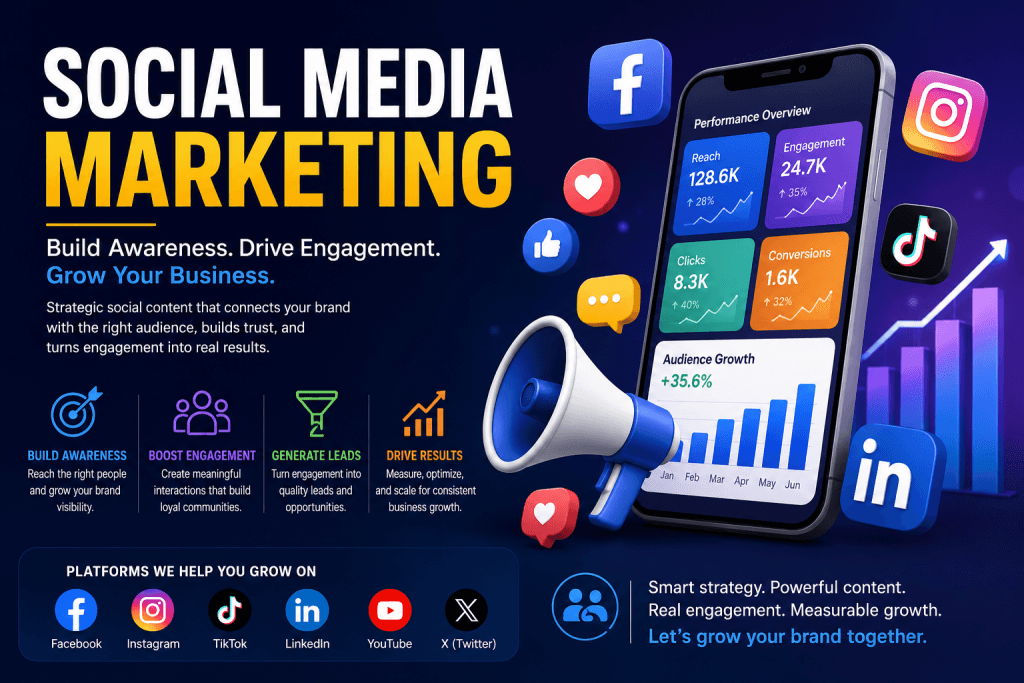
The visual above represents how structured Social Media Marketing dashboards help businesses track engagement, reach, and conversions in real time.
Frequently Asked Questions (FAQ)
1. What is Social Media Marketing in simple terms?
Social Media Marketing is using platforms like Facebook and Instagram to promote products and engage customers.
2. How much does Social Media Marketing cost in Kenya?
Most businesses spend between KES 50,000 and KES 200,000 monthly depending on scale.
3. How long does Social Media Marketing take to show results?
Typically 30–90 days depending on content consistency and budget.
4. Which platform is best for Social Media Marketing?
Facebook and Instagram are best for SMEs, while LinkedIn is best for B2B.
5. Can Social Media Marketing work without ads?
Yes, but growth is slower. Paid ads accelerate Social Media Marketing performance significantly.
Final CTA: Start Your Social Media Marketing Journey
Digital growth is no longer about isolated tactics. It is about building interconnected systems that combine content, automation, targeting, and analytics into one cohesive engine. Businesses that understand this shift are able to scale more efficiently, reduce wasted spending, and build long-term brand equity.
The future belongs to companies that treat digital ecosystems as strategic assets rather than experimental tools.
If you want to scale your business using structured Social Media Marketing systems, automation tools, and proven digital strategies, start today with zama.co.ke.
Explore solutions, tools, and growth systems here: https://zama.co.ke